Reading Time: 12 Minutes
Difficulty Level: Beginner to Intermediate
Reviewed By: FinanceInfoIn Editorial Team
Table of Contents
- The Reality of Leaving the Gas Pump Behind
- Rethinking How You Actually "Fuel" Up
- The Range Reality Check You Need
- The Truth About Maintenance Expectations
- Overlooking The Route Planning Process
- Getting Blindsided By Home Setup Costs
The Reality of Leaving the Gas Pump Behind
Imagine standing in a freezing parking lot with only a 5% battery left on your car. The public charger screen is completely blank, and the customer service line is putting you on hold. Your hands are shaking, not just from the cold, but from sheer panic about how you will get home.
That was my exact situation during my first week driving a battery-powered car. I had traded in my trusted gas guzzler thinking everything would be smooth and futuristic. Instead, I found myself paralyzed by range anxiety and entirely unprepared for the real-world challenges of electric driving.
People switch to these vehicles to save money and help the environment. But the mental toll can be overwhelming if you make the wrong assumptions from day one. You constantly check your dashboard gauge, sweating over every dropped percentage point. The daily commute suddenly feels like a complex math puzzle.
Families end up canceling weekend trips because mapping out charging stations feels like planning a military operation. This constant underlying stress steals the joy of driving a incredibly quiet, smooth, and technologically advanced car.
Normal folks are losing sleep wondering if their home electrical panel can even handle the new charger. The financial surprise of unexpected installation fees hits hard when your household budget is already stretched thin.
You might start feeling like you made a massive mistake buying this car. That knot in your stomach is incredibly real, and it comes entirely from a lack of clear, honest preparation before handing over your keys.
Rethinking How You Actually "Fuel" Up
The biggest shock for new owners is realizing you can no longer wait until the warning light comes on to get fuel. With a standard car, you pull into a station and leave five minutes later. Doing this with an electric vehicle will ruin your daily schedule entirely.
You have to treat your new car exactly like your smartphone. You plug it in every single night when you go to sleep. If you forget, you will wake up to a massive problem the next morning.
Quick Summary
Switching to an EV requires a complete shift in your daily habits. You must plan your charging routines, understand the impact of weather on your battery, budget for home electrical upgrades, and learn entirely new maintenance schedules. Ignoring these factors leads to extreme frustration and wasted money.
Key Takeaways
- Stop treating your battery like a gas tank; charge it daily at home.
- Cold weather and highway speeds destroy your advertised driving range.
- Level 1 wall outlets are basically useless for standard daily commuting.
- EV tires wear out much faster due to heavy weight and instant torque.
Many buyers get extremely confused by the different types of chargers available. They assume all electricity flows at the same speed. This misunderstanding leads to hours stranded at slow public stations.
Let me break down the difference so you know exactly what to expect.
Let us look at a real-life example to see how this math actually works. Meet David, a guy who bought a standard EV with a 60 kWh battery. He thought plugging it into a regular wall outlet (Level 1) overnight would give him a full tank for the next day.
After 12 hours of charging, he only gained 48 miles of range. His daily commute to the office is 60 miles round trip. By Thursday, David was practically empty and forced to pay premium rates at a commercial fast charger just to get to work.
If he had simply invested $600 in a Level 2 home charger from the start, his life would be entirely different. He would wake up to a 100% battery every single morning. He would only pay roughly $7 for a complete fill-up based on standard residential electricity rates.
The Range Reality Check You Need
Car manufacturers love to advertise massive driving ranges to get you into the showroom. They will boldly claim their car goes 300 miles on a single charge. What they conveniently forget to mention is that this test was done in perfect weather on a flat track.
Real-world driving conditions aggressively eat away at your battery life. The temperature outside plays a massive role in how far you can actually drive.
When winter hits, your battery has to spend a huge amount of energy just keeping itself warm. Then, you turn on the cabin heater, the heated seats, and the steering wheel warmer. Suddenly, that 300-mile range drops closer to 200 miles before you even leave your driveway.
Pros & Cons of Going Fully Electric
- The Pros:
- Wake up with a "full tank" every morning.
- Instant, incredibly smooth acceleration.
- No more oil changes, spark plugs, or transmission fluid.
- Significantly cheaper per mile to drive than gas.
- The Cons:
- Cold weather heavily reduces driving distance.
- Public charging networks can be broken or crowded.
- Upfront home installation costs can be surprisingly high.
- Replacing tires happens much more frequently.
Highway driving is another secret range killer that shocks new owners. Gas engines are actually more efficient on the highway because they stay in a high gear. Electric motors work the exact opposite way.
Driving 80 miles per hour punches a massive hole in the wind, forcing the battery to drain incredibly fast. You will notice your percentage dropping rapidly on road trips compared to slow city driving.
Here is a breakdown of what actually kills your battery out on the road.
I learned the hard way that driving fast on the interstate drains the battery significantly faster than stopping and starting in the city. My rule of thumb is to always subtract at least 20% from the dashboard range if I plan on using the heater and driving on the highway.
This simple mental adjustment keeps me from panicking when the numbers start falling fast. It sets honest expectations for the journey ahead.
If you are planning a trip soon, understanding how to map it out is highly necessary. You cannot just wing it like you used to do in a gas car.
Here is an excellent guide on how to plan your first long-distance drive without losing your mind.
Getting Blindsided By Home Setup Costs
Many people think buying the car is the end of their financial commitment. They take the car home and realize they absolutely need a Level 2 charger installed in their garage. They budget maybe a few hundred dollars for the charger itself, completely ignoring the electrician's bill.
Older homes usually have a 100-amp electrical panel in the basement. This was perfectly fine for running your fridge, lights, and television. Adding a massive 40-amp car charger to that old system is often physically impossible.
You might get a quote from an electrician saying you need a complete panel upgrade to 200 amps. This unexpected project can instantly add thousands of dollars to your overall transition costs.
Let us look at a realistic breakdown of what setting up a home charging station actually costs.
Expert Tip: Always get at least three different quotes from certified electricians before you even buy the car. Some local utility companies offer massive rebates that can cover up to 50% of your installation costs, but you have to apply for them before the work begins.
The Truth About Maintenance Expectations
Salesmen love to brag that these vehicles require zero maintenance. They will look you directly in the eye and say you will never visit a mechanic again. This is a very dangerous half-truth that ends up costing owners heavily down the road.
Yes, you never have to buy engine oil, replace spark plugs, or worry about a timing belt snapping. The traditional engine maintenance is entirely gone. However, these cars are incredibly heavy because of the massive battery pack sitting on the floor.
This extreme weight, combined with the instant power of the electric motors, absolutely destroys rubber. Your tires take a massive beating every single time you accelerate from a stoplight.
Drivers who are used to their tires lasting 60,000 miles on a standard sedan are heavily shocked. They often find themselves needing a completely new set of expensive rubber after just 25,000 miles.
You also still have a traditional 12-volt battery under the hood that runs the computers and screens. When this tiny battery dies, the entire car shuts down, even if the main driving battery is completely full.
You still need to replace cabin air filters to keep the AC smelling fresh. The brake fluid needs testing, and the battery cooling system requires specific fluid checks. Ignoring these basic items will leave you stranded on the side of the road, wondering why your "maintenance-free" car stopped working entirely.
Mastering the Electric Shift: Advanced Strategies
Most new owners treat their expensive electric car battery exactly like their smartphone. They plug it in, force it to 100%, and run it down to completely empty before plugging it in again. Doing this with your vehicle is a massive financial mistake that degrades the battery rapidly.
If you want to protect your investment, you have to adopt the 20/80 rule. Keeping your daily charge level between 20% and 80% prevents massive stress on the internal battery cells. You only ever need to charge to 100% if you are about to leave for a very long cross-country drive.
Learning exactly how to extend the battery life of an electric vehicle will save you thousands of dollars in replacement costs. The internal computer software allows you to set a daily charging limit directly from the dashboard. Set it to 80% and simply forget about it.
Weather management is another advanced skill you must master quickly. When temperatures drop below freezing, your battery becomes stiff and refuses to accept electricity efficiently. You must tell the car to warm up the battery before you drive.
This smart feature is usually called "preconditioning" in the mobile app. Turning this on while the car is still plugged into your house pulls power from the grid instead of your battery. You step into a toasty warm cabin, and your battery is fully prepared to deliver maximum driving range.
If you live in a cold region, you should definitely read up on how to safely charge your electric car in freezing temperatures without damaging the internal cells. According to energy efficiency studies from the U.S. Department of Energy, managing extreme cabin temperatures smartly can recover up to 15% of your lost winter range.
Pro Tip: Leave your car plugged in during extreme winter nights even if the battery is already full. The vehicle's computer will occasionally draw tiny amounts of power from your wall outlet just to keep the battery block warm, protecting it from freezing damage.
The Financial Pitfalls of First-Time EV Owners
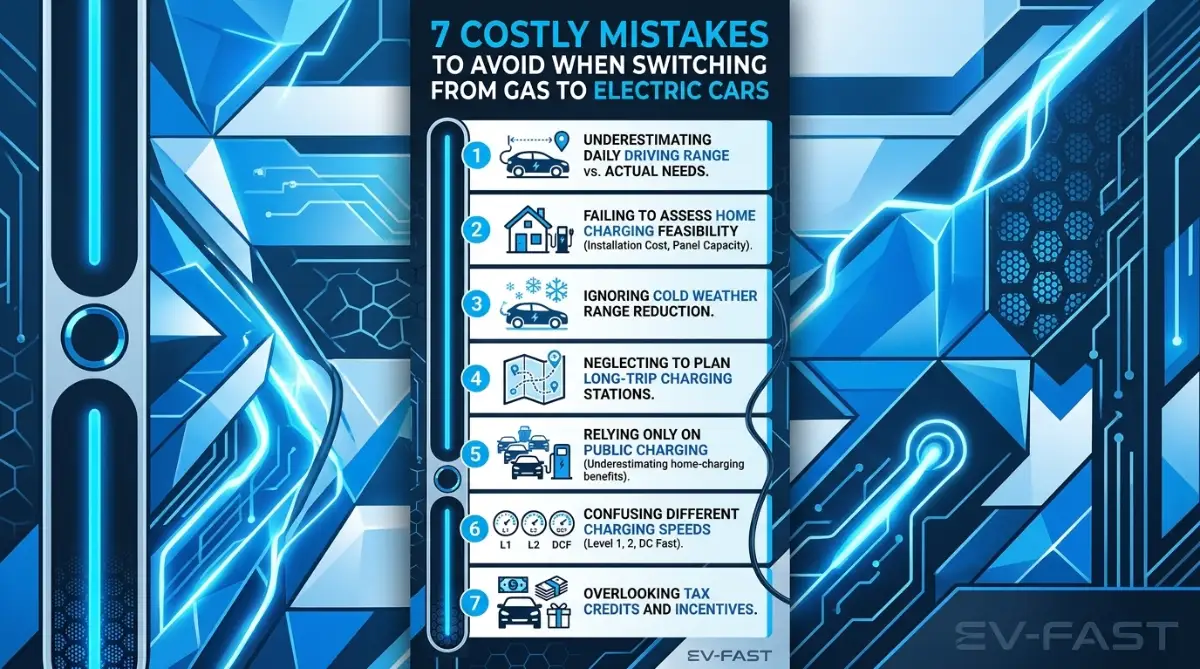
People get so excited at the dealership that they completely ignore the logistics of driving home. This leads directly to the "Public Charging Trap." Relying exclusively on commercial fast-charging stations every single day is a terrible idea.
First, public fast charging costs almost exactly the same as buying premium gasoline. You completely wipe out the financial savings of owning an electric vehicle. Second, aggressively pushing massive amounts of electricity into your car every day causes severe heat buildup, which slowly damages the battery chemistry.
Common Mistakes People Make:
- Assuming all plugs are the same: Plugging into a standard wall outlet only gives you 4 miles of range per hour.
- Ignoring route topography: Driving uphill through mountains drains your battery nearly twice as fast as driving on flat highways.
- Skipping the panel inspection: Buying the car before checking if your home electrical box can actually support a new 240V circuit.
- Trusting the dashboard blindly: The estimated range number changes wildly based on your driving speed and heater usage.
If you are struggling to understand why your car is taking 14 hours to reach a full charge in your garage, you likely have the wrong setup. Educate yourself entirely on what is the difference between Level One and Level Two electric vehicle charging. This knowledge prevents you from waking up to an empty vehicle when you have to get to work.
Sometimes, you might plug into a public station and notice the power trickling in extremely slowly. Understanding why your EV charging is so slow and the hidden causes explained can stop you from panicking. Often, a cold battery or a shared power line at the station is the simple culprit.
Myth vs. Reality
Step-by-Step Blueprint to Transitioning Smoothly
Buying the vehicle should actually be the very last step in your journey. You have to prepare your home base first so you do not get caught in a stressful situation. Follow this exact execution guide to get your garage completely ready.
Step 1: Audit Your Current Electrical Panel
Go to your garage or basement and find your main breaker box. Open the metal door and look at the main switch at the very top. If it says 100 Amps, you will almost certainly need an expensive upgrade to support a heavy car charger.
Step 2: Collect Utility Rebate Information
Before spending a single dime, call your local power company. Ask them directly if they offer cash rebates for installing smart chargers. Many utility companies will actually pay for half of your installation costs just to monitor your usage.
Step 3: Get Multiple Professional Quotes
Do not hire the first electrician who answers the phone. Have three different licensed professionals come to your home to provide a written estimate. Ensure they are quoting you for a dedicated 50-amp circuit using heavy-duty industrial wiring.
To make this entire process effortless, you can follow a complete guide on how to set up your electric vehicle home charger step by step. Doing this right the first time prevents serious fire hazards in your home.
Required Document / Preparation Checklist
- A clear, well-lit photo of your home's main electrical panel with the door open.
- Your last three months of home electric bills to calculate your base usage.
- Your Homeowner's Association (HOA) guideline book regarding exterior modifications.
- The exact specifications of the car you intend to buy (maximum acceptance rate).
Quick Action Checklist
- Download the top three public charging network apps (ChargePoint, Electrify America, EVgo) onto your phone today.
- Order a highly-rated Level 2 smart charger online at least two weeks before buying the car.
- Create a dedicated folder on your computer for electrician quotes and local city permit paperwork.
- Learn how to maximize your electric vehicle range on long road trips before taking your first family vacation.
Embracing Your Seamless Electric Transition
Making the switch from a traditional engine to a battery-powered car requires a total shift in how you think about driving. The first few weeks will definitely feel slightly overwhelming as you learn new habits and break old routines. However, the incredible silence, massive torque, and complete freedom from dirty gas stations make it highly worthwhile.
Once your home charging station is fully active, the daily stress vanishes completely. You simply plug in your car just like your mobile phone and wake up entirely ready for the day ahead.
I clearly remember standing in my dark garage holding my heavy charging cable for the very first time, feeling both terrified and amazed by this new technology. Today, passing by expensive gas stations with a full battery gives me an incredible sense of financial peace. Which part of switching to an electric car makes you the most nervous? Let me know in the comments below!
Real Answers to Your Biggest Electric Car Worries
Can I safely charge my electric car in the rain?
Yes, you can charge your car safely in heavy rain or deep snow. Both the car's charging port and the charging cables are heavily weatherproofed and designed to automatically shut off if water enters the connection.
Do electric cars still need regular maintenance?
While you never have to pay for an oil change again, you still have maintenance duties. You must regularly rotate the heavy tires, replace cabin air filters, and check the brake fluid to keep the car running smoothly.
Why does my battery drain faster on the highway?
Gas engines use gears to become efficient at high speeds, but electric motors do not have traditional transmissions. Pushing a heavy vehicle through intense wind resistance at 75 miles per hour rapidly consumes battery power.
Can I just plug my car into a normal wall outlet?
You technically can, but it is incredibly slow and highly frustrating. A standard household plug only gives you about 3 to 5 miles of range per hour, meaning it takes days to fully charge a completely empty battery.
Does turning on the heater reduce my driving range?
Yes, running the cabin heater pulls a massive amount of electricity directly from your main driving battery. In freezing weather, running the heat on maximum can easily reduce your total driving distance by up to 20%.
What actually happens if I run out of battery on the road?
The car will give you multiple loud warnings before going into a slow "turtle mode" to help you pull over safely. If it dies completely, you cannot push it; you must call a flatbed tow truck to take you to the nearest station.
Do I have to charge to 100% every single time?
No, constantly pushing the battery to a full 100% actually causes long-term damage to the internal cells. Experts highly recommend setting your daily charging limit to 80% to maintain the health of your battery for years.
Is it cheaper to charge the car at night?
Yes, most local utility companies offer heavily discounted "Time of Use" rates during off-peak midnight hours. You can program your car's computer to automatically start pulling power only when the electricity rates drop.
Do electric vehicles perform terribly in deep snow?
The actual driving performance is usually excellent because the heavy battery provides a very low center of gravity. However, the extreme cold weather will severely drain your battery capacity, forcing you to charge much more frequently.
Are public charging stations completely free to use?
A few hotels or shopping malls offer free slow charging to attract nice customers, but most fast chargers require payment. You will need to download specific smartphone apps and link your credit card to activate the commercial machines.
Trusted Legal Resources
- U.S. Department of Energy - Alternative Fuels Data Center
- Environmental Protection Agency (EPA) - Green Vehicles
- National Highway Traffic Safety Administration (NHTSA)
- Federal Highway Administration - EV Corridors
- Consumer Financial Protection Bureau (CFPB) - Auto Loans
- Federal Trade Commission (FTC) - Buying New Cars
Disclaimer
The content provided on FinanceInfoIn is intended for general educational and informational purposes only and does not constitute professional financial, legal, or automotive engineering advice. Transitioning to an electric vehicle involves complex financial decisions, local permit requirements, and electrical safety hazards. FinanceInfoIn and its team make no guarantees regarding energy savings, battery lifespan, or the safety of home modifications. Always consult with certified electricians, authorized vehicle dealerships, and licensed financial advisors before modifying your home or making large automotive purchases. By reading this content, you acknowledge that FinanceInfoIn assumes no liability for any financial losses, property damage, or legal issues resulting from the use of this information.
About the Author
Reviewed by Mithun Halder (Personal Finance & SEO Expert) & The FinanceInfoIn Editorial Team
The FinanceInfoIn Editorial Team researches personal finance, investing, insurance, mortgages, cryptocurrency, and consumer financial topics. Every article is carefully reviewed to provide clear, practical, and trustworthy educational information based on credible sources and industry best practices.
©2026 FinanceInfoIn. All rights reserved.