Reading Time: 11 Minutes
Difficulty Level: Beginner to Intermediate
Reviewed By: FinanceInfoIn Editorial Team
The Hidden Stress of Choosing the Right Solar Setup
My pulse actually raced a bit when I tore open the envelope from the power company last August. Staring at a $340 charge just for keeping the house livable during a standard summer heatwave felt like a punch to the gut. That financial squeeze is exactly what pushes most of us to finally request solar quotes. But instead of finding a quick solution, you often walk right into a massive headache.
A few days later, I found myself sitting across the kitchen table from a very pushy solar salesman. He pointed at a glossy brochure, insisting that his premium black panels were the only option worth buying. The very next morning, a different contractor sat in that exact same chair, swearing those black panels were an overpriced scam and aggressively pitching his cheaper blue panels.
I was just a normal person trying to lower my monthly expenses, yet I felt completely backed into a corner. When you are about to spend thousands of dollars of your hard-earned savings, the fear of making the wrong choice keeps you awake at night. You sit there staring at confusing technical data, wondering who is actually telling the truth to make a commission.
You do not want a masterclass in solar engineering. You simply want to know which equipment will actually protect your bank account without breaking down in five years. The mental stress of trying to separate honest advice from a greedy sales pitch is overwhelming for any family just trying to get ahead.
Table of Contents
- Quick Summary
- Key Takeaways
- How Silicon Crystal Structure Changes Everything
- The Honest Look at Appearance: Black vs. Blue Panels
- Efficiency Ratings and Roof Space Demands
- Temperature Performance: How Heat Alters Output
- Real-Life Math: Sarah's Small Roof vs. Mark's Large Ranch
- The Three-Way Solar Technology Comparison
- Honest Pros and Cons Breakdown
- Everyday Durability and Degradation Rates
- Financial Breakdown: Upfront Cost vs. Long-Term Value
- How to Make the Right Choice for Your Roof
Quick Summary
Monocrystalline panels use single-crystal silicon, delivering higher efficiency (typically 19% to 22%) and a uniform black finish that saves roof space. Polycrystalline panels melt multiple silicon fragments together, yielding lower efficiency (15% to 17%) with a blue textured look at a lower upfront cost. Your available roof space and local climate should dictate your choice.
Key Takeaways
- Monocrystalline panels produce more electricity per square foot, making them ideal for small or partially shaded roofs.
- Polycrystalline panels cost less upfront, providing strong value if you have plenty of unshaded roof area.
- Black monocrystalline panels handle high summer heat better thanks to superior temperature coefficients.
- Both technologies share similar durability profiles, with standard performance warranties spanning 25 years.
Silicon is the second most common element in the earth's crust, but turning it into a working solar panel takes serious engineering. The main difference between these two panel categories comes down to how factories process that raw silicon into working wafers.
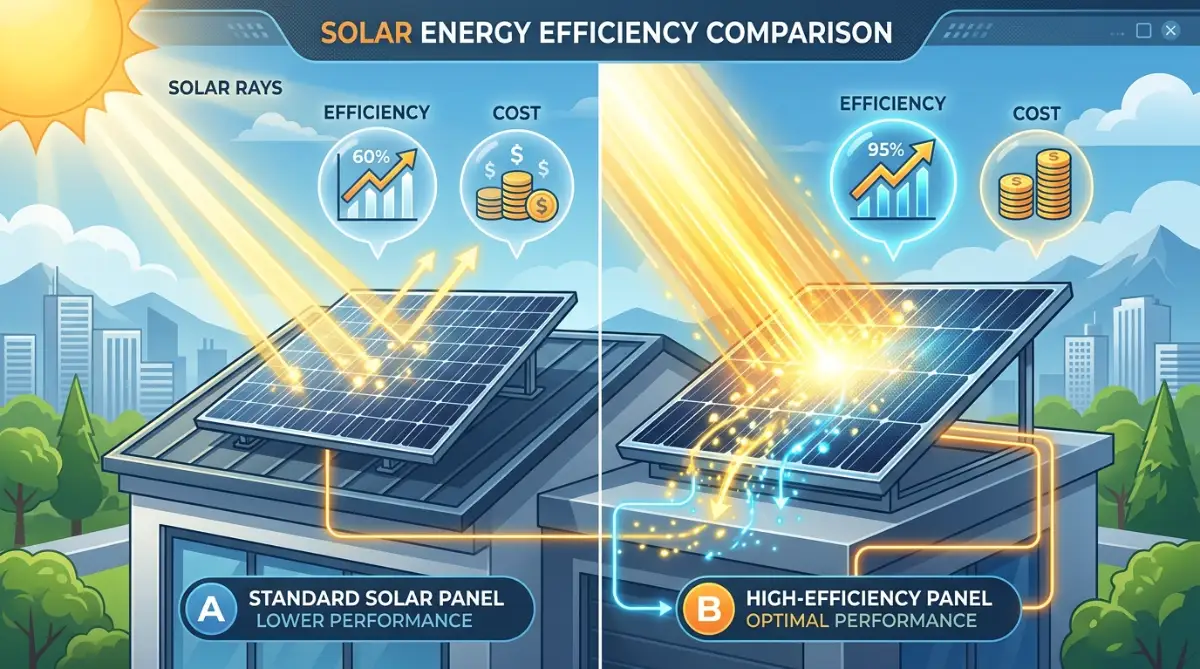
When you buy monocrystalline panels, you pay for high-purity single-crystal silicon. Manufacturers melt raw silicon and slowly pull a single seed crystal upward, forming a long cylindrical ingot through the Czochralski process.
Because the entire ingot shares one continuous crystal structure, electrons move through the material with minimal resistance. Workers then slice the cylindrical crystal into thin wafers, slicing off rounded edges to fit them tightly together inside the frame.
Polycrystalline panels take a very different path through the factory floor. Instead of growing a single pure crystal, workers melt multiple raw silicon fragments together inside a square mold.
As the liquid silicon cools, it forms hundreds of separate crystal boundaries within the block. Slicing these blocks creates perfectly square blue wafers filled with visible grain boundaries that scatter incoming light.
Those crystal boundaries act like small speed bumps for free-flowing electrons. When sunlight knocks an electron loose, that electron has to bounce past multiple internal borders before reaching the metal contact ribbons.
That extra resistance is the exact reason polycrystalline modules have lower efficiency rates than single-crystal alternatives. Less movement means less energy captured from the exact same amount of sunlight.
Performance and Technical Comparison
The Real Look on Your Roof: Black vs. Blue
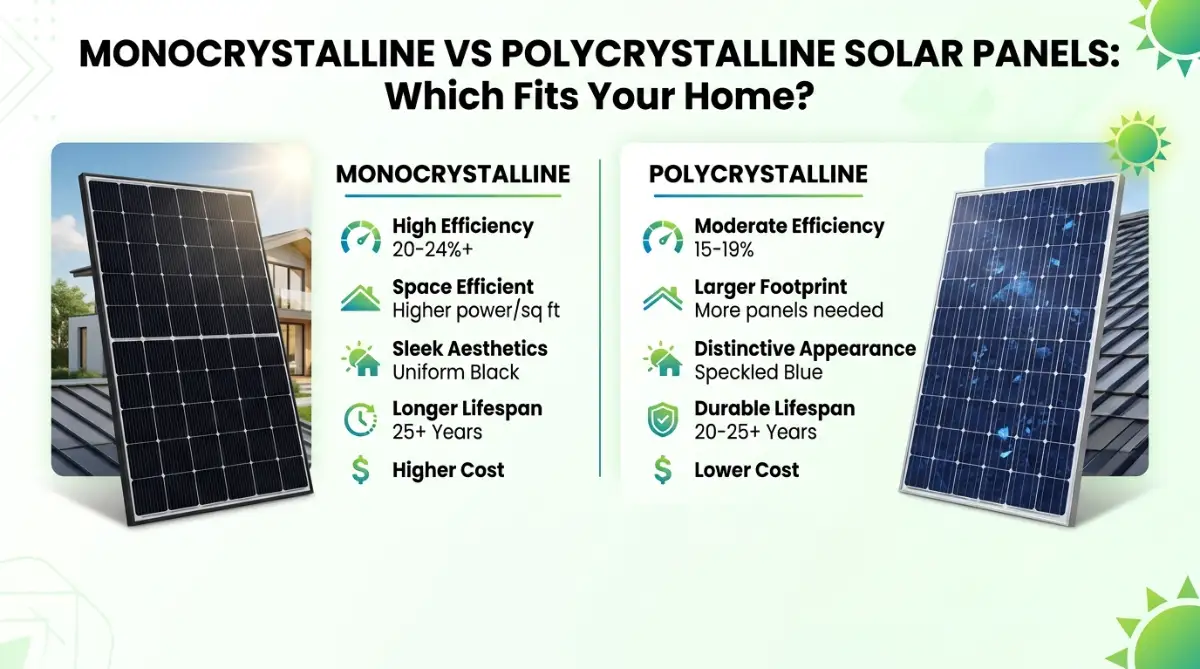
Appearance matters a lot when you plan to install equipment on the front of your home for the next three decades. Monocrystalline panels feature a clean, all-black aesthetic that blends smoothly into modern asphalt, metal, or composite shingle roofs.
Many homeowners prefer monocrystalline modules specifically because they do not draw unwanted attention from the street. Many modern models feature black backsheets and black aluminum frames, creating an ultra-sleek, monolithic appearance.
Polycrystalline modules stand out sharply with their classic speckled marine-blue appearance. When sunlight reflects off the varied crystal fragments, the cells sparkle with light and dark patterns across the array.
If your panels face an alleyway, a backyard, or sit on a remote ground mount, that bright blue color might not bother you at all. However, if your homeowner association enforces strict architectural rules, blue modules can sometimes cause approval delays.

Roof Space Constraints and Output Differences
If you have a compact roof, your equipment options narrow down fast. Monocrystalline panels generate substantially more wattage per square foot of surface area.
To build a standard 6-kilowatt home solar system using high-efficiency monocrystalline panels, you might only need 15 or 16 individual panels. That setup fits comfortably on most modest split-level or ranch homes.
Building that same 6-kilowatt system with polycrystalline modules could easily demand 19 to 22 individual panels. If your roof has dormers, chimneys, plumbing vents, or skylights breaking up flat areas, finding room for extra panels becomes difficult.
Every extra panel requires mounting rails, roof penetrations, grounding clips, and labor hours. Sometimes the equipment savings from cheaper panels disappear once the installer adds extra mounting hardware and labor fees.
Temperature Behavior in Real Climates
Many people assume solar panels work best when the weather is boiling hot. In reality, solar panels absorb light, not heat, and excess warmth actually hurts their overall output.
Once panel temperatures rise above 25°C (77°F), energy generation begins to taper off across every brand on the market. The rate of that drop is measured by an engineering metric called the temperature coefficient.
Monocrystalline cells handle blazing summer afternoons much better than polycrystalline cells. A typical monocrystalline panel loses roughly 0.35% of its output for every single degree Celsius above the baseline temperature.
Polycrystalline panels drop faster, frequently losing 0.42% or more per degree above that same threshold. On a scorching summer afternoon when your roof shingles reach 60°C (140°F), that difference translates into noticeable kilowatt-hour losses right when your central air conditioner runs hardest.
Real-Life Math: Sarah's Limited Roof vs. Mark's Open Acreage
Let us look at a realistic scenario comparing two different homeowners with distinct property layouts and energy goals.
Sarah owns a two-story colonial in a suburban neighborhood with a usable south-facing roof area of roughly 350 square feet. Her household uses 8,400 kilowatt-hours of power each year, requiring roughly a 6 kW solar array to offset her power bills.
If Sarah chooses polycrystalline panels rated at 300 watts each, she can only fit 11 panels on her available roof surface, giving her a 3.3 kW system. That system only covers about 55% of her electric needs, leaving her with an ongoing utility bill each month.
By picking 400-watt monocrystalline panels instead, she fits 15 panels into that exact same space, reaching a 6.0 kW system capacity. She pays roughly $2,100 more upfront for the high-efficiency equipment, but she eliminates nearly 100% of her grid electricity charges from day one.
Now consider Mark, who lives on a rural property with a huge outbuilding and an open, unshaded metal roof measuring over 1,200 square feet. Mark wants to build an 8 kW system to offset his workshop power usage.
Mark has more than enough roof space to install 27 polycrystalline panels rated at 300 watts each. Because he does not face space limitations, buying lower-cost polycrystalline panels saves him nearly $2,400 on his upfront installation bill without sacrificing his target total output.
The Three-Way Solar Technology Comparison
Homeowners exploring solar often stumble upon thin-film panels alongside traditional mono and poly choices. Thin-film technology uses amorphous silicon, cadmium telluride, or copper indium gallium selenide deposited onto glass or metal. Understanding how all three options compare helps you avoid buying mismatched equipment.
Watch this comprehensive visual comparison breakdown to see how these panel types perform in real-world residential tests:
Honest Pros and Cons Breakdown
Monocrystalline Solar Panels
- The Pros:
- Delivers the highest efficiency ratings on the residential market today.
- Conserves valuable roof area by generating more electricity per square foot.
- Modern, uniform black profile improves overall curb appeal on visible roofs.
- Performs more reliably in hot climates and periods of lower natural light.
- The Cons:
- Higher initial purchase price per panel compared to older technologies.
- Manufacturing process discards more raw silicon offcuts when slicing round ingots.
Polycrystalline Solar Panels
- The Pros:
- Lower upfront purchase cost reduces the initial system investment.
- Manufacturing process creates minimal raw silicon material waste.
- Perfectly adequate option when roof space or ground space is unrestricted.
- The Cons:
- Lower efficiency means you need significantly more panels to match power goals.
- Bright blue, crystalline appearance can look dated or clash with roofing materials.
- Lower heat tolerance leads to larger performance drops on hot summer days.
Long-Term Lifespan and Degradation Truths
Solar panels do not suddenly stop working on their twenty-fifth anniversary. Instead, the internal silicon components slowly degrade over decades of sun, wind, and rain exposure.
Most reputable panel manufacturers guarantee that their monocrystalline modules will retain at least 85% to 90% of their original rated capacity after 25 years of service. Their annual degradation rate typically sits around 0.5% per year.
Polycrystalline panels age just a tiny bit faster over long periods. You can expect a standard poly module to lose between 0.6% and 0.7% of its total output each year, typically holding roughly 80% to 83% of its rated capacity after 25 years.
While that small percentage difference sounds minor on paper, it compounds over decades. Over a twenty-year period, a monocrystalline system can produce noticeably more cumulative kilowatt-hours than a poly system with identical starting nameplate wattage.
Pro Tip: What I Learned the Hard Way
A few years back, I made the common mistake of only comparing the upfront price-per-watt figure on equipment spec sheets while ignoring the temperature coefficient.
During our first scorching July, my south-facing roof baked under 100-degree heat, and the actual energy production dropped by nearly 18% during peak afternoon hours.
Always check the temperature coefficient listed on the manufacturer data sheet before signing any agreement. If you live in an area with hot, sunny summers, paying a few extra cents per watt for a lower temperature coefficient will save you real money over the life of your array.
Financial Breakdown: Real Installation Estimates
Let us look at standard out-of-pocket costs for a typical 6 kW residential installation before federal or local incentives come into play.
Notice how the hardware savings of polycrystalline modules get partly eaten away by the need for more racking hardware and extra roof labor. Because the crew has to install more physical panels to reach 6 kW, structural installation labor expenses naturally creep upward.
Making the Final Choice for Your Home
Choosing between monocrystalline and polycrystalline panels comes down to your home's unique layout, your aesthetic taste, and your budget limits.
If your roof area is small, complex, or partially shaded by nearby trees, monocrystalline is almost certainly the right move. The higher efficiency ensures you capture the maximum possible energy from every square inch of available sunny surface.
If you own a home with a massive unshaded roof or plan to build a rural ground mount system, polycrystalline panels offer dependable service at a noticeably lower initial price tag.
Take a close look at your monthly energy consumption, measure your usable roof area, and compare bids using total installed system cost rather than panel prices alone. That simple check will keep your solar upgrade affordable, practical, and dependable for decades to come.
Getting the Most Out of Your Solar Investment
Many homeowners think their job is entirely done the moment the installation crew drives away. However, protecting your investment requires a little bit of ongoing attention. Whether you chose black monocrystalline or blue polycrystalline panels, dust and pollen will eventually build up on the protective glass surface.
That thin layer of grime blocks sunlight and forces your entire system to work harder. In fact, heavy dirt buildup during dry seasons can cut your daily energy production by a noticeable margin. You can easily fix this by safely cleaning your solar panels a few times a year using soft materials.
Another expert strategy involves setting up a smart monitoring app right on your smartphone. Most modern inverters come with free software that tracks your daily kilowatt-hour production in real-time. By checking this app just once a week, you can spot sudden drops in output before a small technical glitch becomes a massive financial headache.
If you notice one specific panel producing less power than the rest, a nearby tree branch might be casting a brand new shadow. Pruning that single branch can instantly restore your system's peak performance. Taking these tiny maintenance steps ensures you squeeze every possible drop of free energy out of your roof.
Pro Tips: Always ask your installer to map out your individual panel layout inside the digital monitoring app. If a specific module ever fails or underperforms, you will know exactly which one on the roof needs warranty service without having to guess.
The Biggest Installation Traps Homeowners Fall Into
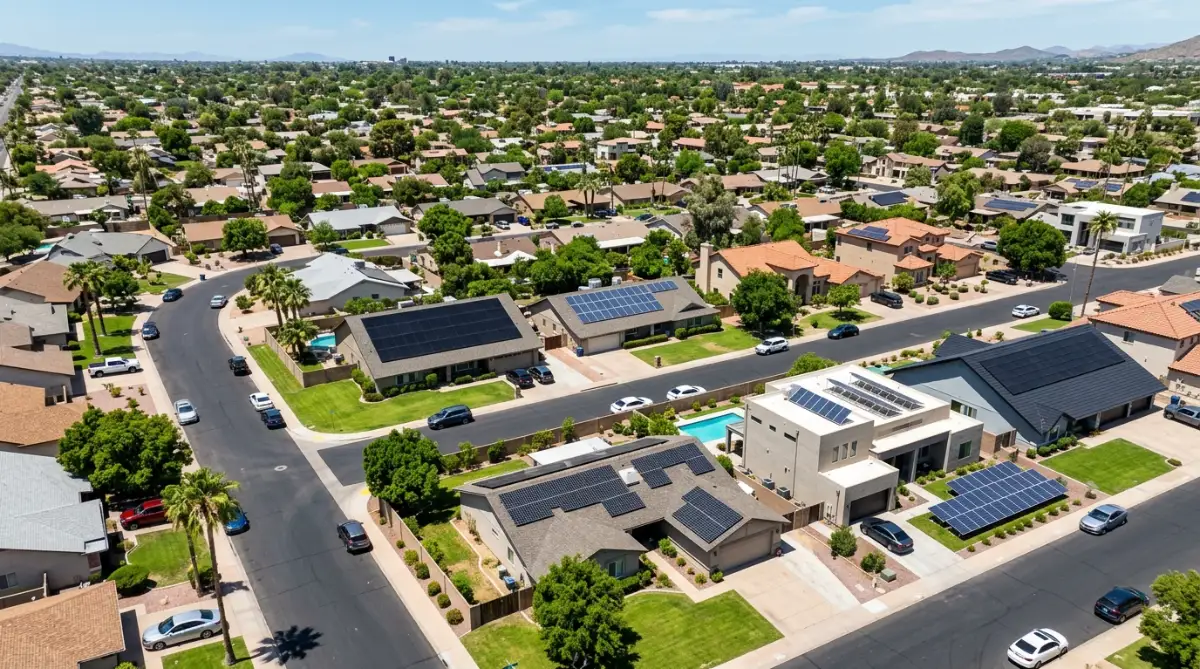
When families try to rush the solar buying process, they often make expensive errors that completely erase their future savings. One of the most heartbreaking scenarios is watching a homeowner buy premium monocrystalline panels, only to install them under heavy shade. It is exactly like buying a high-performance sports car and never taking it out of the garage.
If your roof receives heavy shade from massive oak trees, even the absolute best solar technology will struggle to produce power. Another massive trap is avoiding major solar panel installation mistakes like guessing your family's actual energy usage. Do not just let a salesman guess your system size based on the physical square footage of your house.
Common Mistakes to Watch Out For:
- Signing a binding contract without checking your historical 12-month energy usage first.
- Putting brand new solar equipment on an old, decaying roof that will need replacing soon.
- Focusing purely on cheap panel costs while ignoring the quality of the mounting hardware.
- Forgetting to research local policies, especially understanding how net metering works in your specific utility zone.
If you put a 25-year solar array on a roof that needs to be replaced in five years, you are walking into a trap. You will eventually have to pay a crew thousands of dollars to safely remove and reinstall all those panels later. Taking the time to properly prepare your roof for solar panels saves you from a massive financial burden down the road.
It is always smarter to trust unbiased government data when planning your personal project. You can check the National Renewable Energy Laboratory (NREL) tools to independently verify how much raw sunlight your specific zip code actually receives.
Separating Fact from Fiction
Your Simple Step-by-Step Execution Guide
Moving from late-night internet research to real-world action does not have to feel overwhelming. Your very first step is to gather your last 12 utility bills to find your exact annual kilowatt-hour usage. Once you have that specific number, you can calculate your home solar panel requirements with genuine accuracy.
Next, step outside and physically look at your roof structure during the morning, noon, and late afternoon hours. Note exactly where the shadows fall and roughly how much clear space faces directly south or west. Armed with your usage data and roof observations, call three well-reviewed local installers to request competitive quotes.
When the printed quotes arrive, immediately look past the total price tag at the bottom of the page. Compare the specific equipment brands, the estimated annual production numbers, and the included warranty lengths side by side. Ask each contractor directly why they selected black or blue panels for your specific layout, and listen closely to their reasoning.
Quick Action Checklist
To keep your home upgrade project moving smoothly, gather these exact items before you invite any solar company over for a physical inspection:
- 12 Months of Utility Bills: Shows your exact energy consumption history and rate tiers.
- Homeowners Insurance Policy: To verify what type of roof modifications are currently covered.
- HOA Guidelines: If you live in a community with strict visual rules about roof attachments.
- Recent Roof Inspection Report: Confirms your existing shingles can support the added weight.
- Recent Tax Return Draft: Helps you verify if you qualify for federal or state solar tax credits.
Getting Ready to Power Your Own Home
Taking complete control of your own energy production is one of the most rewarding financial upgrades you can make to your property. You are no longer at the total mercy of unpredictable utility rate hikes when you generate clean power right above your head. Whether you ultimately choose the high-efficiency black panels or the budget-friendly blue ones, you are making a deeply smart move for your family's future.
I know firsthand how intimidating those initial contractor meetings can feel, but armed with this knowledge, you are fully prepared to negotiate. You now understand the basic science behind the silicon, the hard reality of roof space, and exactly what to look for in a fair quote. Trust your own research, ask tough questions, and do not let anyone pressure you into a rushed decision.
I am so excited for you to experience that amazing feeling of relief when your power bill drops down to just a few dollars a month. Which panel technology are you leaning toward for your own roof layout? Let me know your thoughts in the comments below!
Top Questions Homeowners Ask About Panel Types
Are monocrystalline panels always better than polycrystalline?
Not automatically. While monocrystalline modules offer higher efficiency and a smaller physical footprint, polycrystalline modules remain highly cost-effective if you have plenty of open roof space. Your final choice depends entirely on your specific property constraints and budget limits.
Can I mix black and blue solar panels on the same roof?
Technically yes, but experienced installers highly advise against it. Mixing different electrical profiles on the same string inverter can drag the entire system's daily performance down to the weakest panel's output level.
How do I know if my roof is too small for polycrystalline panels?
If your contractor's design software shows that standard blue panels cannot produce 100% of your energy needs in the available space, your roof is technically too small. Upgrading to high-efficiency black panels will squeeze more total power out of that same limited area.
Do polycrystalline panels break easier than monocrystalline?
No, the physical durability rating is nearly identical between the two. Both cell types are protected by heavy-duty tempered glass and strong aluminum frames designed to withstand massive hail and severe hurricane-force winds.
Why do solar panels lose efficiency when it gets really hot?
Solar cells generate electricity directly from light particles, not from atmospheric heat. High temperatures actually increase the electrical resistance inside the silicon materials, making it much harder for electrons to flow freely.
Will my HOA allow me to install blue solar panels?
Many modern Homeowner Associations now face strict laws preventing them from banning solar setups altogether. However, some extremely strict HOAs may require all-black panels because they blend in much better with standard dark roofing shingles.
How long does the blue or black color last on the panels?
The deep color of the raw silicon cells is perfectly permanent and will not fade away over time. However, the protective glass layer on top can become slightly cloudy after thirty long years of intense weather exposure.
Do I have to buy special inverters for monocrystalline panels?
No, both standard panel technologies output normal direct current (DC) electricity. They both work perfectly with the exact same trusted brands of string inverters or microinverters sold on the market today.
Can heavy snow damage the crystalline structure of the panels?
The internal silicon wafers are highly protected and will not break from normal winter weather pressure. However, heavy snow blocks natural sunlight completely, meaning your panels will not produce energy until the snow naturally melts and slides off the glass.
Does the manufacturing process of these panels harm the environment?
Producing raw silicon wafers does require significant factory energy and creates some industrial waste. However, both panel types generate enough clean electricity to entirely offset their own manufacturing carbon footprint within the first three years of normal residential use.
Trusted Legal and Industry Resources
If you want to verify local energy policies or check consumer protection guidelines before signing a contract, please consult these trusted platforms. You can research state-level energy incentives at the Database of State Incentives for Renewables & Efficiency. For current installation safety standards, check the Solar Energy Industries Association. Homeowners should strongly verify local contractor licenses through their local Better Business Bureau. You can read deep technical solar research directly at the Department of Energy. Always verify safe electrical codes via the National Fire Protection Association. Finally, review consumer rights laws on the Federal Trade Commission website.
Legal Disclaimer
The information provided in this article is strictly for educational and informational purposes and does not constitute financial, legal, or professional electrical advice. Solar installation policies, tax incentives, and local building codes vary widely by specific state and municipality. We strongly encourage all readers to consult with licensed solar contractors, certified electricians, and qualified tax professionals before making any massive purchasing decisions or modifying their physical property. The FinanceInfoIn team and its authors are not legally liable for any financial losses, unexpected property damage, or legal complications resulting from the direct or indirect use of this information. Always independently verify warranties and written contracts before signing any documentation.
About the Author
Reviewed by Mithun Halder (Personal Finance & SEO Expert) & The FinanceInfoIn Editorial Team
The FinanceInfoIn Editorial Team researches personal finance, investing, insurance, mortgages, cryptocurrency, and consumer financial topics. Every article is carefully reviewed to provide clear, practical, and trustworthy educational information based on credible sources and industry best practices.
©2026 FinanceInfoIn. All rights reserved.