
Reading Time: 14 Minutes
Difficulty Level: Beginner to Intermediate
Reviewed By: FinanceInfoIn Editorial Team
The Hidden Trap of Endless Power Bills
I still remember tearing open my power bill on a hot summer afternoon and feeling a heavy knot form in my stomach. The number printed on that piece of paper was ridiculously high, completely wiping out my extra savings for the month. I only had my air conditioner running to survive a massive heatwave, but I felt like I was being punished for wanting to be comfortable in my own home.
I felt completely trapped by the utility company, knowing they could raise their rates whenever they wanted without my permission. That terrifying feeling of powerlessness made me seriously consider making massive lifestyle changes just to afford basic electricity. I spent my evenings yelling at my kids to turn off every single light and nervously checking the thermostat every hour.
This is a painful reality that millions of hardworking families deal with every single month. We work tirelessly to provide a comfortable living space, yet we constantly worry about using the appliances we bought with our own money. You plan a careful monthly budget, and then a random weather change causes a massive spike in your power costs.
People are sacrificing their family vacations, skipping dinners out, and living in constant stress just to keep the lights on. It honestly feels like you are renting electricity forever, pouring your hard-earned money into a black hole that gives you no long-term value. We buy homes to build equity and security, but the utility company always holds a financial chain around our necks.
You find yourself staring at your roof, wondering if those shiny solar panels could actually set you free from this endless cycle. You hear neighbors talking about getting zero-dollar bills, but it sounds like some kind of complex scam. The fear of making a costly mistake keeps you paying that painful utility bill month after month.
But I am here to tell you that this financial freedom is highly real, and it is built on a very simple concept. It is not magic, and you do not need an engineering degree to understand it. Let me show you exactly how this system works and how it can finally give you peace of mind.
At a Glance
|
TOPIC |
SUMMARY |
|
What is Net Metering? |
A billing system that gives credit for excess solar electricity sent to the grid. |
|
Main Benefit |
Reduces monthly electricity bills. |
|
Best For |
Grid-connected homeowners with solar panels. |
|
Need a Battery? |
No, the utility grid acts as virtual storage. |
|
Long-Term Savings |
Lower electricity costs over many years. |
Breaking Down the Magic of Two-Way Energy
When most people think about getting solar panels, they imagine a giant battery sitting in their garage storing power. While home batteries exist, they are very expensive and completely unnecessary for most homeowners. The easiest and most profitable way to use solar energy involves staying connected to your local power company.
This brilliant connection is called net metering, and it completely changes the relationship between you and your utility provider. Instead of just being a helpless customer who buys power, you actually become a mini power plant. You produce clean electricity and share it with your neighborhood.
Understanding this concept will completely change how you view your home's roof and your monthly expenses. You will stop seeing your home as an energy drain and start seeing it as an energy asset. Let us break down the exact steps of how this system captures the sun and turns it into real money in your pocket.
The Problem with Daytime Solar Production
To understand why this system is so amazing, we first have to look at how a normal day works for a typical family. Your solar panels only produce electricity when the sun is shining brightly in the sky. They reach their maximum power output right in the middle of the day.
However, the middle of the day is usually when you use the least amount of electricity. You might be at the office working, the kids are at school, and the house is mostly empty. Your panels are working incredibly hard, pumping out massive amounts of clean energy that your empty house simply does not need.
Without a way to store or send this energy somewhere else, all that beautiful solar power would just go to waste. It is like running a massive water hose into a tiny cup; the extra water just spills over the edges. This is exactly where your local power grid steps in to save the day.
The Power Grid Becomes Your Giant Battery
Because you are still connected to the local utility grid, your house does not just throw away that extra daytime electricity. Instead, your home automatically sends all that surplus power backward through the wires and into your neighborhood. Your neighbors actually end up using the solar energy you produced to power their televisions and refrigerators.
This is the very heart of how the entire system operates. When you send this extra electricity into the grid, the utility company keeps track of every single drop of energy you give them. They act like a massive, invisible battery that stores your excess production for later use.
They do not just take your power for free; they owe you for it. For every unit of electricity you push out into the neighborhood, the utility company gives you an energy credit on your account. You are literally building up a digital bank account full of electricity all day long.
What Happens When the Sun Goes Down
Now, let us imagine it is eight o'clock at night. The sun has completely set, and your solar panels have naturally stopped producing power. But this is exactly when your family needs electricity the most.
You are cooking dinner on the electric stove, the kids are watching a movie, and the washing machine is running. Since your panels are sleeping, your house automatically pulls the required power straight from the traditional utility grid. In a normal situation, the power company would charge you a hefty fee for using this evening electricity.
But because you have net metering, you do not have to pay for it. Your house automatically uses the digital credits you earned earlier in the day to pay for your nighttime usage. You are simply trading the extra power you made at noon for the power you need at midnight.
Pro Tip from My Experience: When I first installed my system, I incorrectly assumed I would get a physical check in the mail every month for my extra power. I quickly learned that utility companies hold onto those credits to offset my winter usage instead, which actually turned out to be a massive lifesaver for my yearly budget!
If you are still a little confused about how power flows back and forth between your house and the grid, this quick animation breaks it down perfectly.
The Role of the Smart Utility Meter
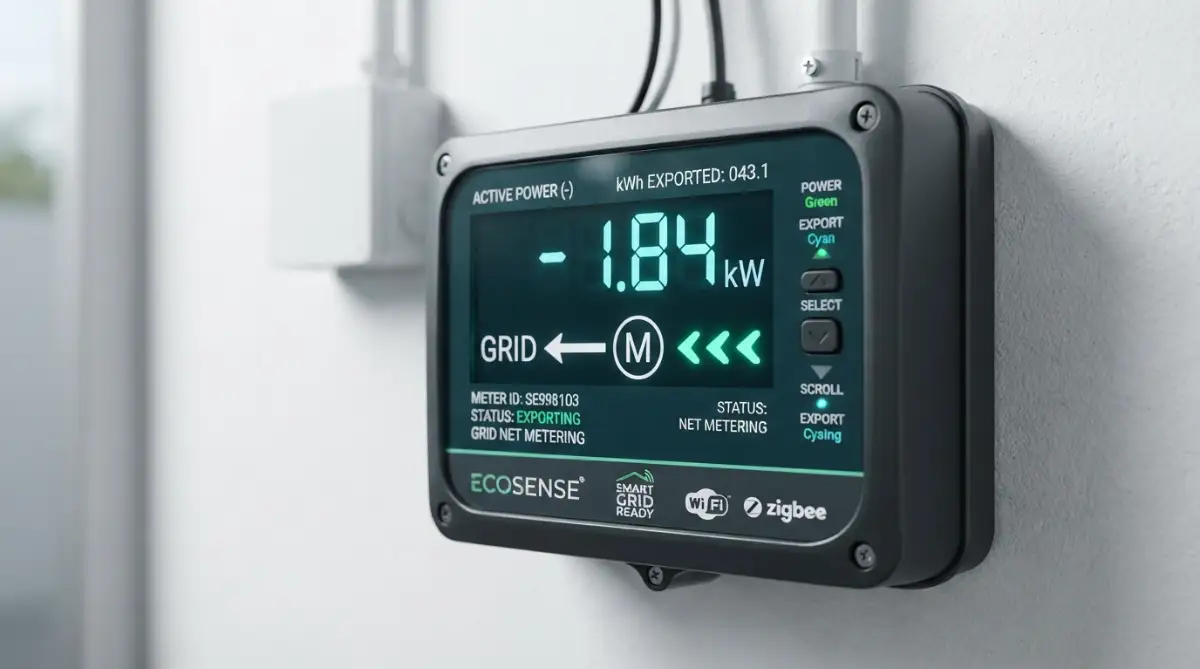
You might be wondering how the power company accurately tracks all this energy moving in two different directions. When you get a solar system approved, the utility company comes to your house and installs a special device called a bidirectional smart meter. This replaces that old, dusty meter with the spinning metal wheel on the side of your house.
This new digital meter reads power flowing in both directions instantly. When you pull power from the grid at night, the meter counts forward, just like it always has. But during the day, when your panels produce extra power, the smart meter actually runs backward.
At the end of the month, the utility company looks at the final number on this smart meter. They take the total amount of power you pulled from the grid and subtract the total amount you pushed back. You are only billed for the "net" difference between those two numbers.
Benefits of Net Metering for Everyday Homeowners
- Lower monthly bills
- Better return on solar investment
- Reduced dependence on utilities
- Cleaner energy usage
- Increased home value
Surviving the Changing Seasons
This clever billing system does not just protect you on a daily basis; it completely shields you throughout the changing seasons. Think about a long, sunny day in the middle of summer. The days are extremely long, and your solar panels produce a staggering amount of energy.
During these highly productive summer months, you will likely produce far more electricity than your family can possibly use. Your monthly bill will drop to zero, and you will have hundreds of leftover credits sitting in your account. The utility company simply rolls those excess credits over to the next month, just like old cell phone minutes.
Then, winter arrives with short, gloomy days and heavy snowstorms. Your solar panels will naturally produce much less energy because the sun sits lower in the sky. Your house will pull heavily from the grid to run your heating system during those dark winter nights.
Without your stored credits, your winter power bills would be completely devastating. But because you banked so much extra energy during the summer, you just use those stored credits to wipe out your winter heating bills. The system perfectly balances out your entire year, giving you predictable and highly stable costs.
Myth vs Reality: Common Solar Misconceptions
People make a lot of wild assumptions about home energy, so let us clear up some of the most common misunderstandings right now.
Myth: I will completely disconnect from the power company and live off the grid.
Reality: Net metering specifically requires you to stay connected to the power company. Without the grid acting as your storage battery, you would have no power at night unless you bought expensive physical batteries for your garage.
Myth: The power company will pay me thousands of dollars in cash for my extra power.
Reality: Most utility companies will not write you a fat check for being a power plant. They compensate you in energy credits, not hard cash. If you produce way more power than you use over an entire year, they might pay you a tiny wholesale rate for the leftovers, which is rarely a lot of money.
Myth: My solar panels will keep my lights on during a neighborhood blackout.
Reality: Because you are connected to the grid, your solar panels actually shut down automatically during a neighborhood power outage. This prevents your panels from sending live electricity into the wires while repair workers are trying to fix the broken lines safely.
Comparison Table: Net Metering vs Solar Battery vs No Solar
|
FEATURE |
NET METERING |
SOLAR + BATTERY |
NO SOLAR |
|
Upfront Cost |
Medium |
High |
None |
|
Monthly Electricity Bill |
Very Low |
Very Low |
High |
|
Backup During Power Outage |
❌ No |
✅ Yes |
❌ No |
|
Uses Utility Grid |
✅ Yes |
Optional |
✅ Yes |
|
Long-Term Savings |
High |
High |
Low |
|
Best For |
Most Homeowners |
Backup Power Needs |
Traditional User |
The True Financial Impact on Your Wallet
To really see the massive financial benefit, you have to look at the math over a long period. Imagine your normal electricity bill is two hundred dollars every single month. Over the course of twenty years, you would hand the utility company almost fifty thousand dollars, and that is assuming they never raise their rates!
When you install a properly sized solar system with this amazing billing policy, that monthly payment practically vanishes. You stop renting your power and start owning your production. The money you used to send to the utility company can now go straight into your family vacation fund or retirement savings.
Of course, you still have to pay for the physical solar panels, either by buying them upfront or getting a solar loan. But your monthly loan payment is usually much lower than your old utility bill used to be. Once the panels are completely paid off, your electricity becomes genuinely free for decades.
System Sizing is the Ultimate Key
One massive mistake homeowners make is assuming that a bigger solar system is always better. Because you rarely get paid a good cash rate for extreme overproduction, buying too many panels is just a waste of money. The goal is not to become a commercial power plant; the goal is to exactly match your family's annual usage.
A good solar installer will look at your past twelve months of utility bills to see exactly how much energy you consume in a year. They will design a system that produces just enough electricity to wipe out that specific amount of usage. This perfectly sized system guarantees you get the absolute fastest return on your investment.
If you know you are going to buy an electric car next year, or you plan to install a hot tub, you should tell your installer right away. They can slightly oversize your system to account for that future energy usage. Planning ahead ensures you never get stuck paying a surprise utility bill down the road.
We have explored the core mechanics of how your house communicates with the local power grid to save you money. Understanding this back-and-forth energy flow gives you the confidence to take control of your home's utility costs. But simply installing panels is only half the battle; knowing how to navigate the specific rules of your local area is what truly maximizes your savings.
Solar System Size Comparison
|
HOME TYPE |
AVERAGE MONTHLY USAGE |
RECOMMENDED SOLAR SIZE |
|
Small Home |
300–500 kWh |
3–4 kW |
|
Medium Home |
500–800 kWh |
5–6 kW |
|
Large Home |
800–1200 kWh |
7–10 kW |
Who Benefits the Most from Net Metering?
- Families with high daytime production
- EV owners
- Large households
- Remote workers
- Homes with electric appliances
Smart Strategies to Maximize Your Solar Energy Returns
Now that you understand exactly how the power flows back and forth, you need to know how to squeeze every single penny out of this system. Getting the panels on your roof is just the starting line; how you manage your daily energy usage is what actually builds real wealth over time.
I have spent years testing different household habits to see what makes the biggest difference in my monthly bills. You do not have to sit around in the dark to save money, but you do need to play the game smartly. Let us walk through the most effective ways to make your local power company owe you a massive credit at the end of the year.
Best Time to Use High-Power Appliances
|
APPLIANCE |
BEST TIME |
|
Washing Machine |
11 AM–3 PM |
|
Dishwasher |
Noon–3 PM |
|
EV Charging |
Midday |
|
Pool Pump |