Reading Time: 12 Minutes
Difficulty Level: Beginner to Intermediate
Reviewed By: FinanceInfoIn Editorial Team
That Sinking Feeling: When You Realize Your Policy Might Not Save You
Standing in the freezing rain on the side of a busy highway, I stared blankly at my crushed front bumper. My hands were shaking, not just from the cold, but from a sudden wave of financial panic hitting my chest. I had just rear-ended a luxury sedan because the wet brakes simply refused to stop in time. My checking account had exactly two hundred dollars in it, and rent was due in three days. As I dialed my insurance agent's number, a horrifying thought crossed my mind. Did the cheap policy I bought online even cover this kind of mess?
That feeling of total helplessness is something millions of drivers face every single day. We pay our premiums month after month, assuming that piece of paper in the glove box is a magical shield against all bad things. Yet, when the worst actually happens, ordinary people are left battling confusing terms and shocking denials. The reality of not knowing your exact protection level creates an intense, lingering anxiety for working families.
A sudden accident does not just damage metal and plastic. It shatters your daily routine, threatens your ability to commute, and can instantly drain your hard-earned savings. Families are often forced to take on massive credit card debt just to get their only vehicle back on the road. The emotional toll of arguing with claims adjusters while trying to manage a normal life is incredibly exhausting.
This deep fear stems entirely from a lack of clear, honest information. Insurance companies use complex language that makes it nearly impossible for the average person to know what they are actually paying for. You should never have to find out your coverage limits while standing next to a wrecked vehicle. Understanding your protection is the only way to regain control and drive with genuine peace of mind.
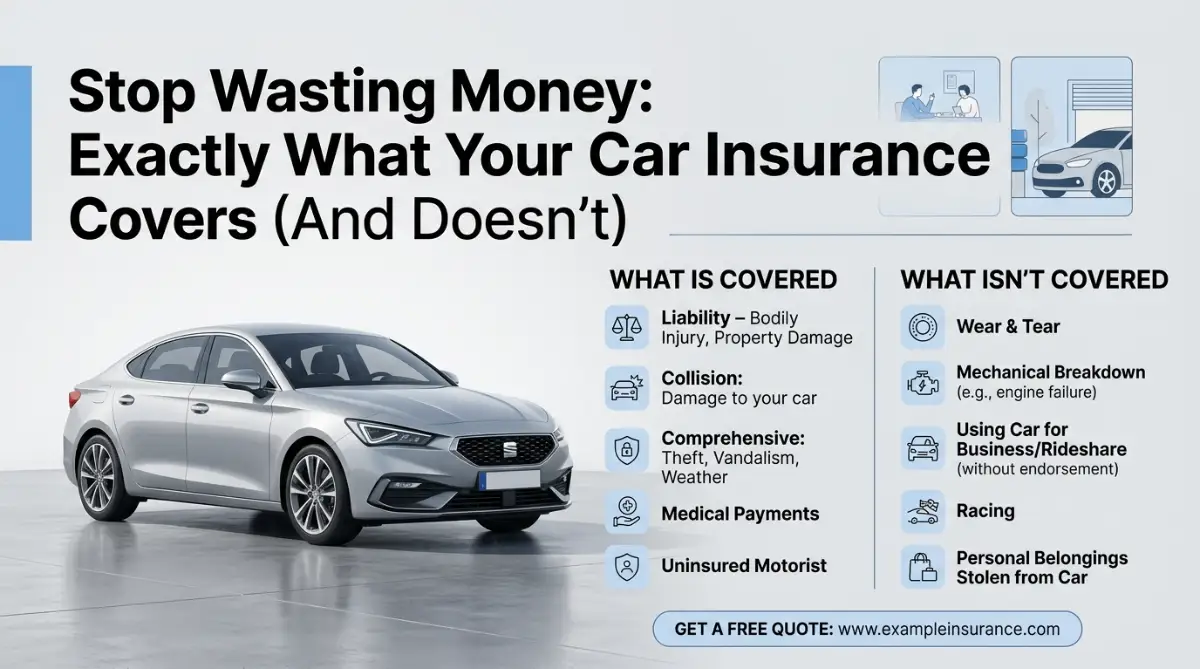
Table of Contents
- Quick Summary
- Key Takeaways
- The Foundation: Breaking Down Standard Auto Policies
- Protecting Your Own Ride: Collision and Comprehensive
- The Hidden Danger: Uninsured Motorists Protection
- Let's Do The Math: A Real-World Accident Scenario
- The Hard Truth: What Your Policy Will Absolutely Reject
- Honest Pros & Cons: Carrying Full Coverage
- Smart Ways to Choose the Right Protection Level
Quick Summary
Auto insurance is a contract protecting you from extreme financial loss, but it never covers everything. Liability pays for damage you cause to others, while collision and comprehensive protect your own vehicle. Mechanical breakdowns, personal belongings inside the car, and intentional damages are strictly excluded. Knowing these boundaries helps you select the right limits and avoid massive out-of-pocket bills.
Key Takeaways
- Liability is mandatory but only protects other people when you are at fault.
- You need specific add-ons (collision and comprehensive) to fix your own car.
- Your auto policy will not replace a stolen laptop left in your backseat.
- High deductibles lower your monthly bill but require more cash upfront after an accident.
The Foundation: Breaking Down Standard Auto Policies
When you buy a basic policy, you are usually purchasing liability protection. This is the absolute core of your agreement and is legally required in almost every state. Liability acts as a financial wall between your personal bank account and the person you accidentally injure.
If you run a red light and hit another driver, your liability coverage steps in to handle their problems. It splits into two main categories: bodily injury and property damage. Bodily injury pays for the other driver's hospital bills, ambulance rides, and lost wages. Property damage covers the cost to fix their vehicle or replace a fence you might have crashed into.
The most important thing to remember is that basic liability gives you nothing for your own damages. You could total your car, and a liability-only policy will not hand you a single penny to buy a new one. This is exactly where so many drivers get confused and end up financially stranded.
Protecting Your Own Ride: Collision and Comprehensive
To fix your own vehicle, you need to add specific layers to your policy. The first layer is called collision coverage. Just like the name suggests, this pays to repair your car if you hit another vehicle, a tree, or a guardrail, regardless of who caused the crash.
The second layer is comprehensive coverage, which handles damages that have nothing to do with driving errors. Think of it as an umbrella protecting your car from the world's random bad luck. If a heavy tree branch falls on your roof, or your car is stolen from a parking lot, comprehensive is what saves you.
Many people mix up these two types of protection. To make it completely clear, let's look at a direct comparison of how they work in real situations.
Pro Tip: I used to think I only needed collision coverage since I was a safe driver. My perspective changed instantly the morning I woke up to find my car's catalytic converter stolen from my driveway. Always carry comprehensive coverage if you park outside, as theft is completely out of your control.
The Hidden Danger: Uninsured Motorists Protection
Even if you carry the best insurance possible, you share the road with people who carry absolutely none. If an uninsured driver hits you and totals your car, their lack of coverage becomes your massive problem. You cannot squeeze money out of an empty bank account.
This is why Uninsured Motorist (UM) protection is a non-negotiable addition for smart drivers. It essentially acts as a stand-in for the other person's missing insurance. It covers your medical bills and, depending on your state, your property damage too.
Why You Must Protect Yourself First
Let's Do The Math: A Real-World Accident Scenario
To truly understand how this works, we need to look at the real numbers behind a standard claim. Let us look at a practical example involving a driver named David. David has a policy with a $500 deductible for collision.
One evening, David slides on black ice and hits a concrete barrier. His car suffers severe front-end damage, and the repair shop estimates the total cost to be $4,500. Because David has collision coverage, he is not responsible for the entire bill.
Here is exactly how the math works out before he gets his car back.
As you can see, David's single decision to carry collision coverage saved him four thousand dollars. He only needed to cover his chosen deductible. This simple math is exactly why carrying adequate limits prevents total financial ruin.
The Hard Truth: What Your Policy Will Absolutely Reject
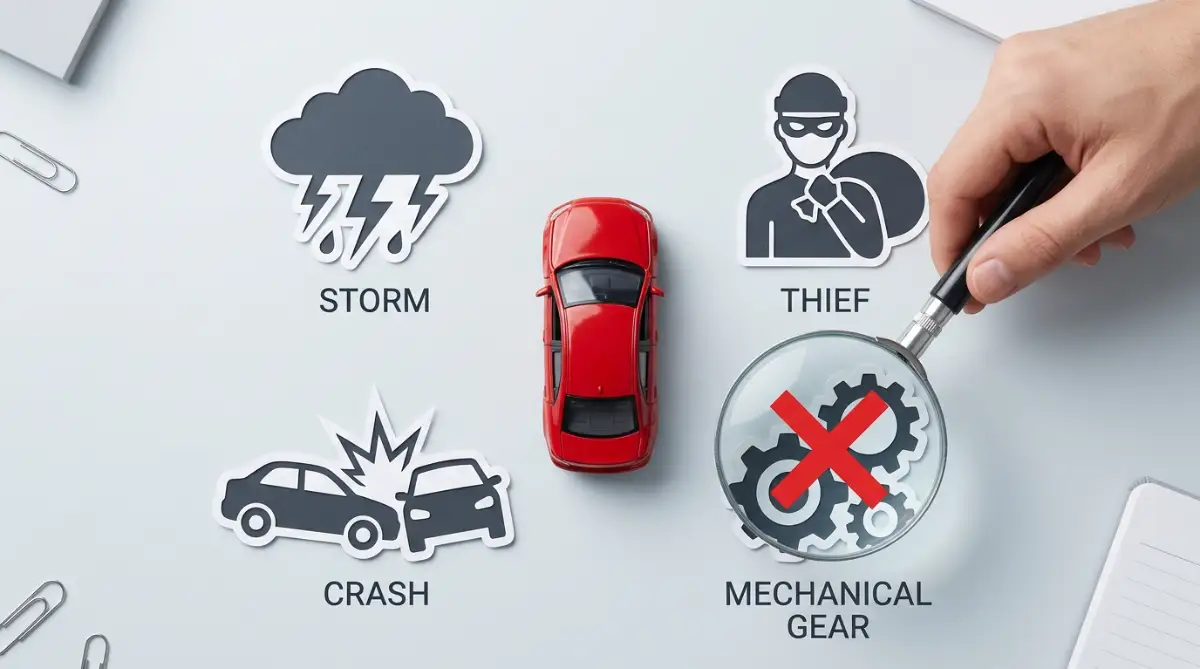
A major part of understanding car insurance explained is knowing what is completely excluded. Your policy is not a maintenance contract. If your engine blows up because it is old, or your transmission fails after 100,000 miles, insurance will not help. Mechanical wear and tear is solely the owner's responsibility.
Another massive exclusion is using your personal vehicle for business purposes. If you are delivering pizzas or driving for a rideshare app like Uber, your personal policy is instantly void during those trips. You must buy a specific commercial endorsement to cover delivery driving.
Finally, your auto policy does not cover the personal property inside your car. If someone smashes your window and steals a $1,500 laptop from the backseat, auto insurance only pays to fix the broken glass. To replace the stolen laptop, you would actually need to file a claim through your renters or homeowners insurance.
Honest Pros & Cons: Carrying Full Coverage
- The Pros:
- Provides complete peace of mind against weather, theft, and animal strikes.
- Guarantees your vehicle will be repaired even if you caused the accident.
- Protects you financially against uninsured or hit-and-run drivers.
- Required by lenders if you are financing or leasing the car.
- The Cons:
- Significantly increases your monthly premium payments.
- Not financially logical for very old cars worth less than a few thousand dollars.
- Still requires you to pay a deductible before getting any help.

Smart Ways to Choose the Right Protection Level
Finding the perfect balance between good protection and an affordable monthly bill takes a bit of strategy. You never want to overpay, but underinsuring yourself is a massive risk. The first step is evaluating your vehicle's current market value.
If you drive a ten-year-old car worth only $2,000, paying $800 a year for full coverage does not make mathematical sense. In that specific scenario, dropping to a liability-only policy might be the smartest move. However, if your car is new or financed, full protection is absolutely mandatory.
You can also control your costs by adjusting your deductibles. Raising your deductible from $500 to $1,000 will noticeably drop your monthly premium. Just make sure you always keep that $1,000 sitting securely in a savings account, ready for a rainy day.
Ultimately, having your car insurance explained clearly removes the fear of the unknown. You can confidently get behind the wheel knowing exactly where your financial safety net begins and ends. Take ten minutes today to review your actual policy documents, because the best time to understand your coverage is long before you ever need to use it.
Smart Strategies to Maximize Your Vehicle Protection
Most drivers simply buy a policy and forget about it until a disaster strikes. However, managing your auto protection requires a bit of active strategy. You can easily squeeze much more value out of your monthly payments by knowing a few inside secrets. The goal is to build a safety net that actually holds you up when life throws a curveball.
One of the best-kept secrets in the industry is the massive value of Gap Insurance. If you finance or lease a brand-new car, its market value drops the second you drive it off the dealer's lot. If you total that car a month later, standard collision coverage only pays the current depreciated value. This leaves you personally owing the bank thousands of dollars for a car you no longer drive.
Adding gap coverage instantly solves this terrifying problem. It pays the exact difference between what the vehicle is worth and what you still owe the bank. It is usually very cheap to add to your existing policy.
Another pro-level strategy is aggressively shopping for multi-policy discounts. Sticking with the same company for a decade does not guarantee you the lowest rate. In fact, many companies slowly increase your premiums over time. Bundling your auto coverage with your renters or homeowners policy can easily shave hundreds of dollars off your yearly bill. You should make it a habit to lower your auto insurance premium without losing essential coverage by getting fresh quotes every two years.
Pro Tip: I always set a calendar reminder one month before my policy renews. I use that specific week to call my agent and explicitly ask if there are any new discounts I qualify for. You will be amazed at how often they magically find savings just to keep you as a customer.
You should also look into accident forgiveness programs if you have a clean driving history. One minor fender bender can cause your premium to skyrocket for the next three years. Accident forgiveness ensures your rate stays flat after your first at-fault crash. It acts like a financial reset button that protects your long-term budget.
If you have significant assets like a house or a healthy savings account, consider an umbrella policy. Standard liability limits cap out eventually, leaving your personal wealth exposed to major lawsuits. An umbrella policy provides an extra million dollars of liability protection for just a few dollars a month. The Insurance Information Institute strongly recommends this layer of security for anyone with a steady income and property to protect.

The Dangerous Pitfalls: What Can Ruin Your Financial Safety Net
When trying to save money, many well-meaning people make sudden changes to their coverage without realizing the consequences. A small mistake on your paperwork can give the company a legal reason to reject your claim. I have seen families face total financial ruin simply because they misunderstood a single box on their application form.
A glaring issue is hiding regular drivers from your policy. If your teenager gets their license, you might be tempted to leave them off the paperwork to keep your bill low. If that teenager causes a serious crash, the company will likely investigate. If they discover the teen lived in your house and regularly drove the car, they can completely deny the payout for insurance fraud.
Another massive trap is relying solely on your state's minimum legal requirements. State minimums are dangerously low and rarely cover the real cost of a modern accident.
If you hit a new SUV and cause $40,000 in damage, a $15,000 minimum limit leaves you personally responsible for the remaining $25,000. You could easily have your wages garnished for years. It is always better to pay a slightly higher monthly bill to avoid a lifetime of debt. Knowing why your car insurance claim was denied and how to fix it starts with carrying adequate limits from the very beginning.
Auto Insurance Myth vs. Reality
Common Mistakes That Cost Drivers Thousands
- Dropping comprehensive too soon: Canceling it just because your car is paid off leaves you helpless against theft or extreme weather. You need to know exactly what does comprehensive auto insurance actually cover in a crisis.
- Setting the deductible too high: Choosing a $2,000 deductible is great for low bills, but useless if you cannot produce $2,000 in cash after a crash.
- Ignoring the fine print: Failing to read the exact terms can lead to horrible surprises. You must learn how to understand your insurance declaration page without confusion.
- Using personal cars for business: Driving for Uber or delivering food without a commercial add-on immediately voids your standard protection.
Quick Action Checklist for Immediate Protection
- Locate your current declaration page in your glove box or email.
- Check your property damage liability limit (Increase to $50k+ if possible).
- Verify that Uninsured Motorist coverage is actively selected.
- Confirm exactly who is listed as a driver on the policy.
- Ensure your deductible amount matches your emergency savings balance.
The Exact Step-by-Step Execution Guide
If you are realizing your current protection is weak, you need to act immediately. Do not wait for your renewal date to fix glaring gaps in your financial armor. Here is exactly how to upgrade your protection today.
Step 1: Gather your current documents.
Pull up your latest policy declaration page. This single sheet of paper lists exactly what limits you currently pay for.
Step 2: Calculate your vehicle's actual cash value.
Use a trusted resource like Kelley Blue Book to see what your car is worth today. If it is worth less than $3,000, keep liability but consider dropping collision.
Step 3: Call your provider and request quotes for higher limits.
Ask them directly: "How much would it cost to increase my property damage liability to $50,000?" Often, jumping to a much safer limit only costs an extra five or ten dollars a month.
Step 4: Audit your exact usage.
Tell your agent honestly how many miles you drive each year. If you recently started working from home, you might qualify for a low-mileage discount immediately. Taking the right steps now is the only way to stop your auto insurance company from denying claims later.
Required Document Preparation Checklist
Before you pick up the phone to negotiate or change your plan, have these items sitting on the table in front of you:
- Your current insurance declaration page.
- The exact Vehicle Identification Number (VIN) for all cars.
- Driver's license numbers for everyone living in your home.
- Current odometer reading (exact mileage on the dashboard).
- A recent pay stub or bank statement to verify your comfortable budget limit.
Taking Control of Your Roadway Security
Understanding your auto policy is not just about fulfilling a legal requirement to get license plates. It is about actively defending your peace of mind, your savings account, and your family's future stability. The language might seem intimidating at first, but breaking it down layer by layer reveals a very logical system. You hold the power to shape that system to fit your exact lifestyle and budget.
By avoiding dangerous minimums and smartly balancing your deductibles, you take the target off your back. You never have to stand on the side of a highway wondering if a tow truck will bankrupt you. Financial confidence comes directly from preparation and clear knowledge.
I remember the massive relief I felt the day I finally organized my own auto policy to cover uninsured drivers. My anxiety about sharing the road with reckless people instantly vanished. Take ten minutes tonight to review your own paperwork and give yourself that same gift of security. Which part of your auto policy are you planning to check first? Let me know in the comments below!
Common Questions About Auto Insurance Coverage
What is a deductible and how does it work?
A deductible is the exact amount of money you must pay out of your own pocket before your insurance company starts paying the rest of the repair bill. If your repair costs $3,000 and your deductible is $500, you pay $500 to the mechanic, and the insurance covers the remaining $2,500.
Does my insurance cover a rental car if my car is in the shop?
Standard policies do not automatically pay for a rental vehicle while your car is being repaired. You must specifically purchase "Rental Reimbursement" coverage as an add-on to get this benefit.
Will my policy pay off my loan if my car is totaled?
No, standard collision coverage only pays the current depreciated market value of the vehicle, which is often less than what you owe the bank. To cover the remaining loan balance, you must carry gap coverage.
Does my personal auto policy cover me if I deliver food or groceries?
Absolutely not. Personal auto policies strictly exclude business use, including driving for apps like DoorDash, Uber, or Amazon Flex. You need a specific commercial or rideshare endorsement to stay protected.
What happens if an uninsured driver hits my car?
If you have Uninsured Motorist (UM) protection, your own policy will step in to cover your medical bills and, depending on your state, your vehicle damage. If you do not have UM coverage, you will likely have to pay for the repairs yourself or sue the driver.
Do I need comprehensive coverage on an old, high-mileage car?
If your car's total market value is very low (e.g., under $2,000), it might not make financial sense to pay for comprehensive coverage. You could end up paying more in premiums and deductibles than the car is actually worth.
Will my rate go up if I file a claim for a cracked windshield?
In many cases, filing a small comprehensive claim for a windshield repair will not drastically raise your rates. Some companies even waive the deductible entirely for simple glass repairs to keep you safe on the road.
Does car insurance cover stolen items left inside the vehicle?
No, your auto policy only covers parts permanently attached to the vehicle itself. If a thief steals your laptop, phone, or golf clubs from the trunk, you have to file a claim through your renters or homeowners insurance.
What is the difference between bodily injury and personal injury protection?
Bodily injury liability pays for the medical bills of the other person if you cause an accident. Personal Injury Protection (PIP) pays for your medical bills and lost wages, regardless of who caused the crash.
Can anyone drive my car and still be covered by my insurance?
Generally, yes, if you give them explicit permission to drive your vehicle, your insurance will cover them for occasional use. However, anyone who lives in your house and drives the car regularly must be officially listed on your policy.
Trusted Legal Resources
- National Association of Insurance Commissioners (NAIC)
- Insurance Information Institute (III)
- Consumer Financial Protection Bureau (CFPB)
- Federal Trade Commission (FTC) - Auto Insurance Guide
- National Highway Traffic Safety Administration (NHTSA)
- USA.gov - Consumer Protection
Disclaimer: The information provided in this article is for educational and informational purposes only and does not constitute financial, legal, or professional insurance advice. Insurance regulations vary significantly by state and country, and individual policies have specific terms, limits, and exclusions. FinanceInfoIn and its editorial team are not licensed insurance agents or financial advisors. Always consult with a licensed insurance professional and carefully read your specific policy documents before making any decisions or changes to your coverage. We assume no liability for actions taken based on the contents of this website.
About the Author
Reviewed by Mithun Halder (Personal Finance & SEO Expert) & The FinanceInfoIn Editorial Team
The FinanceInfoIn Editorial Team researches personal finance, investing, insurance, mortgages, cryptocurrency, and consumer financial topics. Every article is carefully reviewed to provide clear, practical, and trustworthy educational information based on credible sources and industry best practices.
©2026 FinanceInfoIn. All rights reserved.