
Reading Time: 13 Minutes
Difficulty Level: Beginner to Intermediate
Reviewed By: FinanceInfoIn Editorial Team
The Real Struggle with Hair Care: Why Your Products Keep Failing
I remember standing in front of my bathroom mirror, looking at a shelf full of expensive bottles. I had just spent over forty dollars on a highly recommended deep conditioning mask. My hair felt dry, brittle, and looked incredibly frizzy, so I was desperate for a quick fix.
I applied the mask, waited twenty minutes, and rinsed it out with high hopes. Instead of soft, shiny curls, my hair felt like it was coated in heavy wax. It was greasy on the outside, yet bone-dry on the inside.
I felt completely defeated and exhausted by the endless cycle of buying products that promised miracles but left my hair looking worse.
Many people face this exact frustration every single day. You see a glowing review online, buy the product, and get terrible results. You start to think that your hair is just naturally bad or unmanageable.
This ongoing struggle can drain your confidence and make you want to hide your hair under a hat. The real problem is not your hair itself, but a complete mismatch between your products and your hair porosity.
Understanding hair porosity is the missing key to ending this cycle and saving your hard-earned money.
Table of Contents
- Quick Summary of Hair Porosity
- What is Hair Porosity and Why Does It Matter?
- Key Takeaways for Daily Care
- The Three Levels of Hair Porosity
- How to Test Your Hair Porosity at Home
- An In-Depth Look at Low Porosity Hair
- An In-Depth Look at High Porosity Hair
- How to Care for Medium Porosity Hair
- Common Mistakes to Avoid
Quick Summary of Hair Porosity
Hair porosity is your hair’s natural ability to absorb and hold onto moisture. It is decided by the structure of your hair cuticles, which act like tiny protective shingles. Knowing your specific level helps you choose products that actually penetrate the hair shaft rather than sitting on top of it.
Key Takeaways for Daily Care
- Low Porosity: Needs light, water-based products and gentle heat to open up tight cuticles.
- Medium Porosity: Requires minimal maintenance and easily balances moisture absorption.
- High Porosity: Needs rich butters, oils, and protein treatments to seal loose cuticles.
- Clarification: Always test clean, product-free hair for accurate results.
What is Hair Porosity?
To understand your hair, we must look at its outer layer, known as the cuticle. Think of the cuticle as a series of protective shingles on a roof.
When these shingles lie flat and tight, water has a hard time getting inside. When they are open or damaged, water rushes in quickly but escapes just as fast.
Your porosity level determines how your hair responds to water, oils, creams, and leave-in conditioners. If you do not know your level, you are basically guessing in the dark every time you wash your hair.
Simple Ways to Diagnose Your Hair Porosity at Home
You do not need an expensive lab test to figure out your hair type. You can easily perform a couple of simple tests in your own bathroom using basic items.
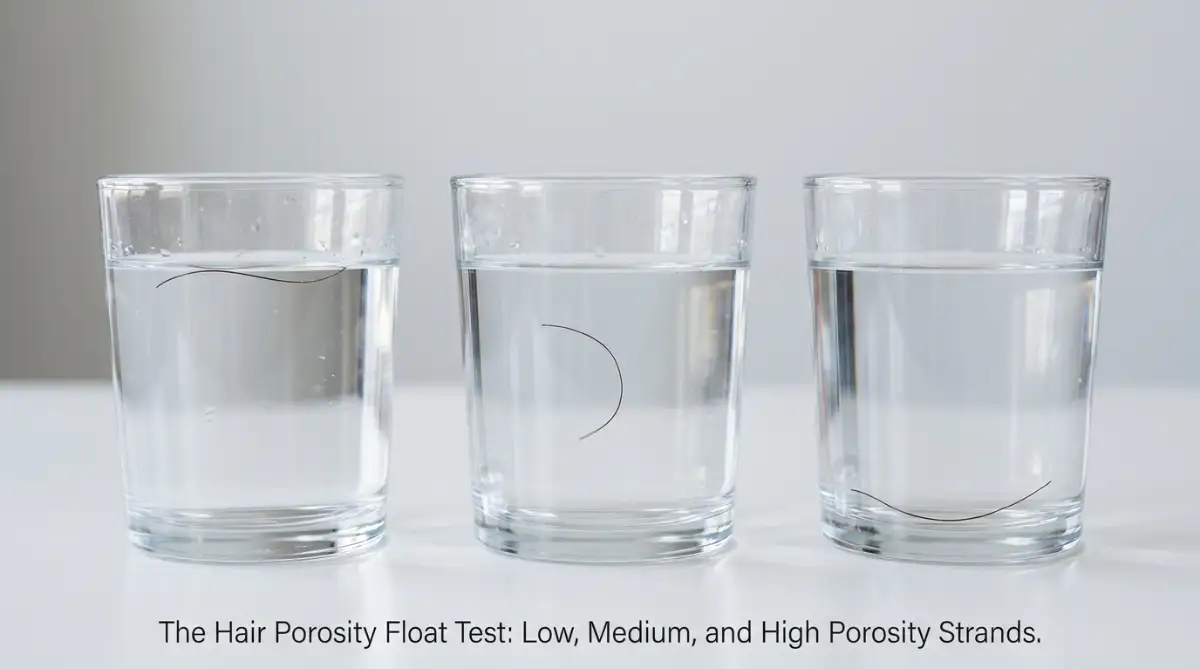
The Water Float Test
This is the most popular test used by hair professionals. It gives a quick visual representation of how your hair reacts to moisture.
To begin, wash your hair thoroughly with a simple clarifying shampoo. Do not apply any conditioners, leave-in creams, or styling oils afterward.
Let your hair air-dry completely. Take a single clean strand of hair and gently drop it into a clear glass of room-temperature water.
Watch the glass closely for about five minutes.
- Low Porosity: The strand will float on the surface of the water without sinking.
- Medium Porosity: The strand will slowly drift down and hover in the middle of the glass.
- High Porosity: The strand will sink to the bottom of the glass almost immediately.
The Spray Bottle Test
If you want to double-check your results, you can try the spray bottle test. This test looks at how water droplets behave on the surface of your hair.
Mist a small section of dry, clean hair with a spray bottle filled with water. Watch how the water drops sit on your hair.
- Low Porosity: You will see tiny water droplets beads sitting on top of your hair strand without soaking in.
- Medium Porosity: The water will bead for a second and then soak smoothly into the hair.
- High Porosity: The hair will drink up the water instantly like a dry sponge.
Caring for Low Porosity Hair
Low porosity hair has cuticles that are tightly bound together. Because of this structure, getting moisture into the hair shaft is your biggest challenge.
If you have this hair type, you might notice that water rolls right off your hair when you step into the shower. It takes a long time for your hair to get fully wet.
Once you do get moisture inside, however, your hair holds onto it for a long time.
Light Products are Your Best Friend
Heavy creams, thick oils, and heavy butter will only sit on top of your hair. This leads to a greasy look and feel, also known as product buildup.
Instead, look for lightweight formulas. Water-based leave-in conditioners, milks, and light oils like jojoba or almond oil work best.
Use Heat to Your Advantage
Because your cuticles are tightly closed, you need a way to open them up gently. Warm water is a simple and effective tool for this.
Always wash your hair with warm water to help lift the cuticles.
When applying a deep conditioner, use a warm shower cap or a steamer. The gentle warmth helps the treatment slide past the tight cuticles and work its way deep into the hair shaft.
Want to see these home tests performed in real-time? Watch this simple demonstration to see exactly how different hair types react.
Caring for High Porosity Hair
High porosity hair is on the opposite end of the spectrum. The cuticles are raised, chipped, or damaged due to genetics, heat styling, or chemical treatments.
With this hair type, water easily enters the hair shaft, but it evaporates almost immediately. Your hair might dry incredibly fast after a shower, but it will quickly feel dry and frizzy again.
Lock in the Moisture
To keep your hair hydrated, you must seal the raised cuticles after moisturizing. This is where heavy products actually become useful.
Use thick creams, shea butter, and heavy oils like castor oil or olive oil. These products create a protective barrier over the damaged cuticles, trapping the moisture inside.
The Power of Protein Treatments
High porosity hair often has gaps in its cuticle structure. Mild protein treatments can help fill these microscopic gaps temporarily.
This strengthens the hair strand and reduces breakage. Try incorporating a gentle protein treatment into your routine once or twice a month.
Caring for Medium Porosity Hair
If your hair falls in the middle, you have medium or normal porosity. Your cuticles are balanced, allowing moisture to enter and stay inside without much effort.
Keep It Simple
You do not need to overthink your hair care routine. Your main goal is to maintain the natural balance your hair already has.
Use regular moisturizing conditioners and lightweight leave-in products. Avoid overusing heavy protein treatments or harsh chemicals that could damage your healthy cuticle structure.
Pro Tip: Clean Hair is the Secret to Accurate Testing
My Personal Realization:
When I first tried the water float test, my hair sank to the bottom of the glass immediately. I assumed I had high porosity hair and started buying heavy protein products. My hair quickly turned into a stiff, straw-like mess.
Later, I realized that my hair was actually low porosity, but it was coated in weeks of heavy product buildup. The weight of the old creams made the strand sink. Always wash your hair with a strong clarifying shampoo before testing to avoid this costly mistake.
Common Mistakes to Avoid When Testing Your Hair
It is easy to get confused when you are first learning about hair care. Here are a few common mistakes that can ruin your progress.
1. Testing Dirty Hair
As mentioned in the tip above, product buildup, natural scalp oils, and dirt will completely alter your test results. Always start with a clean slate.
2. Using Ice Cold Water
Cold water naturally causes hair cuticles to close up tightly. If you use cold water for your float test, even high porosity hair might float, leading to incorrect results. Use lukewarm or room-temperature water instead.
3. Forgetting the Role of Damage
Keep in mind that the ends of your hair are older and more damaged than the roots. Your roots might have low porosity, while your dry ends have high porosity. Test strands from different areas of your head to get an accurate overall picture.
Expert Tip: Listen to Your Hair Over Time
Your hair porosity is not always permanent. While genetics play a major role, your habits can change your cuticle health. Excessive heat styling, bleach, and harsh sun exposure can turn low porosity hair into high porosity hair over time. Pay close attention to how your hair behaves after washing and adjust your product choices accordingly.
Mastering the Hidden Settings of Your EV
You already know that slowing down and managing your cabin heater will save massive amounts of energy. Now, let us move to the advanced strategies that truly separate an average driver from a road trip expert. These small tweaks often go completely unnoticed, but they add up to give you huge gains on the highway.
The most ignored component of any electric vehicle is the rubber touching the road. Your tires play a massive role in how far you can drive. When your tires are under-inflated, they flatten out slightly at the bottom. This creates a larger surface area rubbing against the pavement, which is called rolling resistance.
Your car has to push much harder to overcome this sticky friction. Keeping your tires at the absolute perfect pressure is non-negotiable. According to the U.S. Department of Energy’s advanced vehicle testing data, under-inflated tires severely reduce overall efficiency. You are literally bleeding energy into the pavement.
Pro Tip: Check your tire pressure early in the morning when the rubber is completely cold. Hot air expands, so checking them after driving will give you a false reading. Adding just one extra PSI above the recommended limit can harden the tire slightly and reduce friction, buying you free miles.
Next, you have to ruthlessly manage the weight and shape of your car. I completely understand wanting to bring everything on a family vacation, but roof boxes are an aerodynamic nightmare.
A sleek electric car is designed in a wind tunnel to slice through the air perfectly. When you bolt a big plastic storage box to the roof, you act like a parachute catching the wind. If you must carry extra gear, try using a hitch-mounted cargo carrier instead. It hides behind the car in a slipstream, doing far less damage to your aerodynamics.
If you want to ensure the long-term health of your vehicle, you should read about how to extend the battery life of an electric vehicle. Knowing how your battery degrades over time will help you plan your trips much better.
Quick Action Checklist
- Buy a high-quality digital tire pressure gauge and keep it in your glovebox.
- Remove unused roof racks, bike carriers, or cargo boxes before hitting the highway.
- Clean your car thoroughly; a smooth, waxed exterior actually glides through the air better.
- Check your navigation system for software updates to ensure the most accurate routing.
- Pack heavier luggage low in the trunk to keep the car's center of gravity stable.
Different accessories drain your power in very different ways. Look at this breakdown to see exactly where your energy disappears when you modify your vehicle's exterior.

Where Most Drivers Lose Their Battery Power
We all make mistakes when we are learning something new. Driving a battery-powered car requires a completely different mindset compared to a traditional gas vehicle. The biggest errors usually happen when people try to apply old habits to new technology.
One major pitfall is waiting until the battery is nearly empty before looking for a fast-charging station. In a gas car, running until the low fuel light comes on is normal. In an electric vehicle, this is a dangerous game. Fast chargers sometimes break down, or they might be occupied by other drivers.
If you pull into a station with only 2% power left and the machine is broken, you are completely stuck. You always want to arrive at a charging stop with at least a 15% buffer. This gives you enough juice to comfortably drive to a backup location if needed.
Common Mistakes
- Not using battery pre-conditioning before fast charging: Your car needs to warm up the battery cells before you plug into a high-speed charger to accept the maximum flow of electricity.
- Charging all the way to 100% on a road trip: The last 20% of a battery charges incredibly slowly. You waste hours sitting there. Charge to 80% and keep moving.
- Ignoring the weather forecast: Extreme rain or snow forces the tires to push heavy water out of the way, which drains power extremely fast.
- Blasting the heat on short trips: Turning the cabin heater on full blast for a 10-minute drive wastes energy before the car even gets fully warm.
Another massive mistake happens right in the driveway. People often forget how to set up your electric vehicle home charger step-by-step to maximize overnight efficiency. If you leave your car sitting outside in freezing temperatures unplugged, the battery will literally lose power just trying to keep itself from freezing solid.
You have to be very careful in cold weather. Learning how to safely charge your electric car in freezing temperatures is an absolute must if you live in a snowy area. The cold slows down the chemical reactions inside the battery, which naturally limits your total driving distance.
Always look closely at how weather and charging habits interact.
Making smart choices on the road also applies to your general lifestyle. Just like planning a route saves your battery, having a solid plan for your personal finances and smart budgeting gives you peace of mind in every aspect of life. Both require thinking ahead and avoiding unnecessary waste.
Your Next Confident Road Trip Starts Today
You now have the exact blueprint to handle any long-distance journey. By preparing your battery at home, managing your highway speeds, and keeping your tires properly inflated, you take complete control of the road.
Range anxiety only happens when you do not know what to expect. Once you understand the science of aerodynamics and regenerative braking, the fear completely vanishes. You become a smarter, more efficient driver who knows exactly how to manipulate the vehicle for maximum performance.
I remember the first time I confidently drove past a charging station because I knew exactly how much power I had saved. My family was comfortable, the car was gliding perfectly, and I felt like I had completely mastered the technology. It was an incredibly empowering feeling.
You are going to experience that exact same freedom on your next trip. Use these strategies, trust your dashboard navigation, and enjoy the quiet, smooth ride that only electric power can provide.
Which destination are you planning for your next long electric road trip? Let me know in the comments below!
Answers to Your Biggest Range Anxiety Questions
Does using cruise control save battery?
Yes, using cruise control on flat highways keeps your speed perfectly steady. This prevents unnecessary bursts of acceleration, which drain your power very quickly.
Will driving at night increase my range?
Driving at night requires using headlights, but they use very little power. However, cooler night temperatures might require more cabin heating, which can actually decrease your total distance.
How much range do roof racks actually waste?
Even an empty roof rack disrupts smooth airflow. A large cargo box on the roof can reduce your total highway driving distance by up to 25 percent.
Is it better to charge to 100% before a road trip?
Yes, charge to 100% at home right before you leave. However, once you are on the road, only fast-charge up to 80% because the final 20% takes way too long and wastes your travel time.
Does a heavier car drain the battery faster?
Yes, extra weight forces the electric motors to work much harder. Removing heavy junk from your trunk will instantly improve your efficiency.
Can I draft behind trucks to save energy?
Driving behind a large semi-truck blocks the heavy wind resistance. Always maintain a very safe following distance, but yes, drafting safely will noticeably improve your battery performance.
Why does rain reduce my driving distance?
Your tires have to physically push standing water out of the way to grip the road. This creates heavy resistance, forcing the battery to use more energy to maintain speed.
Does playing the radio drain my battery?
The energy used by the stereo system or the dashboard screens is incredibly tiny. Listening to music will not have any noticeable impact on your total driving distance.
Will flat tires ruin my electric motors?
Under-inflated tires will not ruin the motors, but they create massive rolling resistance. This forces the motors to draw extra power, killing your efficiency.
Should I use Eco mode on the highway?
Eco mode is fantastic because it limits aggressive acceleration and manages the climate control to save energy. It is highly recommended for long highway stretches.
Trusted Legal Resources
- National Highway Traffic Safety Administration (NHTSA)
- U.S. Department of Energy - Fuel Economy
- Environmental Protection Agency (EPA) - Green Vehicles
- Argonne National Laboratory - Energy Storage
- Federal Highway Administration (FHWA)
- Insurance Institute for Highway Safety (IIHS)
Disclaimer: The information provided in this article is for general educational and informational purposes only and does not constitute professional automotive, financial, or legal advice. Driving conditions, weather, and vehicle specifications vary widely. Always consult your vehicle's official manufacturer manual and follow local traffic laws before attempting to modify your driving habits. The author and the FinanceInfoIn team assume no liability for any vehicle damage, range depletion, stranding, or safety hazards resulting from the use or misuse of this information.
About the Author
Reviewed by Mithun Halder (Personal Finance & SEO Expert) & The FinanceInfoIn Editorial Team
The FinanceInfoIn Editorial Team researches personal finance, investing, insurance, mortgages, cryptocurrency, and consumer financial topics. Every article is carefully reviewed to provide clear, practical, and trustworthy educational information based on credible sources and industry best practices.