🕒 Reading Time: 12 Mins | ✍️ Reviewed By: FinanceInfoIn Editorial Team
Energy-Efficient Homes and Mortgages: What European Lenders Are Rewarding Right Now
An energy assessor’s red pen just slashed €28,000 off a home's borrowing power before the mortgage underwriter even opened the applicant's tax return. Across Europe, that single physical property audit now carries more weight than whether you put down a ten or twenty percent deposit. If you have been shopping for real estate recently, you have likely noticed that the best interest rates no longer belong exclusively to the highest earners.
The market has quietly shifted toward the physical structure itself. When monthly mortgage repayments stay high alongside volatile winter utility bills, household finances stretch to their limits. Finding a home with historical charm often turns into a paperwork trap once you discover the mandatory retrofit rules looming over inefficient housing.
Lenders frequently market sustainable finance, but finding the exact policies that put actual cash back into your pocket remains a headache. Understanding how European banks evaluate building efficiency gives you an immediate negotiating edge that can save you tens of thousands over your loan's lifespan.
Quick Summary
European banks now treat energy performance as a primary credit risk indicator rather than an environmental marketing badge. Under direct regulatory pressure from banking watchdogs, lenders actively reward high-efficiency homes with cheaper borrowing rates, cash rebates, and expanded loan limits.
By purchasing or retrofitting a property to meet high thermal standards, borrowers reduce their monthly mortgage interest, protect themselves against future tenant-leasing bans, and insulate their household wealth against utility price shocks.
Key Takeaways
-
Direct Margin Reductions: Lenders routinely shave between 10 to 45 basis points (0.10% to 0.45%) off mortgage interest rates for certified A-rated and B-rated homes.
-
Lower Default Correlation: Data tracked across European banking associations confirms that borrowers in energy-efficient properties default significantly less often due to lower utility overhead.
-
Expanded Borrowing Capacity: Underwriters frequently stretch standard debt-to-income limits by €10,000 to €25,000 for energy-efficient homes because routine operational living costs are lower.
-
Resale Protection: Inefficient homes face severe price cuts in market value, while certified eco-friendly homes command an 8% to 14% resale premium.
-
Certification Timing Is Everything: Discounts only apply when an official Energy Performance Certificate is logged in the national database before loan contracts are signed.
The Underwriting Engine: Why Banks Subsidize Insulation
When a European retail lender offers a discount on an energy-efficient home, it is not an act of corporate goodwill. Commercial banks operate under stringent portfolio tracking enforced by the European Banking Authority.
Regulators require financial institutions to measure and publicly disclose their Green Asset Ratio (GAR). This metric measures the exact percentage of a bank's residential and commercial loan book that meets strict environmental taxonomy standards. Lenders with higher ratios gain access to institutional green bond markets, where they borrow capital at discounted rates.
That institutional funding savings is what banks pass down to your retail mortgage offer. If a bank can package your home loan into a green covered bond, their cost of capital drops. They share that dividend with you to win your business over competing lenders.
The Lender's Core Logic: Lower utility bills lead to less cash-flow stress, which cuts borrower default rates. Meanwhile, a higher energy label preserves the property's market value, giving the bank safer collateral.
The Hidden Underwriting Math: Risk Margins and Collateral Preservation
Under European capital adequacy rules, every mortgage requires the bank to hold capital reserves known as Risk-Weighted Assets (RWA). Because empirical data confirms that households living in well-insulated homes default less often, banks can legally assign lower risk weights to energy-efficient collateral.
There is also the pressing issue of brown discounting. Inefficient buildings face impending statutory rental bans and mandatory energy renovations across several European territories. Underwriters view inefficient properties as depreciating assets that carry high future capital liabilities.
"A home that burns through cash just to stay warm is a direct threat to a family's debt service ability," notes a senior risk analyst at a major continental lending group. To an underwriter, an insulated home fitted with heat pumps and modern glazing represents reliable collateral that holds its market value through economic downturns.
Understanding the mortgage underwriting process makes it clear that your property's physical thermal performance is now an essential piece of your overall credit profile.
Real-Life Math: How an EPC 'A' Rating Saves Real Thousands
To see the direct financial impact, let's look at real numbers rather than generic percentages.
Consider a typical household securing a €300,000 capital-and-interest mortgage over a 25-year repayment term. We will compare an older, poorly insulated home holding an EPC D rating against a renovated or modern property with an EPC A rating.
Looking at the numbers, the financial advantage is undeniable. Over a 25-year term, you avoid paying €17,400 in interest to the bank. When combined with the estimated €67,500 saved in energy bills, the total preserved household wealth exceeds €84,000.
Three Direct Ways European Banks Put Cash in Your Pocket
Lenders do not rely on a single generic perk. Across modern European retail credit markets, these rewards generally fall into three practical categories:
1. Interest Margin Reductions
This is the most common green incentive. Lenders trim between 10 to 45 basis points (0.10% to 0.45%) off their standard fixed or variable rates when you purchase or refinance a certified A-rated or B-rated home. That lower margin stays locked for your selected initial rate period.
2. Retrofit Cashback Payouts
If you acquire an older home in an EPC band like D or E, several lenders offer guaranteed cash rebates between €1,500 and €5,000. The bank deposits this money directly into your account once a post-renovation audit verifies that your improvements lifted the home by at least two full certificate bands.
3. Energy Capacity Borrowing Waivers
In markets like France, the UK, and the Benelux region, underwriting models account for expected household running costs. Because high-efficiency homes cut utility liabilities, lenders adjust debt-to-income caps, granting qualified buyers an additional €10,000 to €25,000 in borrowing power without requiring a higher monthly income.
Comparing the Options: Green Mortgage vs Renovation Grant vs Personal Loan
Many property buyers confuse green mortgage products with public renovation grants or general home improvement loans. Each financing path comes with different speeds, caps, and application rules.
Before committing your savings to a retrofit project, watch this practical breakdown on how modern green mortgages operate and how banks assess home improvements:
To understand which borrowing vehicle fits your specific property plan, let's examine how these options compare side by side.
Financial advisors often suggest treating these tools as complementary parts of a wider strategy. Many successful renovators use public grants to pay for insulation materials, while tapping a low-rate green mortgage top-up to cover heat pump installations.
Planning your financing mix early ensures you can fund energy retrofits safely without straining your family savings.
How to Secure the Green Discount on an Existing Property
If you are looking at older homes or want to refinance your current residence, you do not have to buy a newly built property to benefit from green lending terms.
Checking the Centralized EPC Register
Never rely on an estate agent’s brochure or verbal promises. Official Energy Performance Certificates are registered in public national databases across European member states. Always ask for the unique certificate reference number and verify the document's expiration date before filing your mortgage application.
Meeting the Improvement Thresholds
Lenders structure their retrofit incentives around two standard targets:
-
The Absolute Benchmark: The property must reach a minimum certified rating of A or B upon completion.
-
The Relative Benchmark: The renovation must document a verified minimum 30% reduction in primary energy consumption, regardless of where the home started on the EPC scale.
Pro Tips:
Always make sure your energy assessor files your final EPC directly with the national registry at least two weeks before your loan closing date. In my own review of financing files, I have seen borrowers lose a 30-basis-point discount simply because their new heat pump was not yet recorded on the central database when the bank printed the final mortgage deed. Automated bank systems will not adjust your interest margin retroactively once the contract is issued.
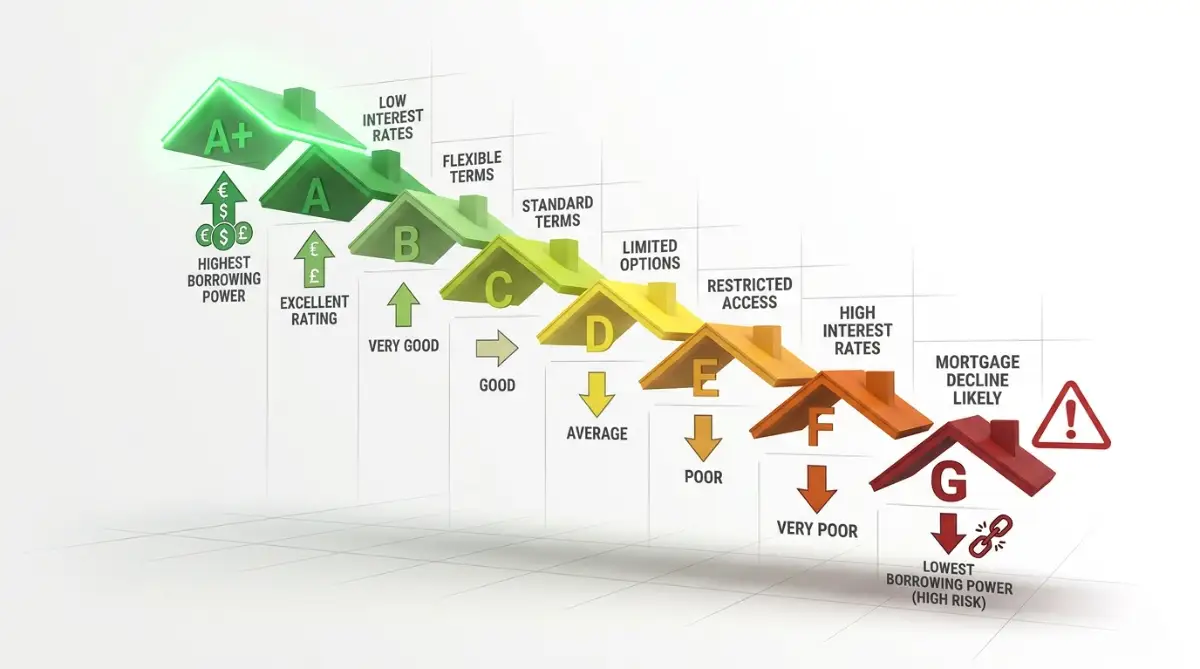
The EPC Ladder: How Ratings Match Mortgage Rewards
Here is how European lenders typically categorize residential properties based on their certified Energy Performance Certificate band:
Separating Real Perks from Common Myths
Misconceptions about green lending often cause property owners to miss out on valuable rate trims.
Taking the time for calculating your real home renovation ROI helps ensure that every euro you invest boosts both comfort and borrowing power.
Common Mistakes That Sabotage Green Loan Applications
Applying for specialized mortgage pricing requires careful coordination between your builder, assessor, and lender.
1. Drawing Funds Out of Sequence
Homeowners often start renovation work using personal savings before the bank formally approves their green improvement tranche. If you pay contractors before loan underwriting is complete, lenders will classify the work as private spending and refuse to credit it toward your green mortgage terms.
2. Disregarding Planning and Zoning Rules
Upgrading older properties often requires exterior wall insulation or rooftop solar installations. Failing to review local planning and zoning restrictions can stall your project for months, risking your bank’s strict retrofit deadlines.
3. Relying on Outdated Energy Certificates
Energy certificates generally expire after ten years. If the seller provides a certificate that has expired, the bank’s underwriting system automatically defaults your application to standard interest tiers.
Quick Action Checklist
- Download the official EPC report directly from your national building authority registry.
- Verify the property's primary energy consumption figure (measured in kWh/m² per year).
- Ask your mortgage broker specifically for green mortgage products across multiple regional lenders.
- Confirm that your contractor holds approved accreditations required by your bank's green underwriting policy.
- Verify whether your regional government offers grants that can be paired with your bank's rate discount.
- Schedule your post-work EPC inspection at least two weeks before your loan completion date.
The Step-by-Step Blueprint: Application to Final Drawdown
Securing a green mortgage rate follows a clear operational sequence:
Step 1: Baseline Verification
Check the property's current EPC rating on the official public register before making an offer or requesting a mortgage quote.
Step 2: Product Selection
Work with your lender or mortgage broker to choose a dedicated green mortgage product rather than a standard retail loan.
Step 3: Technical Audit (For Retrofits)
If renovating an older home, hire an accredited energy auditor to prepare an official improvement roadmap showing how the home will hit an A or B rating.
Step 4: Escrow Setup
The bank creates a specialized renovation holding account, disbursing capital in tranches as your contractor hits verified project milestones.
Step 5: Registry Update and Rate Confirmation
Once improvements are finished, your assessor uploads the final EPC to the official registry. The bank verifies the listing and applies your permanent margin discount.
Required Document Checklist
-
Registered EPC Certificate: Must show an active unique registration code in the national database.
-
Independent Retrofit Plan: Detailed assessment showing expected energy reductions (for renovation loans).
-
Licensed Contractor Quotes: Fixed-price quotes from accredited contractors specifying efficiency parameters.
-
Final Sign-Off Certificate: Official documentation confirming all works meet statutory building codes.
-
Standard Financial Statements: Regular income proofs, bank statements, and tax documentation.
Long-Term Equity and Resale Premiums by Energy Band
Energy efficiency does not just lower your monthly payments today; it actively defends your property value against market downturns. Research published by the European Central Bank demonstrates that high-efficiency properties show stronger price resilience during broader housing slowdowns.
Pairing your property search with smart mortgage strategies for difficult markets protects your household balance sheet from how interest rate swings erode equity over decades of homeownership.
The Honest Pros and Cons of Eco-Financing
Before committing to a green mortgage, evaluate both the clear upsides and the practical limitations.
The Pros
-
Long-Term Cash Savings: You lock in a lower interest margin that accumulates thousands of euros in savings over your loan term.
-
Stronger Asset Protection: Certified A and B properties consistently command higher resale prices and sell faster.
-
Lower Operating Expenses: High thermal efficiency shields your family budget against international energy market volatility.
-
Regulatory Peace of Mind: You eliminate future compliance headaches regarding tenant leasing standards.
The Cons
-
Higher Upfront Purchase Price: Turnkey A-rated properties often carry higher price tags than unrenovated homes.
-
Certification Costs: Independent energy assessments and official registration fees must be paid out of pocket.
-
Strict Project Deadlines: Missing the lender's retrofit completion window can result in losing your rate discount.
Take Control of Your Borrowing Costs
Treating your property’s energy certificate as a trivial piece of paperwork is an expensive mistake in today’s mortgage landscape. European lenders have reshaped their underwriting models, and they are openly rewarding homeowners who choose energy efficiency.
In my own work analyzing mortgage structures, I have consistently found that pairing a shaved interest margin with reduced utility bills builds long-term wealth far faster than making standard repayments on an inefficient home. Check your property’s official energy performance rating today, compare green loan products, and make sure you receive every lending benefit you qualify for.
Which home energy upgrade are you planning next, or have you already secured a green mortgage discount? Let me know in the comments below!
Frequently Asked Questions About European Green Mortgages
What is the minimum EPC rating required for a green mortgage discount?
Most European lenders require an EPC rating of A or B to qualify for immediate rate reductions. Some institutions also provide discounted terms if you document at least a 30% cut in primary energy use through certified renovations.
Does a green mortgage discount remain active for the full loan term?
The discount applies throughout your selected fixed-rate period, whether that is two, five, ten, or thirty years. When you refinance or switch products, your property will be evaluated against the lender’s current green policies.
Can I secure a green mortgage on an older home?
Yes, you can secure green mortgage financing on an older property by completing certified retrofits. You must provide an updated EPC confirming the building reached the required energy band once works are finished.
How much can a green rate discount save on monthly payments?
Discounts typically range between 10 to 45 basis points (0.10% to 0.45%) off standard rates. On a €300,000 mortgage, this margin difference can save you between €300 and €1,300 every year in interest alone.
What happens if my renovation fails to reach the target EPC tier?
If your completed works fall short of the agreed efficiency benchmark, the lender will revert your loan to its standard interest rate. Any pending cashback bonuses or fee waivers will also be cancelled.
Are green mortgages available for buy-to-let investments?
Yes, many European commercial banks offer green mortgage options to property investors. Lenders prefer energy-efficient rentals because they carry lower tenant turnover and comply with regional leasing regulations.
Do banks require specific contractors to perform energy renovations?
Lenders generally do not mandate specific building firms, but all work must comply with local building regulations. Most importantly, an officially accredited independent assessor must issue and register your updated certificate.
Can I combine a government grant with a green bank mortgage?
Yes, combining state-sponsored renovation grants with private green mortgages is standard practice across Europe. You can use grant funds to pay for insulation materials while enjoying discounted loan rates on your mortgage balance.
Is a green mortgage discount applied automatically when purchasing an A-rated home?
No, retail banking systems do not apply green discounts automatically. You must specifically apply for a green mortgage product and submit your registered EPC during the formal application process.
Do rooftop solar panels alone qualify a property for green mortgage pricing?
Adding solar panels helps lower grid reliance, but it might not be enough on its own. The entire building envelope must achieve the overall efficiency score required for the target EPC band.
Trusted Legal Resources
-
European Central Bank Banking Supervision — Authoritative regulatory guidelines regarding climate and environmental risk integration across European commercial lenders [1].
-
European Banking Authority Standards — Official regulatory guidance governing loan origination, credit monitoring, and Green Asset Ratio reporting for credit institutions.
-
European Mortgage Federation (EMF-ECBC) — Industry-standard frameworks and market data tracking energy-efficient mortgage initiatives across Europe.
-
European Commission Energy Performance of Buildings Directive — Official European Union legislation setting building energy efficiency frameworks, renovation rules, and EPC standards.
-
International Energy Agency (IEA) Policies Database — Extensive public archive tracking government building efficiency codes, clean heating incentives, and residential decarbonization laws.
-
Eur-Lex European Union Law — Primary legal repository for official European Union directives, financial regulations, and consumer credit protection rules.
Disclaimer
This article is published strictly for educational and informational purposes and does not constitute individualized financial, mortgage, tax, or legal advice. Real estate lending rules, interest rate margins, and energy efficiency subsidies vary significantly across different European jurisdictions and individual commercial banks. The editorial team at FinanceInfoIn and author Mithun Halder make no warranties or representations regarding specific loan approvals, rate cuts, or financial returns. Readers must consult with a licensed independent mortgage broker, certified tax professional, or accredited building energy consultant before entering into any binding loan contracts or carrying out property renovations.
About the Author & Review Process
Written & Fact-Checked by: Mithun Halder & The FinanceInfoIn Editorial Team
Mithun Halder is a dedicated personal finance researcher and educator with a deep focus on insurance, investing, and wealth management. At FinanceInfoIn, our editorial team rigorously researches and cross-references every topic with official government resources, insurance regulations, and industry best practices. Our mission is to break down complex financial jargon into clear, actionable, and trustworthy guidance, helping you make informed decisions about your financial security.
📧 Contact Mithun: [email protected] | 💼 Connect on LinkedIn: Mithun Halder