
Reading Time: 10 Minutes
Difficulty Level: Beginner to Intermediate
Reviewed By: FinanceInfoIn Editorial Team
Table of Contents
- Quick Summary
- Key Takeaways
- The Quiet Drain on Your Daily Budget
- The Illusion of Affordability at the Checkout Counter
- Chasing Rewards Points Blindly
- Losing Your Interest-Free Grace Period
- Treating Credit Limits Like Personal Cash
- Storing Your Card Information on Every App
- Ignoring the Impact on Your Credit Utilization
- How to Fix Your Daily Spending Habits Today
Quick Summary
Using a credit card for everyday items like groceries, coffee, and gas seems harmless and convenient. However, without strict discipline, these small swipes can easily snowball into overwhelming revolving debt. This guide breaks down the most common traps associated with daily credit spending. You will learn exactly how to protect your income from unnecessary interest charges while still managing your daily needs.
Key Takeaways
- Paying for daily consumables with credit is dangerous if you do not pay the statement balance in full every month.
- Chasing cash-back rewards on everyday items often leads to overspending that wipes out the value of the rewards.
- Carrying a balance causes you to lose your grace period, meaning you pay interest on your morning coffee the moment you buy it.
- High daily spending can negatively impact your credit score by artificially inflating your credit utilization ratio.
The Quiet Drain on Your Daily Budget
I remember staring at the card terminal at my local grocery store, holding up a line of four frustrated people. The screen had just blinked "Insufficient Funds" on my debit card. I panicked, quickly pulled out my credit card, and swiped it for a $42 grocery run.
It felt like an easy, harmless fix at the time. What I did not realize was that treating my credit card like a backup checking account for everyday items was secretly destroying my budget. I ended up paying interest on that milk and bread for several months because I only made the minimum payments.
That specific moment forced me to take a hard look at how I was managing my daily expenses. Millions of people fall into this exact same trap every single day. We swipe for a quick lunch, a subscription, or a tank of gas without thinking twice.
But when the bill arrives, the reality of those small, combined purchases hits hard. Managing credit requires a completely different mindset than managing cash. Let us look at exactly why everyday plastic usage can go so wrong and how you can stop the bleeding.
The Illusion of Affordability at the Checkout Counter
The biggest danger of using a credit card for daily purchases is the emotional disconnect it creates. When you hand over a $20 bill for a sandwich, your brain registers the loss of that physical money. When you simply tap a piece of plastic or your smartphone, that psychological friction disappears completely.
This lack of friction makes everything feel instantly affordable. You stop looking at the price tags on groceries. You start adding extra items to your online shopping cart simply because you do not have to pay for it today.
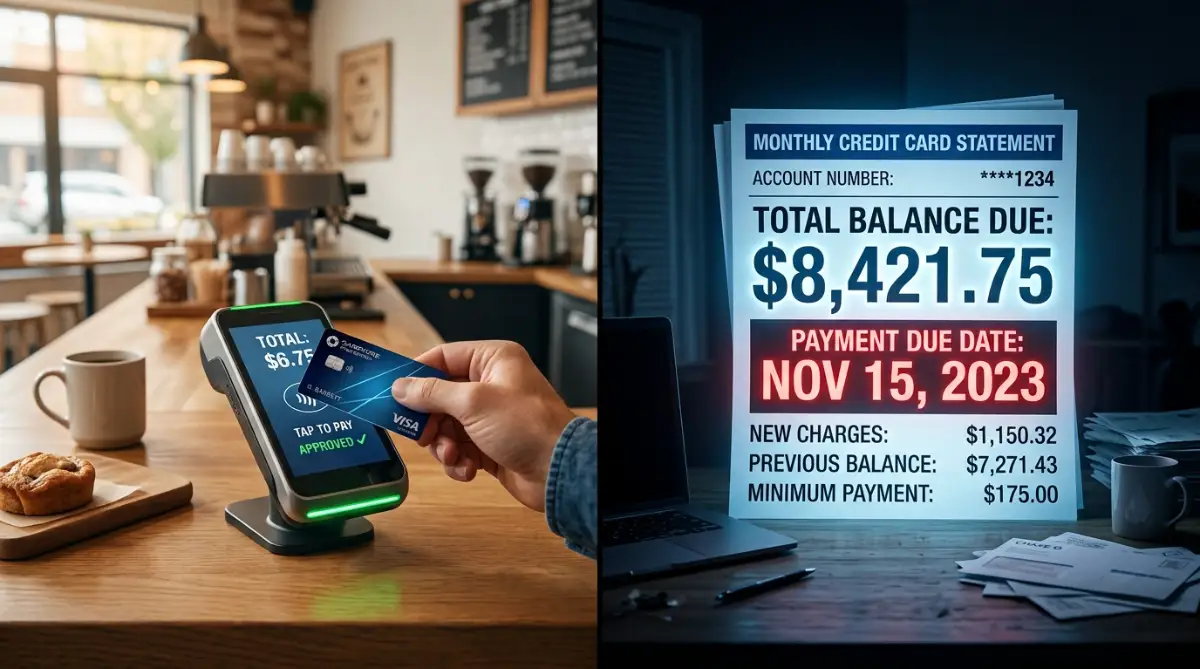
Over time, this behavior leads to a massive inflation of your lifestyle. You might think you are just buying everyday necessities, but you are actually spending 15% to 20% more than you would with cash.
A Real-Life Everyday Math Scenario
Let us look at David, a regular office worker who decides to use his credit card for his daily routine to "build credit." Every workday, David buys a $5 coffee and a $15 lunch using his card. That equals $20 a day, or roughly $400 a month just on workdays.
If David hits a tight month and can only afford to make a $40 minimum payment, the remaining $360 starts gathering an Annual Percentage Rate (APR) of 22%. By the next month, he is paying interest on a sandwich he already ate four weeks ago.
As you can see in the table, David is paying nearly $90 extra just in interest for his basic daily food intake. This is how small daily transactions quietly drain your future wealth.
Chasing Rewards Points Blindly
Credit card companies are incredibly smart marketers. They heavily promote cash-back and travel points for money spent on groceries, gas, and dining out. This sounds like an amazing deal on the surface.
The mistake happens when people start buying things they do not need just to earn a few extra points. You might find yourself upgrading your daily coffee size or buying premium groceries just to hit a spending bonus.
The math on rewards programs is very strict. Most cash-back cards offer between 1% and 3% back on daily purchases. However, the average credit card interest rate is well over 20%.
If you carry a balance from month to month, the interest you pay completely destroys any points you earned. You are essentially spending $1 in interest to earn 3 cents in rewards.
Honest Pros & Cons: Using Credit for Daily Rewards
- The Pros:
- You can earn 1% to 3% cash back on money you were going to spend anyway.
- It provides excellent fraud protection for daily transactions compared to debit cards.
- Consistent, responsible use helps build a strong credit history.
- The Cons:
- It strongly encourages unnecessary impulse buying to maximize points.
- Carrying a balance instantly cancels out the financial value of any rewards earned.
- It can make budgeting much more complicated at the end of the month.
Expert Tip: Treat your credit card rewards as a fun bonus, never as a primary income strategy. I used to justify expensive daily lunches by telling myself I was earning double dining points, which completely derailed my monthly food budget.
Losing Your Interest-Free Grace Period
One of the most misunderstood concepts in personal finance is the credit card grace period. A grace period is the time between the end of your billing cycle and your payment due date.
During this time, if you pay your full statement balance, you will not be charged any interest on those daily purchases. This is how financially savvy people use credit cards for free.
However, the moment you fail to pay the statement balance in full, you completely lose that grace period. This is where daily spending becomes extremely toxic.
Once the grace period is gone, every new daily purchase starts accumulating interest the exact second you swipe the card. There is no waiting until the end of the month. If you buy a gallon of milk on Tuesday, you start paying interest on that milk on Wednesday.
Understanding the True Difference
Many people confuse how credit tools work for everyday expenses. Using the wrong card for daily spending can lead to disaster. Let us clarify the difference.
To get your grace period back, you usually have to pay off your entire balance and keep it at zero for one to two full billing cycles. Until then, you should stop putting daily expenses on that specific card.
Treating Credit Limits Like Personal Cash
A massive mistake people make is looking at their credit limit and seeing it as available spending money. If you have $500 in your checking account but a $5,000 credit limit, it is easy to feel wealthy.
This false sense of security leads to careless daily spending. You might opt for the premium gas for your car, buy the more expensive brand of paper towels, or treat your coworkers to coffee.
Your credit limit is not a reflection of your income. It is simply the maximum amount of rope the bank is willing to give you. Treating borrowed money like your own cash is a guaranteed path to financial stress.
Every dollar you put on that card for today's convenience is a dollar you are stealing from your future paycheck.
Are you ready to stop letting credit card debt control your daily life? Watch this short guide to reframe your mindset.
Storing Your Card Information on Every App
We live in a world of maximum convenience. Food delivery apps, ride-sharing services, and online retailers all ask to save your credit card information for "faster checkout."
Agreeing to this is a massive mistake for your daily budget. When your card is stored on an app, spending money requires zero physical effort. You do not even have to get up off the couch to find your wallet.
This leads to passive daily spending. You might order takeout three times a week simply because it only takes two taps on your screen. You might pay for auto-renewing subscriptions that you do not even use anymore.
If you want to stop making daily credit mistakes, delete your saved cards from every single app. Force yourself to manually type in the card number every time you want to buy something. That 60 seconds of effort is often enough time for your logical brain to talk you out of a bad purchase.
Ignoring the Impact on Your Credit Utilization
Even if you pay your balance in full every month, putting all your daily expenses on a credit card can still hurt you. This is due to a metric called your credit utilization ratio.
Your utilization ratio is the amount of credit you are currently using compared to your total credit limit. Financial experts highly recommend keeping this number below 30%.
If you have a credit card with a $1,000 limit, and you put $600 worth of groceries, gas, and daily bills on it throughout the month, your utilization is at 60%.
Expert Tip: Credit card companies report your balance to the credit bureaus on a specific day of the month, usually the statement closing date. If they report that 60% utilization, your credit score will drop, even if you plan to pay it off completely a week later.
If you are going to use a card for daily expenses, you must pay attention to when your statement closes. Consider making weekly payments to keep the reported balance low.
How to Fix Your Daily Spending Habits Today
If you realize you have been making these mistakes, do not panic. You can change your trajectory starting right now.
First, take the credit card out of your wallet and leave it at home. Switch back to a debit card or physical cash for all your daily purchases like food and gas. This will immediately reconnect your brain to the reality of your spending.
Second, sit down and review your last two months of credit card statements. Highlight every single purchase under $20. You will be shocked at how quickly those small, daily swipes add up to hundreds of dollars.
Finally, stop chasing rewards until you are completely debt-free. Points and miles are only beneficial for people who never pay a single cent in interest. Until you reach that level of financial discipline, your primary goal must be protecting your cash flow from high-interest rates.
Advanced Strategies to Master Everyday Credit Use
Let us talk about fixing the root cause of the problem. Many people try to rely on willpower to stop swiping their cards. Willpower eventually runs out. You need a rock-solid system that protects your money automatically.
I used to manually check my accounts every Friday, but I always forgot when life got busy. Once I set up automated alerts and removed my saved data from my phone, my daily spending dropped immediately. It is much easier to manage a personal budget when living paycheck to paycheck if you let the bank software do the heavy lifting for you.
You have to create friction. Friction is the small amount of effort it takes to complete a purchase. When you increase the friction, your brain has time to process whether you actually need the item.
The Exact Step-by-Step Execution Guide
You can regain control of your daily cash flow starting right now. Follow these exact steps to lock down your accounts and build better habits today.
Step 1: Log into your primary banking application on your smartphone and navigate directly to the security or alert settings menu.
Step 2: Set up a real-time text message alert for any transaction over $1. This forces you to acknowledge every single daily purchase instantly.
Step 3: Go into your smartphone’s main settings app and manually delete your credit card from Apple Pay, Google Wallet, or Samsung Pay.
Step 4: Update your recurring daily apps, like ride-sharing or food delivery, to pull money directly from your debit card instead of your credit limit.
Step 5: Physically remove the credit card from your wallet and lock it in a safe drawer at home before you leave for work.
Required Document and Preparation Checklist
Before you sit down to restructure your daily spending systems, gather these items on your desk so you do not get distracted:
- Your physical wallet with all active debit and credit cards.
- Your smartphone with your primary banking apps already installed.
- A notebook and pen to write down your current account balances.
- A list of all daily subscription apps currently active on your phone.
- Your most recent physical or digital statement to identify sneaky recurring charges.
Many people believe false information about how plastic money actually works. The internet is full of bad advice regarding daily habits. Let us clear up the confusion right now.
Pro Tip: If you ever notice a fraudulent daily charge at a local gas station, freeze your card immediately through your bank's mobile app. Knowing how to protect your personal bank account from online phishing scams and local card skimming devices will save you hours of terrible stress.
The Most Dangerous Daily Spending Traps
Breaking bad money habits is incredibly difficult. We often slide into these traps without even noticing because spending plastic feels so completely normal in our modern society. If you do not recognize these pitfalls, you will keep bleeding money every single month.
I once spent six months paying off a balance that was made up entirely of drive-thru coffee, fast food, and random convenience store snacks. It was a highly embarrassing wake-up call. Understanding these psychological traps is the absolute only way to stop them permanently.
Common Mistakes to Avoid
Here are the specific areas where people lose the most money on daily transactions:
- Buying emotional comfort items, like expensive takeout, on credit after a long and stressful workday.
- Ignoring the weekly statement balance until the exact day the monthly bill is actually due.
- Assuming small $5 and $10 swipes do not matter in the grand scheme of your monthly finances.
- Using credit to cover basic utility bills without adjusting your core lifestyle expenses to match your actual income.
- Paying only the minimum amount due while continuing to make new daily purchases on the exact same card.
If you find yourself relying on borrowed money just to survive the week, you need a fundamentally different strategy. You should focus heavily on building an emergency fund when your income is small rather than trying to increase your credit limits.
Let us look at how different daily spending choices directly impact your financial future.
If you ever find yourself drowning in high interest rates due to these daily mistakes, you must take immediate action. Do not be afraid to pick up the phone and call your bank. Learning how to negotiate with credit card companies to lower your interest rate is a powerful skill that can instantly save you thousands of dollars.
Quick Action Checklist
- Delete all saved card data from your favorite food delivery apps tonight.
- Put your physical credit card in a drawer at home before leaving for work tomorrow morning.
- Log into your banking account and set up automatic full statement payments.
- Switch your morning coffee run to a strict cash-only transaction.
Frequently Asked Questions About Everyday Credit Spend
You probably still have a few specific questions about managing your daily money. I hear these exact concerns from readers every single day. Here are the most direct answers to help you move forward confidently.
Is it bad to use a credit card for every single purchase?
It is not inherently bad if you are incredibly disciplined with your budget. However, it is highly dangerous for most people because it completely removes the emotional pain of spending money.
Will my credit score drop if I stop using my card daily?
No, your score will not suddenly plummet just because you stop buying daily coffee. You only need to use the card occasionally, like buying one tank of gas a month, to keep the account highly active.
Why did the bank lower my limit after I paid it off?
Banks constantly monitor risk and changing economic conditions. Sometimes, understanding why your credit card application was denied or why a limit was lowered comes down to your debt-to-income ratio, not just your daily habits.
Do debit cards offer any rewards for daily spending?
Yes, some modern banks and fintech companies do offer cash-back debit cards. These allow you to earn small daily rewards without the terrifying risk of high-interest debt.
How long does it take to get my grace period back?
Usually, you need to pay your entire statement balance in full for two consecutive billing cycles. Always check your specific card agreement terms to be completely sure.
Should I put my daily bills on auto-pay with a credit card?
Only do this if you have the physical cash sitting in your checking account to pay the card off immediately. Otherwise, you are just financing your basic electricity and water at a 22% interest rate.
What exactly is the 30% utilization rule?
Financial experts heavily suggest you should never use more than 30% of your total available credit limit at one time. Going over this number, even just for daily groceries, can temporarily hurt your credit score.
Can a merchant charge me extra for using credit daily?
Yes, many small businesses now add a 2% to 3% surcharge at the register to cover their processing fees. Paying with cash or a debit card avoids this extra daily tax entirely.
How do I stop impulse buying with my card?
Create strict physical distance between you and the plastic card. If you have to walk to another room to get your wallet, your logical brain will likely talk you out of the impulse purchase.
What should I do if I am already overwhelmed by daily spending debt?
Stop using the card completely right now. Switch to a strict cash budget, cut up the physical plastic if you have to, and focus every spare dollar on paying down the principal balance.
Trusted Legal Resources
For independent consumer protection guides and financial rights information, please review these official platforms:
- Consumer Financial Protection Bureau (CFPB)
- Federal Trade Commission (FTC) Consumer Advice
- Office of the Comptroller of the Currency (OCC)
- National Foundation for Credit Counseling (NFCC)
- MyMoney Official Government Site
- FDIC Consumer Resource Center
Your Blueprint for Stress-Free Daily Spending
Managing your money should never feel like a daily punishment. It is simply a helpful tool to build the peaceful life you actually want to live. By stepping away from the daily plastic habit, you are actively taking back control of your hard-earned paycheck.
Remember that building real wealth is about making small, highly intentional choices every single day. You do not have to be perfect from day one, you just need to be fully aware of where your money is actually going.