

Reading Time: 15 Minutes
Difficulty Level: Beginner to Intermediate
Reviewed By: FinanceInfoIn Editorial Team
The Cost of Unverified Dreams
I can still feel the exact sinking sensation in my stomach as I stared at the towering stack of brown cardboard boxes in my tiny living room. Inside those boxes were 500 custom-made, premium fitness planners. I had drained my savings account to get the best price per unit.
I was absolutely convinced people would love them. My friends said it was a genius idea, and my family told me I was going to be rich.
But when the website finally went live, the result was complete silence. I refreshed the page for days, but the only person who bought a planner was my own mother.
That failure cost me everything I had saved up, but it taught me the most expensive lesson of my life. I had built a product based on my own assumptions instead of real proof. I fell in love with my solution without ever asking if the market actually had a problem to solve.
Every single day, passionate entrepreneurs make this exact same mistake. They secretly build their product in the dark for months. They spend huge amounts of money on logos, inventory, and legal fees before getting a single paying customer.
When the business eventually fails, it destroys their confidence and drains their bank accounts. It creates massive stress that spills over into their family life and daily mental peace.
You do not have to gamble your life savings on a hunch. There is a scientific, completely practical way to know if people will buy your product before you actually build it.

Quick Summary
Testing customer demand, known as market validation, is the process of confirming people will actually pay for your idea before you spend money creating it. Instead of relying on surveys or family opinions, you use small, low-cost experiments like landing pages and pre-sales to measure true buying intent. This approach saves thousands of dollars, prevents emotional burnout, and guarantees you only build products that the market actively wants.
Key Takeaways
- Never trust opinions from friends and family; they will lie to protect your feelings.
- The only true validation of a business idea is a financial transaction or a significant time commitment from a stranger.
- You can test demand for almost any product using a simple landing page and $50 in advertising.
- Validating an idea first saves you from the financial ruin of buying unsold inventory.
- Failing a market validation test is actually a huge success because it saves your money and time.
Why We Lie to Ourselves About Our Business Ideas
When you get a sudden burst of inspiration for a new business, your brain immediately starts playing tricks on you. You start noticing your specific problem everywhere, assuming the whole world is struggling with the exact same thing. This is called confirmation bias, and it is a silent killer of new startups.
You begin to imagine the end result—the success, the sales, the freedom. Because the fantasy feels so good, you skip the hard work of verifying the foundation.
We convince ourselves that if the product is just high quality enough, people will naturally figure out they need it. We think, "If I build it, they will come." This is almost never true in the real world.
The Danger of Asking the Wrong Questions
The first thing most people do when they have an idea is ask people they know. You might text your best friend and say, "Hey, would you buy a monthly subscription box for premium dog treats?"
Of course, your friend says yes. They love you, and they want to support your dreams. Even strangers in Facebook groups will say "Great idea!" because typing a supportive comment costs them absolutely nothing.
Opinions are free, but actual products cost money. You cannot build a sustainable business on compliments and hypothetical promises.
The David and Sarah Scenario: A Real-Life Math Example
Let's look at a practical example of how much guessing can truly cost you. David and Sarah both want to start a premium meal-prep delivery service in their local city.
David decides to jump right in because his friends told him the food was great. He signs a six-month lease for a commercial kitchen at $1,500 per month. He spends $3,000 on branding, $2,000 on custom packaging, and $1,500 on initial food inventory.
Before taking a single order, David is already $15,500 in debt.
Sarah takes the validation route. She creates a simple menu on a free website builder. She posts in local community groups saying she is doing a "beta run" next week and can only take 10 orders.
She asks for a $50 upfront payment via a simple payment link. If she gets the 10 orders, she will buy the groceries and cook the food in her home kitchen.
If Sarah gets zero orders, she lost about three hours of her time and zero dollars. If David gets zero orders, he is facing potential bankruptcy. Sarah used math and real buyer intent to protect her downside.
Market Validation vs. Traditional Market Research
People often confuse these two concepts, but they serve entirely different purposes. Research helps you understand a market, while validation proves that you specifically can sell something to that market.
To make this completely clear, let us look at the distinct differences between the two approaches.
Step 1: Define Your Riskiest Assumption
Before you run any kind of test, you need to know exactly what you are testing. Every business idea is built on a pile of assumptions. Your job is to find the assumption that, if proven wrong, will instantly destroy the entire business.
For example, if you are building an app that helps people find local dog walkers, your riskiest assumption is not whether you can code the app. The riskiest assumption is whether pet owners will actually trust a stranger from the internet with their dog.
You do not need to test the color of your logo or the name of your company. You only need to test if the core problem is painful enough that people will actively seek a solution.
Step 2: The "Painted Door" Landing Page Strategy
You do not need a product to sell a product. This might sound completely backwards, but it is the secret weapon of smart entrepreneurs. You can use a strategy called the "Painted Door" test.
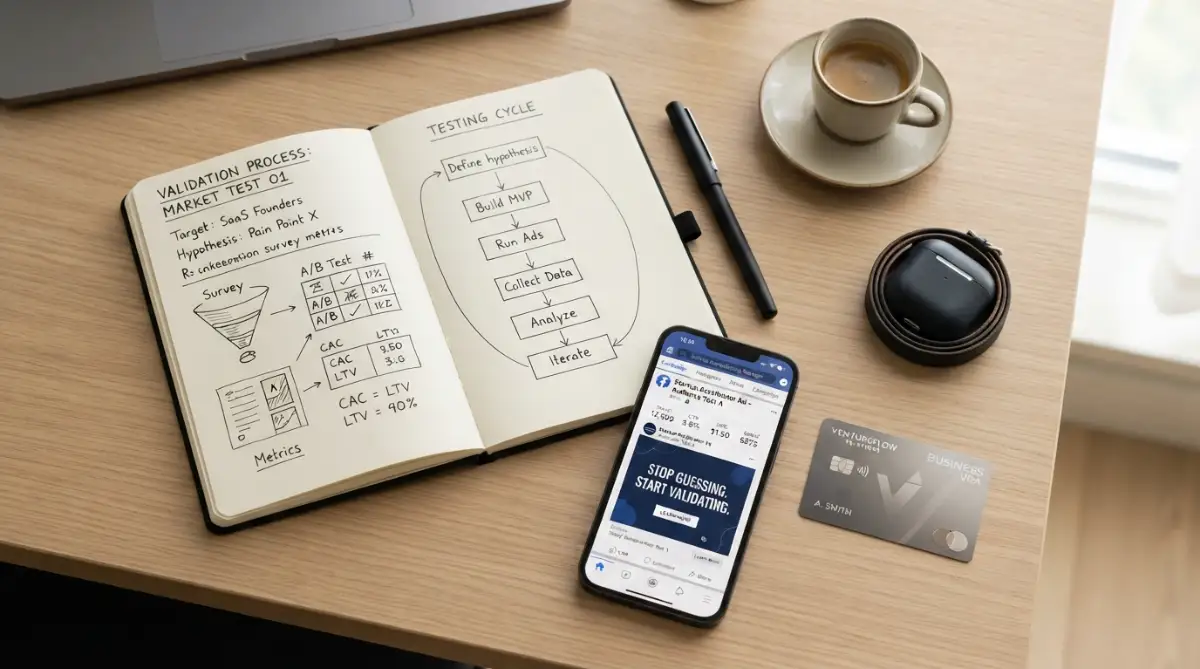
You build a simple, one-page website that describes your product as if it already exists today. You highlight the main benefits, show a mockup image, and clearly state the price.
At the bottom of the page, you place a bright button that says "Buy Now" or "Start Your Free Trial." When a customer clicks that button, a small popup appears. The popup honestly explains, "We are currently out of stock" or "We are launching soon, leave your email to get early access."
This method is incredibly powerful. You are not tracking how many people looked at your page. You are tracking how many people had enough desire to actually click the buy button.
Expert Tip: Always put a clear price on your Painted Door landing page. If you just ask for emails without showing a price, you are only measuring curiosity. If you show a price of $99 and they still click the purchase button, you have discovered true buyer intent.
Step 3: Run Highly Targeted Micro-Ads
Once your landing page is ready, you need to send strangers to it. You cannot rely on your personal social media accounts for this. You need cold traffic from people who do not know you.
Set up a very small advertising campaign on platforms like Facebook, Instagram, or Google. You only need to spend about $10 to $15 a day for less than a week.
Discovering Your Message Through Ads
Write three different ad variations targeting three different pain points.
- Ad 1 might focus on saving time.
- Ad 2 might focus on saving money.
- Ad 3 might focus on reducing stress.
Watch the data closely over the next few days. One of these ads will likely get significantly more clicks than the others.
You are now validating two things at once. You are proving that people want the product, and you are figuring out exactly which marketing message makes them click.
Step 4: The Concierge Minimum Viable Product (MVP)
Sometimes a landing page is not enough, and you need to prove you can deliver the service. This is where the Concierge MVP comes into play. You perform the service entirely manually, behind the scenes, making the customer think it is automated.
Imagine you want to build a complex software program that uses artificial intelligence to write personalized cover letters. Building that software might cost $20,000 and take six months.
Instead, you set up a website offering the service. When a customer pays $15, you personally sit down, read their resume, and type the cover letter yourself.
Why This Works Brilliantly
You do not need perfect technology to prove your business model works, you just need to solve the customer's problem manually first.
By doing the work manually, you get intimately close to the customer's actual problem. You learn exactly what they complain about, what words they use, and what features they actually care about.
If nobody is willing to pay you $15 for the manual version, they definitely will not pay for the automated software version later.
Honest Pros & Cons of Early Demand Testing
Testing your idea before diving in sounds perfect, but it does come with its own set of unique challenges. It is important to look at both sides of the coin so you can set realistic expectations.
The Pros:
- Saves you from wasting thousands of dollars on unproven ideas.
- Forces you to talk to real customers and understand their true pain points.
- Gives you absolute confidence to move forward if the test is successful.
- Helps you build an email list of eager buyers before you even launch.
The Cons:
- Requires you to face potential rejection very early in the process.
- Can be slightly frustrating to set up landing pages and ad campaigns if you are not tech-savvy.
- Requires a small initial budget (around $50 to $100) for running micro-ads.

How to Measure Real Buyer Intent (The Go/No-Go Decision)
Running the tests is only half the battle. You need to know how to interpret the numbers you get back. If you do not have strict goals before you start, you will twist the data to justify your original idea.
Before you launch your test, write down exactly what success looks like. Decide what conversion rate or how many emails will convince you to move forward.
Let us break down exactly what metrics you should be looking at to make your final decision.
If your numbers fall significantly below these targets, you have a decision to make. You can either change your marketing angle, adjust your pricing, or abandon the idea completely.
Abandoning an idea that fails validation is not a defeat. It is a massive victory.
Every failed test is a bad idea you successfully dodged. It frees up your time, energy, and capital to go find the idea that the market is actually begging you to create.
I learned my lesson the hard way with a garage full of unsold planners. You have the tools to be smarter. Start small, test cheaply, and let the customer's wallet make the final decision.
Advanced Strategies to Measure Real Buying Intent
Once you understand the basic mechanics of testing, it is time to look at the advanced tactics that separate successful founders from struggling ones. You need to move beyond simple page views and start measuring actual human behavior. A person clicking a link is interesting, but a person pulling out their wallet is proof.
To get this proof, you have to create a sense of urgency and scarcity in your testing phase. If people think they can buy your product anytime, they will delay their decision forever. You want to see if they are hungry for a solution right now.
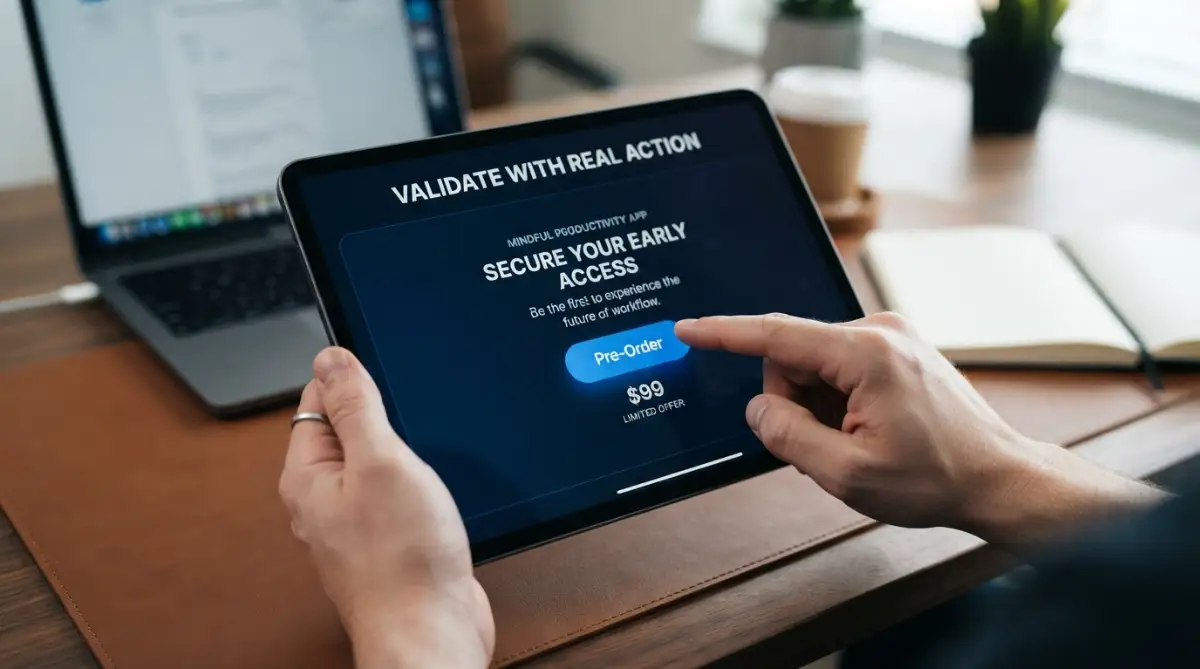
Pro Tip: One of the best ways to force an immediate decision is to offer a limited-time founding member discount. Tell your test audience that the first 50 people get a massive 50% discount for life. If they still will not pay at half price, the market demand simply does not exist.
Instead of looking at massive amounts of generic traffic, pay close attention to where your best clicks are coming from. You might find that Facebook ads fail, but answering questions in a specific Reddit community brings in highly motivated buyers. You want to double down on the platform that shows the highest intent to purchase.
If you plan on running a very lean operation, you might want to look into completely free ways to validate your startup before spending money on ads. The more you can test using sweat equity, the safer your initial investment will be.
Traffic Quality vs. True Validation
Not all feedback is created equal. You must learn to separate polite interest from raw, desperate demand. Let us look at how different actions carry completely different weights in the real world.
When you review your daily metrics, ignore the likes and focus entirely on the direct messages and the deposits. A tiny audience of eager buyers is infinitely better than a massive audience of casual window shoppers.
Where Most Entrepreneurs Crash and Burn
Testing a business idea requires a lot of emotional discipline. When you are deeply in love with an idea, your brain will naturally try to ignore any bad news. This emotional attachment leads to some of the most expensive mistakes a founder can make.
The most dangerous trap is what we call the "False Positive." This happens when you accidentally ask leading questions that force people to agree with you. If you ask, "Do you want to save time at work?", literally everyone will say yes.
This gives you a huge false sense of confidence. You will think you found a goldmine, but you actually just asked a meaningless question. Instead, ask them exactly how many hours they wasted on the problem last week.
Many new business owners also get obsessed with building features that nobody asked for. They delay their test by weeks because they want the landing page to look absolutely perfect. By the time they finally launch the test, they have already spent way too much money and energy.
The Ultimate Truth Check: Myth vs Reality
The internet is filled with terrible advice about how to start a business. Let us clear up the most common misunderstandings so you can avoid these financial traps.
If you ignore these realities, you will end up building something in complete isolation. As we know, why early cash flow problems destroy companies is often directly tied to building things without confirmed upfront demand.
Your Zero-to-One Execution Plan
You now understand the theory, but theory does not pay the bills. It is time to turn these concepts into a physical action plan that you can start on this weekend. This is exactly how you move from dreaming to doing without risking your entire savings account.
Here is your exact step-by-step roadmap to get your first test live in the next 48 hours.
Step 1: Write down the single biggest promise you are making.
If you are starting a cleaning business, your promise is not "we clean floors." Your promise is "you get your weekends back." Focus your message entirely on the emotional relief your customer will feel.
Step 2: Build a one-page checkout using a free tool.
You do not need a fancy developer. Use platforms like Stripe Payment Links or a basic Carrd website. The page only needs a strong headline, three bullet points explaining the benefit, and a button to buy.
Step 3: Setup a separate business checking account.
Do not mix your personal grocery money with your test money. Keeping things separate makes the math much clearer. If you are serious about setting things up right from day one, you should learn how to register your small business so you look professional to early customers.
Step 4: Launch a $10 per day digital experiment.
Go to Facebook or Google Ads and set a strict daily limit. Target a highly specific group of people. If you are selling dog treats, do not target "all dog owners." Target people who follow specific high-end dog training pages.
Required Preparation Checklist
Before you spend a single dollar on advertisements or domain names, make sure you have these items completely locked down. Missing even one of these can ruin your test results.
- A clear, one-sentence description of who your ideal buyer is.
- A defined "failure metric" (e.g., if I get zero sales in 7 days, I kill the idea).
- A simple way to instantly refund anyone who actually tries to buy your non-existent product.
- A clean, professional email address (not a generic Yahoo or AOL account).
- A dedicated notebook to write down every single piece of customer feedback you receive.
Structuring Your First Test Budget
You do not need a massive bank loan to figure out if an idea has legs. In fact, keeping the budget incredibly tight forces you to be more creative.
This small investment is an insurance policy against losing $20,000 later. For more context on building things without outside money, exploring starting a business without massive funding can give you a major advantage over competitors who rely on debt. It is always safer to rely on early sales rather than bank loans.
The Final Push: Let the Market Decide
I spent years of my life building things in secret because I was terrified of rejection. I thought if I just worked a little harder, the product would be so good that people could not say no. I was completely wrong, and it cost me thousands of dollars and countless sleepless nights.
When you shift your mindset from "guessing" to "testing," everything changes. Business stops feeling like a wild gamble and starts feeling like a predictable science experiment. You take the emotion out of the process and let the cold, hard numbers guide your path.
Do not let the fear of a failed test stop you from trying. A failed test is the greatest gift you can receive because it points you directly toward what actually works.
Quick Action Checklist
- Identify your core business assumption right now.
- Write a headline that solves a painful problem.
- Set up a one-page test site by tomorrow morning.
- Commit exactly $50 to driving initial traffic.
- Let the numbers make the final decision for you.
You have the blueprint, the tools, and the exact steps to protect your time and money. The only thing left is to actually put your idea out into the real world.
Which idea are you going to test this weekend? Let me know in the comments below!
Common Questions About Validating Ideas
How long should I run my validation test?
You should run your initial landing page and ad test for about five to seven days. This gives the advertising algorithms enough time to find your ideal audience without burning through too much cash.
What if people buy, but the product isn't ready?
If someone pays for a product that does not exist yet, immediately send them an honest email. Thank them, fully refund their money instantly, and tell them they will get the product for free when it officially launches.
Is it legal to sell something I haven't made yet?
Yes, as long as you are completely transparent or you immediately refund the money if you cannot deliver. Crowdfunding platforms operate entirely on this exact model of taking money before manufacturing begins.
Do I need an LLC before I run a landing page test?
For a simple five-day landing page test, you generally do not need formal incorporation. However, once you validate the demand and decide to actually build the business, you should set up the proper legal structure immediately.
Should I ask my friends to share my test page?
No, you should actively avoid showing your test to friends and family. You need cold, unbiased data from strangers to know if the market demand is actually real.
How much traffic do I need before making a decision?
Aim for at least 200 to 300 highly targeted visitors to your test page. If you get 300 visitors and zero email signups or zero clicks on the buy button, the idea likely needs major changes.
What if a competitor steals my idea while I am testing?
Execution is infinitely harder than having an idea. Your competitors are too busy struggling with their own daily operations to drop everything and steal a totally unproven concept.
Can I validate a physical product like clothing?
Absolutely. You can use cheap 3D mockup software to create highly realistic images of your clothing designs. Put those mockups on a simple pre-order page and see if anyone actually enters their credit card details.
What if my test fails completely?
Celebrate the failure because you just saved yourself months of wasted effort. Take the data you learned about why they did not buy, adjust your offer, and run a brand new test with a better angle.
Do I need a massive social media following to test an idea?
Not at all. In fact, starting from scratch with paid micro-ads is often better because the data is incredibly pure. A massive following can sometimes give you false positive data based on their loyalty to you personally.
Authoritative Market Validation & Research Resources
-
U.S. Small Business Administration (SBA) - Market Research Guidelines – Federal frameworks for evaluating consumer demographics and economic viability.