🕒 Reading Time: 13 Mins | ✍️ Reviewed By: FinanceInfoIn Editorial Team
1099 vs W-2: The Gig Economy Tax Shock Nobody Warns You About
A consulting contract worth $65,000 looks incredible on paper when you leave a standard $65,000 salary job. Then the first April tax deadline arrives, and the actual settlement on Form 1040 reveals an unexpected balance due of nearly $11,000.
No one stole the money, and the tax software didn't break. The brutal reality is that zero federal, state, or payroll taxes were deducted from those incoming client payments all year long.
A traditional corporate paycheck handles those obligations behind the scenes before direct deposit ever hits your checking account. When you step out as an independent contractor, you step directly into the crosshairs of the complete self-employment tax structure.
This specific moment ruins the financial stability of thousands of new freelancers, app-based couriers, and remote consultants every single season. You believe you earned a healthy living, yet your liquid cash balance tells an entirely different story.
The psychological toll of this surprise creates overwhelming anxiety. You watch your hard-earned emergency savings evaporate overnight just to keep the revenue authorities from freezing your business accounts.
When you budget your rent, groceries, and car payments around your gross revenue, finding out that nearly a third of that money belongs to the government feels like a punch in the gut.

Quick Summary
Working as an independent contractor on a 1099 form removes the safety net of automated workplace tax withholding. While a traditional W-2 employer quietly pays half of your mandatory Medicare and Social Security contributions, independent workers are legally obligated to cover the full 15.3% self-employment tax out of pocket.
Without proactive planning, quarterly payments, and clean accounting, this tax structure leads to severe penalties and devastating cash crunches. By understanding how the tax system operates behind the scenes, you can separate your funds, claim legitimate business deductions, and protect your hard-earned earnings.
Key Takeaways
-
The 15.3% Self-Employment Surcharge: Unlike W-2 employees whose employers cover half of FICA, 1099 contractors pay the entire 12.4% for Social Security and 2.9% for Medicare themselves.
-
The Take-Home Gap: A $75,000 independent contractor take-home pay is roughly $8,700 less than an identical $75,000 W-2 salary due to self-employment taxes and out-of-pocket health coverage.
-
The 30% Quarantine Rule: Automatically diverting 30% of every invoice into a separate tax reserve account prevents cash shortages at tax time.
-
Quarterly Deadlines Matter: The IRS enforces strict quarterly estimated tax payments (Form 1040-ES), charging compounding interest penalties to earners who wait until spring to pay.
-
Lender Underwriting Reality: Banks and mortgage underwriters evaluate your borrowing limits using your net Schedule C income, meaning aggressive tax write-offs can hurt your chances of qualifying for a home loan.
The Hidden Machinery Behind Your Paycheck
To understand why this financial shock happens, you have to look at how employment taxes are structured beneath the surface. When you work as an employee on a Form W-2, your employer acts as an administrative buffer between your labor and the government.
Federal law mandates the Federal Insurance Contributions Act (FICA), which funds Social Security and Medicare. The total levy stands at 15.3% of your earned income.
Here is the thing: as a W-2 worker, you never pay that full amount out of pocket. Your employer is legally required to pay half of that bill (7.65%), while the remaining 7.65% is split into micro-deductions across your regular paychecks.
When you transition to a 1099 independent contractor arrangement, that employer contribution disappears completely. By law, you are now classified as both the employee and the employer.
That means the entire 15.3% self-employment tax lands squarely on your shoulders. You pay the standard 12.4% for Social Security up to the statutory wage cap, plus 2.9% for Medicare, before you even begin calculating your regular federal and state income tax brackets.
Recent tracking by the Federal Reserve on household economic well-being reveals that nearly 40% of non-traditional workers struggle with unexpected tax burdens. Traditional payroll systems protect workers from their own behavioral blind spots by withholding funds automatically. In the gig economy, that guardrail is entirely removed.
The Cold, Hard Math: A Realistic Income Comparison
Let's look at why this happens in real-world dollar amounts rather than abstract percentages. Consider a professional earning an identical gross income of $75,000 under both classifications, assuming a single filer taking standard deductions.
For the W-2 employee, the payroll department automatically withholds $5,737.50 across the year for FICA. Their employer quietly writes a matching check to the government for that exact same amount out of corporate operating expenses.
Now, consider an independent consultant billing clients that same $75,000 on Form 1099-NEC. The entire gross amount arrives in their checking account without a dime taken out.
When calculating self-employment taxes on Schedule SE, the net taxable earnings figure comes out to $69,262.50 (92.35% of gross). Multiplying that by the full 15.3% yields an immediate self-employment tax bill of roughly $10,597.
That is an instant $4,859 cash penalty simply for working for yourself on an identical top-line salary. You haven't even paid your regular income tax yet.
Looking at the numbers, it seems obvious why so many new gig workers find themselves in panic mode. To match the actual take-home purchasing power of a $75,000 W-2 job, an independent contractor needs to bill roughly $92,000 to $95,000 to cover the extra tax weight and replace lost workplace benefits.
Evaluating the 1099 Trade-Off
Before deciding how to handle this structure, you have to weigh both sides of the coin. Independent contracting offers real perks, but it introduces real operational risks that W-2 jobs shield you from.
The Advantages (The Pros)
-
Uncapped Earning Potential: You can service multiple clients simultaneously without corporate non-compete limits.
-
Extensive Write-Off Capabilities: You can deduct legitimate business expenses, depreciation, and mileage directly against gross revenue on Schedule C.
-
Above-the-Line Health Insurance Deduction: Self-employed workers can write off 100% of their health and dental insurance premiums directly on Schedule 1 without itemizing.
-
Complete Schedule Autonomy: You decide when, where, and how your labor is deployed.
-
Qualified Business Income (QBI) Deduction: Eligible sole proprietors and LLC owners may deduct up to 20% of their qualified business income from federal income taxes under Section 199A.
The Disadvantages (The Cons)
-
Full Self-Employment Tax Liability: You are fully responsible for the entire 15.3% Social Security and Medicare allocation.
-
Zero Workplace Safety Nets: No paid time off, no subsidized group health coverage, and zero access to traditional state unemployment insurance.
-
Strict Compliance Deadlines: You face administrative penalties if you miss quarterly estimated tax submission windows.
-
Inconsistent Cash Inflows: Clients pay on their own schedules (Net-30 or Net-60), while tax deadlines remain rigid.
Practical Steps to Shield Your Cash Flow
Surviving and thriving in the gig economy comes down to building a disciplined financial firewall between your client invoices and your personal checking account.
Automate the 30% Quarantine Protocol
The biggest mistake new independent earners make is leaving gross client payouts sitting inside their primary operating account. When money sits in a checking account, your brain assumes it is available for spending.
Open a dedicated business savings account specifically labeled for tax reserves. Every single time an invoice is paid or an app deposit clears, immediately transfer 30% of that gross deposit into the reserve account.
Watch this comprehensive breakdown to see how top independent earners set up automated banking buckets to eliminate end-of-year tax stress.
If you net $5,000 in a month, move $1,500 into your tax reserve the exact same day. If that money never mingles with your day-to-day capital, you will never face a cash crunch when payment deadlines arrive.
Respect the Quarterly Estimated Calendar
The IRS operates on a pay-as-you-go principle. They do not want to wait until April to collect an entire year's worth of revenue from independent earners.
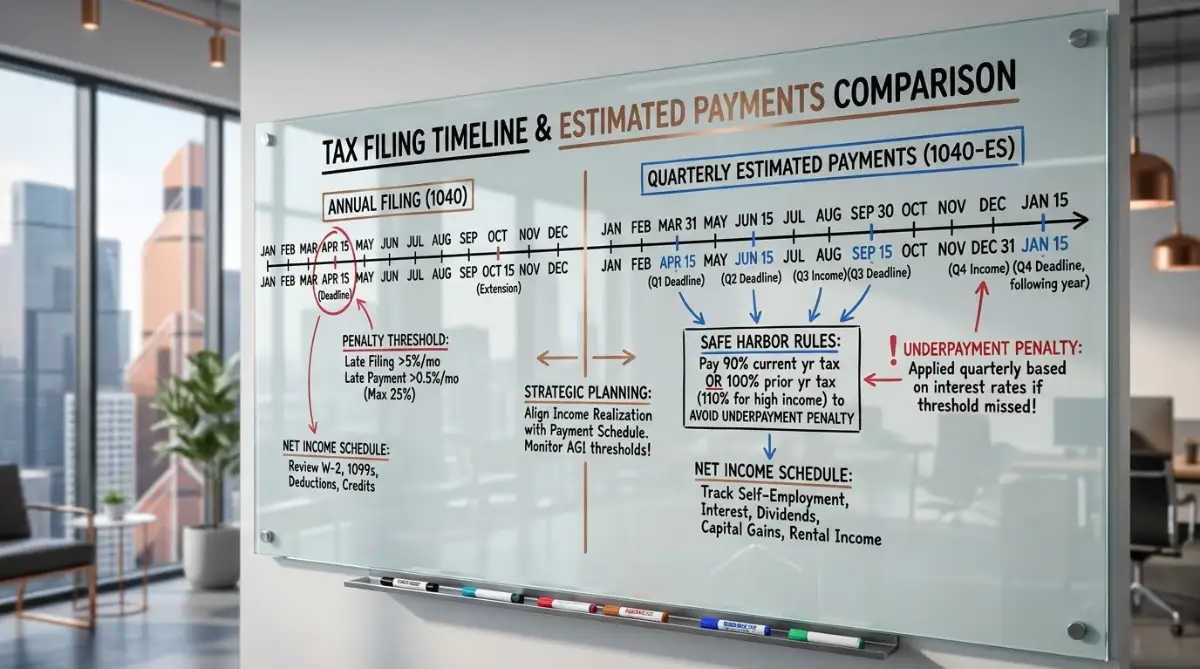
If you expect to owe more than $1,000 in taxes for the year, you are generally expected to make quarterly estimated payments using Form 1040-ES. Missing these deadlines triggers statutory underpayment penalties under Internal Revenue Code Section 6654.
To avoid late-filing fees, financial advisors often point to the Safe Harbor rule. If you prepay either 90% of your current tax liability or 100% of your previous tax bill (110% for higher earners) across four equal payments, the IRS waives underpayment penalties even if you owe money in the spring.

Maximize Legitimate Schedule C Deductions
Your primary weapon against the 15.3% self-employment levy is reducing your net business profit through accurate, documented deductions. You only pay self-employment tax on net profit, not your total gross revenue.
Every legitimate business expense lowers your taxable baseline. This includes home office space used exclusively for business, professional software subscriptions, industry certifications, mobile phone usage percentages, and vehicle mileage.
"In my early freelancing days, I relied on memory and shoe boxes filled with faded paper receipts, which caused me to miss thousands in legitimate write-offs. My advice would be to use a cloud accounting app linked to a separate business debit card from day one. Tracking miles and software costs in real time turns invisible expenses into powerful tax shields."
Behind the Scenes: How Banks and Lenders View 1099 Income
Beyond the tax return itself, working on a 1099 creates unique hurdles when dealing with banking institutions and mortgage lenders.
Traditional underwriting software loves W-2 income because it is predictable, steady, and backed by third-party payroll processors. Independent contractor income, on the flip side, triggers enhanced risk algorithms.
When a W-2 worker applies for a home loan, the lender looks at their gross base salary. If you make $80,000, that $80,000 is plugged directly into their debt-to-income (DTI) calculations.
When a 1099 contractor applies with $80,000 in gross invoices, the lender refuses to use that top-line number. Instead, underwriters demand your last two years of signed tax returns and examine line 31 of Schedule C: your net taxable income.
This dynamic creates a frustrating double-edged sword. If you write off aggressive business expenses to crush your tax bill down to $35,000, your tax accountant will celebrate.
However, the mortgage underwriter will evaluate your purchasing power as if you only make $35,000. You save money on taxes, but you severely limit your ability to finance a home or secure a business loan.
Understanding this industry dynamic allows you to plan your financial moves strategically. If you plan to apply for a major mortgage within the next two seasons, you might choose to claim fewer subjective deductions to show higher taxable earnings to the bank.
Advanced Tax Shields: Moving Past the Basic Sole Proprietor Model
When your gross revenue crosses into higher brackets, operating as a basic sole proprietor becomes an expensive way to run a business. Financial planners often point out that once your net earnings consistently clear the $60,000 threshold, you have options to restructure how your revenue is categorized.
One effective strategy is petitioning the tax authorities to treat your limited liability company as an S-Corporation. This structural shift allows you to split your earnings into two distinct buckets: a reasonable W-2 wage and shareholder distributions.
Here is the thing: you only pay the 15.3% self-employment tax on the reasonable salary portion. The distributions pass through to your personal return free from Social Security and Medicare levies, saving thousands in payroll liabilities every year.
Recent industry reports from the National Bureau of Economic Research demonstrate that small business owners who fail to adapt their legal entity as their income scales lose up to 8% of their lifetime earnings to unnecessary payroll taxes. However, you have to be careful with this structure.
Setting an artificially low salary to dodge taxes can trigger an immediate audit by the authorities. Underwriters and financial examiners look closely at local wage data to verify that your declared wage reflects industry reality.
Another legitimate avenue for sheltering your earnings is setting up specialized retirement accounts built specifically for independent professionals. If you leave your funds in a standard checking account, that money faces immediate taxation in the current filing period.
Setting up a Simplified Employee Pension (SEP-IRA) or an individual Solo 401(k) lets you direct a substantial percentage of your net earnings straight into pre-tax accounts. Recent surveys tracking consumer trends by the CFPB highlight that independent workers lag significantly behind traditional employees in personal savings reserves.
Directing income into pre-tax accounts lowers your adjusted gross income immediately while helping you build long-term personal equity outside the volatile gig market.

Navigating the Traps: Common Mistakes Independent Earners Make
Stepping into the independent workforce without a safety net often leads to avoidable missteps that hurt your balance sheet. The psychological shift from being an employee to running your own business entity requires unlearning years of corporate habits.
Common Mistakes
-
Commingling Personal and Business Cash: Using your personal debit card for client expenses and your business card for family dinners creates an accounting nightmare. When tax season arrives, sorting through hundreds of mixed transactions leads to overlooked deductions and audit red flags.
-
Treating Gross Cash Inflow as Spendable Income: Believing that an $8,000 monthly invoice deposit represents your true take-home pay ruins household budgeting. If you fail to subtract taxes, operating costs, and health insurance cushions immediately, you end up borrowing against your own future to survive.
-
Relying on High-Interest Debt to Cover Tax Shortfalls: When spring arrives and cash reserves fall short, many contractors turn to credit cards. Some jump into balance transfers without calculating terms, falling straight into the 0 intro APR trap when deferred interest kicks in.
-
Triggering High IRS DIF Scores Through Outlier Write-Offs: The IRS uses an automated Discriminant Inventory Function (DIF) scoring system to compare your expense ratios against industry averages. Claiming 100% business use on your only personal vehicle or reporting round numbers like $5,000 for office supplies triggers automated audits.
-
Missing the 1099-K Reporting Threshold Changes: Digital payment platforms are legally required to report business transactions directly to the government. Assuming that secondary platform earnings will slip under the radar without matching paperwork is a fast track to automated penalty notices.
-
Over-Financing Business Vehicles: Buying an expensive truck or sedan simply because it offers a tax write-off often backfires. Misunderstanding depreciation rules can leave you underwater on your car loan, wiping out any small tax advantages you hoped to secure.
Pro Tips for Long-Term Solvency
-
pro tips: Always open two separate bank accounts on your first day of contracting: one dedicated business checking account and one high-yield tax escrow account.
-
pro tips: Never rely on annual paper receipts; snap digital photos of every receipt instantly and synchronize them to a dedicated business cloud drive.
-
pro tips: Before paying high annual card fees for business perks, evaluate whether you should pay an annual fee for a credit card based on your real spending volumes.
To help you distinguish between real write-offs and wishful thinking, the table below highlights standard business deductions alongside non-deductible personal expenses.
The Step-by-Step Execution Plan for New Contractors
Establishing a dependable tax framework doesn't have to feel overwhelming if you break the process into manageable stages. You can complete these practical actions in order to ensure you remain fully compliant and financially secure.
Step 1: Secure a Separate Employer Identification Number (EIN)
Never use your Social Security Number on client W-9 forms if you can avoid it. You can register for an EIN directly through official government portals at no cost within minutes.
Using an EIN protects your identity from data breaches and establishes your independent entity as a professional commercial venture.
Step 2: Open Dedicated Business Banking Channels
Take your new EIN to an insured financial institution and establish a clean commercial checking account. When shopping for vehicle purchases or equipment, compare options carefully; for instance, look at dealership financing vs bank loans to keep financing fees low.
Make sure all incoming client payments flow into this account before any money touches your personal household budget.
Step 3: Implement Automated Withholding Rules
Set up an automatic recurring rule with your bank to sweep 30% of every inbound deposit into a designated tax savings account.
Treat this reserve as untouchable money that belongs directly to the tax authorities. When your quarterly estimated payment dates arrive, the funds are already sitting there waiting.
Step 4: Establish a Real-Time Mileage and Expense Tracker
Install an automated expense-tracking application that uses GPS to log business trips as they happen.
Reconstructing travel history months later from memory rarely holds up during an official examination, meaning thousands of dollars in deductible mileage slip away.
Quick Action Checklist
-
Apply for a free federal EIN online to keep your Social Security Number off client forms.
-
Open an isolated commercial checking account and order a dedicated business debit card.
-
Connect accounting software to your business card to capture expenses in real time.
-
Mark quarterly estimated tax deadlines on your personal digital calendar with advance alerts.
-
Consult a certified public accountant to establish your annual safe harbor tax payment target.
Required Document & Preparation Checklist
-
Form W-9: Completed for each corporate client before commencing billable work.
-
Form 1099-NEC & Form 1099-K: Collected from every client and payment portal after the calendar year closes.
-
Mileage Logs: Digital records showing trip dates, starting points, destinations, and stated business purposes.
-
Home Office Measurements: Square footage documentation of your dedicated workspace relative to total home area.
-
Depreciation Schedules: Receipts and serial numbers for major hardware, computers, or machinery purchased for work.
-
Bank & Credit Card Statements: Complete, reconciled monthly records for all dedicated business accounts.
Many independent workers operate under outdated assumptions that derail their annual finances. Let's look at the actual reality behind the most common gig tax assumptions.
Understanding how lenders view your documents is just as important as managing your tax bill. For example, you might think a 20 down payment guarantees approval for a home loan, but underwriters will recalculate your borrowing limits based strictly on your net Schedule C figures, not your gross receipts.
Taking Charge of Your Independent Financial Future
"The tax system isn't rigged against independent workers, but it is merciless toward those who fail to separate business gross revenue from personal net profit."
Building a thriving freelance career or small business comes down to respecting the difference between revenue and profit. The freedom to set your own schedule and select your clients is one of the most rewarding moves you can make, but that independence comes with administrative accountability.
In my own journey through the independent workforce, the turning point came when I stopped viewing taxes as an annual disaster and started managing them as a standard weekly operating cost. The peace of mind that comes from knowing your tax reserve is fully funded eliminates the knot in your stomach every spring.
What is the biggest tax surprise you have encountered since entering the gig economy? Share your experience in the comments below!
Frequently Asked Questions About Gig Taxes and 1099 Filings
What is the primary difference between a W-2 and a 1099?
A W-2 employee has federal, state, and payroll taxes withheld automatically by their employer, who also pays half of their FICA taxes. A 1099 contractor receives gross pay with zero withholdings and is responsible for paying both the employee and employer shares of self-employment tax.
How much should I set aside for taxes as a 1099 contractor?
Financial advisors generally suggest reserving between 25% and 30% of your net earnings in a dedicated account. This percentage covers the 15.3% self-employment tax along with regular federal and state income tax obligations.
What happens if I miss a quarterly estimated tax deadline?
Missing a quarterly payment deadline triggers an underpayment penalty calculated by the authorities based on prevailing interest rates under IRC Section 6621. You can minimize these charges by catching up on your balance as soon as you discover the oversight.
Can I write off my vehicle if I use it for gig work?
You can deduct the business-use portion of your vehicle using either the standard mileage rate or the actual expense method. You cannot deduct miles driven for personal errands or routine commuting to a single permanent worksite.
Why does my taxable income matter so much to mortgage lenders?
Mortgage underwriters evaluate your ability to repay loans based on your net profit on Schedule C, not your gross revenue. Aggressive write-offs reduce your tax bill but simultaneously lower your qualifying income for home financing.
Does receiving payment through digital apps exempt me from reporting?
No, digital payment platforms report transactions directly to revenue services based on established legal thresholds. Regardless of whether a form is issued, all earned revenue must be included on your annual tax return.
What is the Safe Harbor rule for estimated taxes?
The Safe Harbor rule protects you from underpayment penalties if you pay at least 90% of your current tax liability or 100% of the previous period's bill through timely quarterly payments. The threshold rises to 110% of the previous bill for higher earners.
Can I deduct a home office if I work from a shared living room?
No, the regulations require that a home office space must be used exclusively and regularly for your trade or business. A desk placed in a room that also serves as a family den or bedroom does not qualify for the deduction.
How does forming an LLC change my tax obligations?
A single-member LLC is treated as a disregarded entity by default, meaning you pay the exact same self-employment taxes as a sole proprietor. The LLC provides legal liability separation rather than automatic tax reductions until you elect S-Corp taxation.
What should I do if I cannot afford my tax balance in the spring?
If your tax bill exceeds your liquid savings, you can apply for an installment agreement directly through official revenue portals. Setting up a formal payment plan prevents aggressive collection actions, asset liens, and elevated non-filing penalties.
Trusted Legal & Financial Resources
-
Internal Revenue Service (IRS) Self-Employed Center: The official government clearinghouse providing forms, deduction guidelines, and quarterly payment portals for independent contractors.
-
Consumer Financial Protection Bureau (CFPB): Federal consumer advocacy portal offering educational frameworks on managing unexpected debt and understanding commercial lending disclosures.
-
U.S. Small Business Administration (SBA): Official federal agency offering step-by-step guidance on entity registration, business banking, and small enterprise licensing.
-
Federal Reserve Economic Data (FRED): Authoritative macroeconomic research database tracking national household liquidity, employment classifications, and savings metrics.
-
Federal Deposit Insurance Corporation (FDIC): Federal regulatory resource providing safety guidelines for commercial banking accounts and business reserve protection.
-
National Association of Enrolled Agents (NAEA): Professional registry for locating licensed tax specialists who specialize in complex independent contractor audits and representation.
Important Financial Disclaimer
This content is published strictly for educational, informational, and general financial literacy purposes. It should not be interpreted as personalized banking, accounting, investment, legal, or tax advice. Financial products, deposit account features, automated transfer settlement policies, interest rates, and fee schedules vary across individual banking institutions and are subject to change without notice.
Neither the author nor FinanceInfoIn guarantees specific savings outcomes or financial results by implementing the organizational strategies described. Readers are strongly encouraged to assess their personal financial circumstances, review their institution’s account agreements, and consult with a licensed financial planner or certified banking specialist before making significant structural changes to their banking arrangements.
About the Author & Review Process
Written & Fact-Checked by: Mithun Halder & The FinanceInfoIn Editorial Team
Mithun Halder is a dedicated personal finance researcher and educator with a deep focus on insurance, investing, and wealth management. At FinanceInfoIn, our editorial team rigorously researches and cross-references every topic with official government resources, insurance regulations, and industry best practices. Our mission is to break down complex financial jargon into clear, actionable, and trustworthy guidance, helping you make informed decisions about your financial security.
📧 Contact Mithun: [email protected] | 💼 Connect on LinkedIn: Mithun Halder