
 🕒 Reading Time: 14 Mins | ✍️ Reviewed By: FinanceInfoIn Editorial Team
A coworker of mine, Marcus, financed a family crossover in suburban Ohio with just $1,000 down. Six weeks into his morning commute, a delivery truck ran a stop sign and crushed his front end.
Marcus walked away with sore ribs, but his crossover was declared a total loss. He felt relieved because he carried full coverage with a major national carrier.
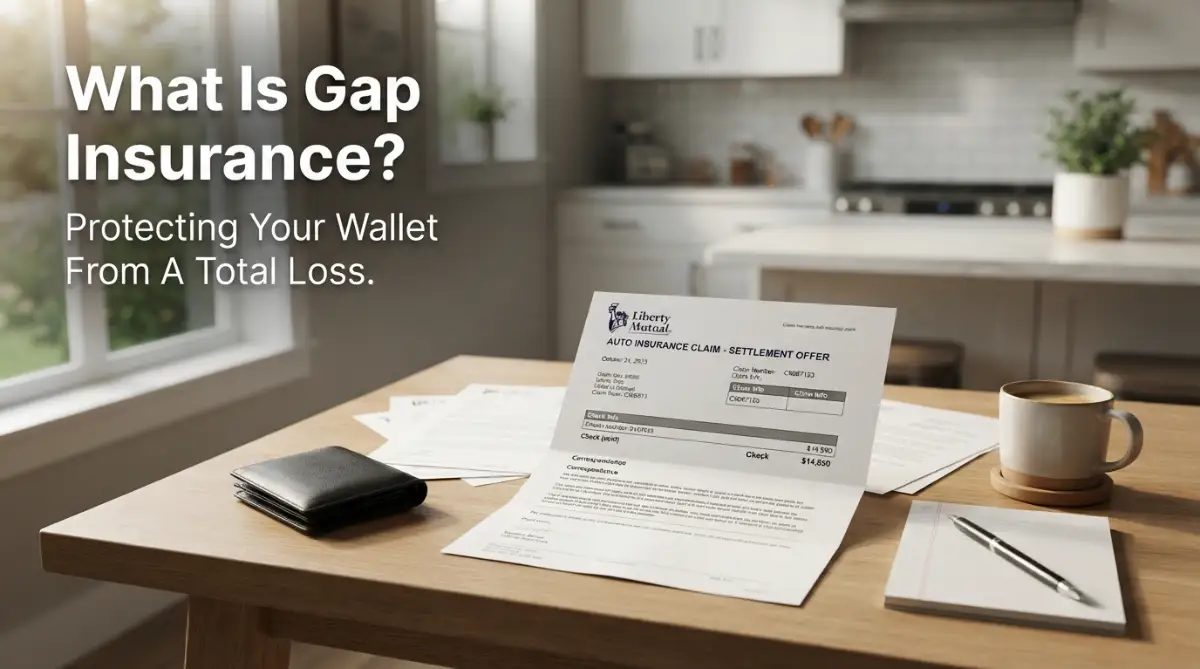
That relief turned to pure shock when the insurance settlement arrived. The insurer assessed the market value of the crossover at $27,000.
After subtracting his $500 collision deductible, the insurance company wired $26,500 directly to his lender. The problem? Marcus still owed $33,500 on his auto loan.
He was legally on the hook for a $7,000 deficit on a vehicle currently resting in a scrap heap. His lender expected him to continue making monthly payments for the next five years.
This financial trap catches thousands of American drivers off guard every month. Guaranteed Asset Protection—better known as gap insurance—is built specifically to absorb that exact loss.
Let's look at why standard policies fall short and how you can protect your wallet before you drive home.
The Cold Math: Actual Cash Value vs. Your Loan Balance
Standard auto policies are written to protect the depreciated machine sitting in your driveway. They do not care how much money you borrowed from your bank to buy it.
The moment you drive a brand-new vehicle off a dealership lot, its retail value drops significantly. Your primary insurance company only owes you the actual cash value (ACV) of the vehicle immediately before the collision.
A lot of people assume their collision coverage pays off whatever balance remains on the bank note. The reality is, lenders and insurers operate under two completely separate sets of math.
Let's walk through an honest, realistic breakdown that includes the numbers people usually forget.
Sarah's Real-World Financing Breakdown:
-
Purchase Price: Sarah purchases a brand-new vehicle with taxes and registration fees for $36,000.
-
Financing: She puts down $1,000 and finances the remaining $35,000.
-
The Total Loss: Seven months later, a flash flood severely damages the vehicle and the adjuster writes it off as a total loss.
-
Market Valuation (ACV): The insurance company appraises the market value at $28,000.
-
The Deductible: Sarah carries a $500 comprehensive deductible, issuing a net payout of $27,500.
-
The Remaining Debt: Sarah's loan payoff statement from her bank sits at $33,800.
-
The Uninsured Deficit: $33,800 minus $27,500 leaves a $6,300 balance that Sarah must pay out of pocket without Gap insurance.
Before buying, it helps to understand your existing policy limits by understanding your insurance declaration page so you know where your collision coverage stops.

Hidden Limits: LTV Caps and Exclusions You Need To Watch
Gap protection is an incredible safety net, but it is not a blank check for reckless financing. Many buyers get burned because they never read the fine print regarding policy limitations.
The most important thing to verify is your policy's Loan-to-Value (LTV) cap. Most gap underwriters cap their maximum settlement payout between 125% and 150% of the vehicle’s actual market value.
If you roll $8,000 of negative equity from an old trade-in into a new car loan, your loan-to-value ratio might reach 160% on day one. If you total the car, your gap insurer will legally refuse to pay the portion of debt exceeding their LTV cap.
Also, watch out for aftermarket accessory exclusions. If you spend $4,000 on custom off-road wheels, a suspension lift, or a custom stereo, gap policies exclude those additions entirely during a total loss settlement.
Understanding how vehicle value tracks against typical loan amortization helps you pinpoint the exact window where this risk exists.