

🕒 Reading Time: 14 Mins | ✍️ Reviewed By: FinanceInfoIn Editorial Team
The Crushing Weight of Multiple Bills
I stared at my phone screen in the grocery store aisle, completely frozen. My total was $47.30, and I had to quickly check three different credit card apps to see which one had enough available balance to cover it. The first card was maxed out, the second one had a payment due tomorrow, and the third was my absolute last resort. I felt a heavy knot in my stomach, praying the transaction would go through without that embarrassing decline beep. That moment of panic was my everyday reality, constantly juggling money just to survive another week.
Living with multiple debts feels like carrying a backpack full of bricks while trying to run a marathon. You wake up on the 5th of the month worrying about the car payment, the 12th brings anxiety over the first credit card, and by the 25th, you are scraping pennies together for a personal loan. The mental fog is absolutely exhausting.
You are not just losing money; you are losing your peace of mind. Every time your phone buzzes with an email notification, your heart drops, thinking it is another missed payment alert. The sheer amount of mental energy it takes to remember due dates, minimum payments, and login passwords is overwhelming.
Many people think they are bad at managing money when they find themselves in this trap. The truth is, managing five different high-interest accounts is a mathematical nightmare for almost anyone. Minimum payments are designed to keep you trapped, paying mostly interest while your actual balance barely moves.
You work hard every single day, yet your bank account looks exactly the same at the end of the month. It feels deeply unfair. This exact frustration is why looking for a realistic, manageable way out becomes an absolute necessity for your mental health.

Step 1: Audit Your Credit Score and Debt-to-Income (DTI) Ratio
Before submitting any application, you must view your financial profile through the underwriter's eyes. Lenders evaluate two primary metrics: your FICO credit score and your debt-to-income (DTI) ratio.
Your DTI represents the percentage of your gross monthly income that goes toward paying existing debts. Most prime lenders strictly reject applicants with a DTI higher than 45% to 50%.
Step 2: Assemble Your Underwriting Documentation
Loan approvals stall most frequently during the document verification phase. Gathering your financial paperwork beforehand allows you to complete the application rapidly and prevents underwriters from shelving your file.
Essential Document Checklist:
-
Proof of Identity: Government-issued photo ID (Driver's license, State ID, or Passport).
-
Proof of Income: Your two most recent paystubs, W-2 forms from the last two years, or 1099 statements if you are self-employed.
-
Proof of Residence: A recent utility bill, lease agreement, or mortgage statement.
-
Creditor Verification: The most recent statement for every credit card or personal loan you plan to consolidate, including exact account numbers and payoff balances.
Step 3: Compare Lenders and Choose the Right Institution
Do not blindly apply at your regular checking bank. Different financial institutions have radically different risk tolerances and fee structures:
Step 4: Prequalify via Soft Credit Checks Before Final Submission
Never submit multiple formal loan applications at once. A formal application triggers a "hard inquiry," which temporarily docks your credit score by 5 to 10 points.
Instead, utilize online prequalification tools. Prequalification uses a "soft credit pull" to show you estimated loan amounts, terms, and interest rates without impacting your credit score. Once you find the most competitive offer, proceed with the formal application.
Step 5: Review the Loan Offer and Finalize Disbursement
Let us walk through exactly what happens when you apply for one of these loans. First, the lender will look at your credit score and your income. They want to see that you have a steady job and a history of trying to pay your bills.
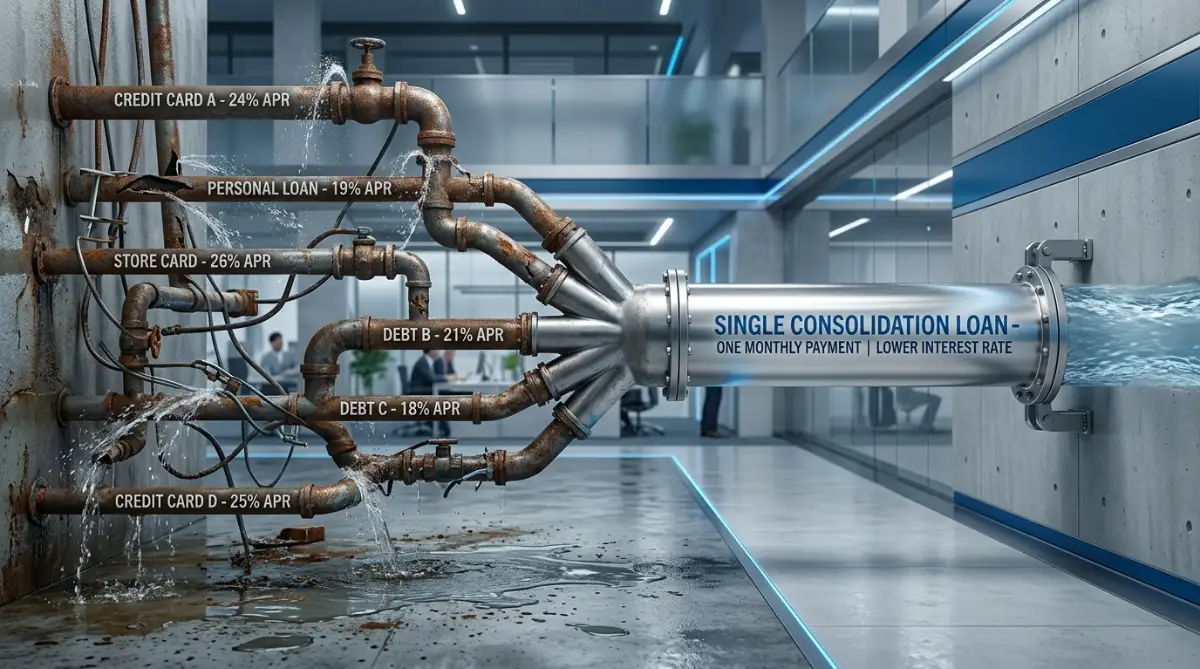
If you are approved, the lender will offer you a specific interest rate based on your financial profile. This is the moment of truth. You must compare this new rate to the average rate you are currently paying on your credit cards.
If the new rate is significantly lower, moving forward makes perfect mathematical sense. The lender will then either deposit the funds directly into your bank account or send the money straight to your creditors. If the money comes to you, it is your strict responsibility to pay off those credit cards immediately.
Here is a quick look at the typical requirements lenders ask for:
Do not use this money for a vacation or a new gadget. That is the quickest way to double your financial trouble. The money has one job, and that is to wipe the slate clean with your old creditors.
The Hidden Truth About Interest Rates
Many people misunderstand how interest rates actually drain their wealth. An interest rate is simply the price you pay for the convenience of buying things before you actually have the cash. Credit card companies make billions of dollars because people ignore this invisible price tag.
When you consolidate, your primary goal is to slash that price tag. Even a drop of five or six percent can save you thousands of dollars over a few years. That is money that stays in your pocket instead of funding a bank's corporate retreat.

However, you must read the fine print. Some lenders charge an origination fee just for processing the loan. This fee is usually deducted directly from your loan amount before you receive it.
You need to make sure the money you save on interest is much higher than any fees you have to pay upfront. Math never lies. Always do the calculations before signing any digital paperwork.
Myth vs Reality: The Credit Score Impact
A huge fear people have is that applying for a new loan will destroy their credit score. The truth is a bit more nuanced than that. When you first apply, the lender does a hard inquiry, which might cause your score to drop by a few points temporarily.