

Reading Time: 12 Minutes
Difficulty Level: Beginner to Intermediate
Reviewed By: FinanceInfoIn Editorial Team
The Crunch, and the Math That Came After
It was a Tuesday, it was raining, and I was at a red light with a podcast on, not thinking about anything. Then the truck behind me didn't stop. My seatbelt yanked across my collarbone and the whole car filled with this flat, ugly crunch.
What I did next still surprises me. I didn't check myself for injuries. I started doing sums. Repair bill, maybe a thousand dollars. A rental? Could I even get to work Thursday? My account was low that month, so every number I came up with felt worse than the last.
Then I was standing on the shoulder with rain running down my neck, looking at a folded bumper and thinking: I pay for insurance. Every single month. And I have no idea what it's about to do for me.
That's more common than people admit. Most of us pick a policy on price, file it away, and only read it once something breaks. By then you're also juggling a police report, a tow truck, an adjuster who talks fast, and maybe a stiff neck.
So this is the guide I wish I'd read a week before that Tuesday. It goes through what each part of your policy does when a crash happens, and where people tend to get caught out.
Quick Summary
What gets paid after a crash depends on which coverages you actually have. Liability pays for damage you do to other people. Collision and comprehensive pay for your own car. MedPay or PIP handles injuries to you and your passengers. Uninsured motorist coverage matters when the other driver has nothing. Most big out-of-pocket bills come from gaps between these.
Key Takeaways
- Liability only pays other people. It will not fix your car or treat your injuries.
- Collision repairs your car no matter who caused the crash, after you pay the deductible.
- PIP and MedPay cover medical bills for you and your passengers. PIP can also replace some lost income.
- Uninsured motorist coverage is mainly about injuries. Whether it also covers your car depends on your state.
- If you owe more on your loan than the car is worth, a total loss leaves you paying for a car you no longer have.
Liability: The Coverage That Never Touches Your Car
Almost every state requires liability, and it's the part of the policy people understand least. The idea is simple. If you cause a crash, liability pays for the harm to the other party. It protects your savings from their lawyer.
The catch is that "other party" means exactly that. Run a stop sign, wreck your own car, and liability will pay for the other driver's repairs and hospital bills while you get nothing from it. Your own car is handled by a different coverage, which comes next.
There are two halves. Bodily injury pays for the medical costs and pain and suffering of the people you hurt. Property damage pays for what you damaged, usually a car, but sometimes a fence or a mailbox.
Limits are often printed as three numbers, like 25/50/25. Read that as $25,000 per injured person, $50,000 total for injuries per accident, and $25,000 for property damage. Some states set minimums lower than that, with property damage as low as $10,000.
I think that's too thin for almost anyone. A new SUV can cost more than $40,000 by itself, and one hospital trip can pass that number quickly. Once your limit runs out, the other side can pursue you personally for the rest, which means your wages and your assets. Moving from state minimums to something like 100/300/100 usually costs a lot less than you'd expect, so get a quote before you assume it's expensive.
Collision and Comprehensive
If you own your car outright, these two are optional. If you have a loan or lease, your lender will insist on both.
Collision pays when your car hits something: another vehicle, a tree, a guardrail, a wall. Fault doesn't matter, and it applies even if you slid on ice and hit a pole with nobody else around. Comprehensive covers the stuff that isn't a driving mistake. Theft, hail, flooding, a branch coming down in a storm, a deer that steps out of the dark. Some insurers call it "other than collision," which is actually the clearer name.
|
Coverage Type |
Collision Coverage |
Comprehensive Coverage |
|
Covers |
Crashes with a vehicle or object |
Theft, weather, fire, falling objects, animals |
|
Fault matters? |
No |
Not applicable |
|
Deductible? |
Yes |
Yes, often the same or lower |
|
Example |
Backing into a post |
A stolen catalytic converter |
Deductibles, With Actual Numbers
Your deductible is what you pay before insurance pays anything. Say David rear-ends a delivery van. The shop quotes $3,500 for his sedan and his collision deductible is $500. He pays the first $500, his insurer pays $3,000, and his liability coverage deals with the van separately. If the quote had been $400, he'd pay all of it, since it never reached the deductible.
That's why a small dent is often not worth claiming. A claim you were at fault for can raise your premium for a few years, sometimes by more than the claim paid. Get the estimate, subtract your deductible, and compare what's left with what your rates might climb before you file.
On the deductible itself, a higher one lowers your monthly bill. Just don't pick a number you couldn't pay this week without borrowing.
When You're the One Who Got Hit
In my case, the truck driver's insurance was supposed to pay for my repairs. In theory I never needed my own collision coverage at all. In practice, their insurer took its time, and people who were sure they weren't at fault get told otherwise more often than you'd think.
A lot of drivers use their own collision coverage to get the car fixed fast, then let their insurer recover the money from the other company. That's called subrogation. When it works you generally get your deductible back too, though it can take a while.
Injuries and Medical Bills
Bumpers get replaced. Bodies are harder, and the bills stack up fast. An ambulance, an ER visit, and imaging can pass $10,000 before you've met a specialist.
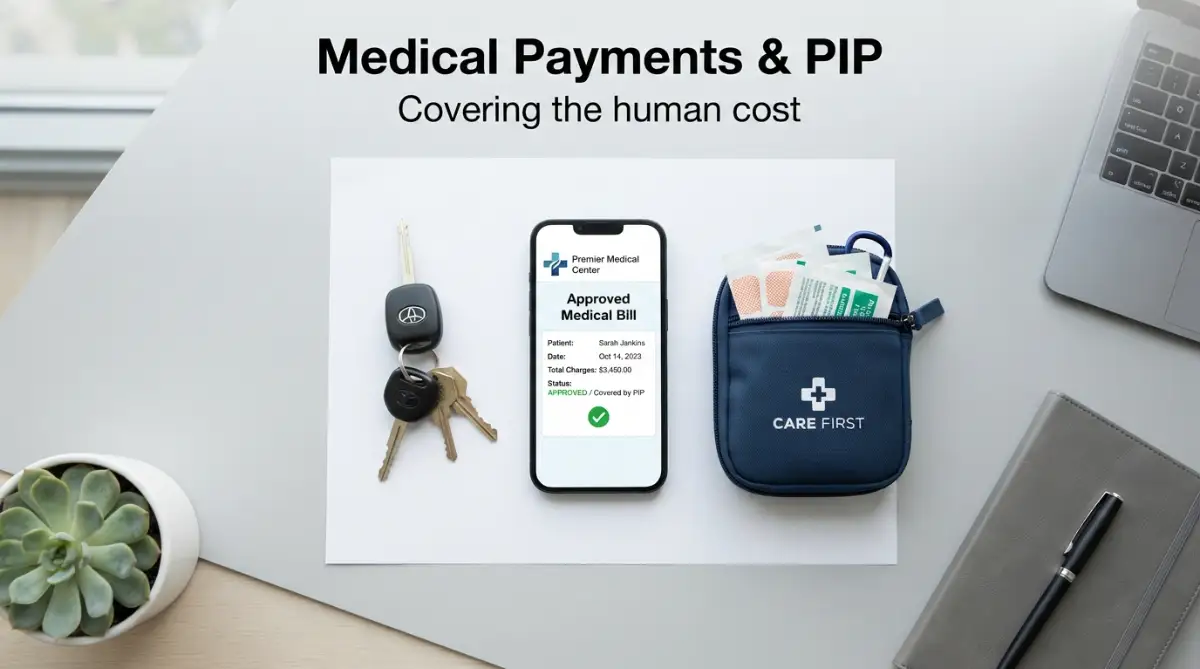
Your policy might include one of two coverages for this. MedPay pays reasonable medical costs for you and your passengers, whoever caused the crash, and it's usually sold in small amounts. PIP goes further. It's required in "no-fault" states such as Florida, Michigan, and New York, and beyond medical bills it can replace part of your income if you can't work. Some policies also help with things like childcare during recovery.
I skipped PIP once to save a few dollars. My reasoning was that health insurance would cover me. Then I needed a month of physical therapy, and my plan came with a high deductible and a co-pay at every visit. That decision cost me a good chunk of savings. Health plans and auto medical coverage aren't interchangeable. They have their own deductibles and network rules, and some plans want the auto coverage to pay first.
One more thing about injuries: they often show up late. Neck and back pain can take a day or two to appear, once the adrenaline drains out. If something feels off, get it checked and keep the records. Also, don't sign a settlement release until you know the full extent of your injuries, because a signed release is usually final.
If the Other Driver Has No Insurance
This isn't a rare situation. Industry estimates put uninsured drivers at roughly one in seven nationally, and higher in some states. If one of them hits you, there's no policy to collect from.
Watch this video to understand exactly how claims adjusters evaluate your damage.
Uninsured Motorist (UM) coverage stands in for the missing insurance, and it usually applies in hit-and-run cases too. Its main job is paying your medical bills and related losses. For your car it varies by state. Some states offer a separate uninsured motorist property damage coverage, and elsewhere your collision coverage is what repairs the car.
Most insurers also sell Underinsured Motorist (UIM) coverage, and I'd say it's the more overlooked of the two. It applies when the at-fault driver has a policy that's too small. A driver with a $25,000 limit can easily leave you with a hospital bill twice that size.
| Coverage | Who it protects | What it pays |
|---|---|---|
| Bodily Injury Liability | The people you injure | Their medical bills when you're at fault |
| MedPay / PIP | You and your passengers | Your medical bills, regardless of fault |
| Uninsured / Underinsured Motorist | You and your passengers | Your injury costs when the at-fault driver has none or too little |
Totaled Cars and the Loan Gap
When repairs would cost more than the car is worth, the insurer declares it a total loss. Many states set a percentage threshold for this, and insurers also weigh what the wreck could sell for as salvage.
They won't buy you a replacement. They pay the Actual Cash Value (ACV), which is what the car was worth right before the crash, based on make, model, mileage, condition, and similar cars for sale near you. In many states, sales tax and title fees are added to the payout, though not all.
The first number isn't always the final one. If your car had new tires, recent major work, or features the valuation missed, send proof. Service records, receipts, and listings of comparable cars nearby can move the offer. Plenty of people accept the first figure without checking and leave money behind.
Now the part that hurts newer-car owners. Cars lose value quickly, and it's easy to end up owing more than the car is worth. Say you financed $25,000 and the car is worth $20,000 at the time of the crash. Your insurer pays $20,000. The bank still wants the other $5,000, for a car that no longer exists.
Gap insurance covers that difference. On a lease it's usually built in. If you finance, you have to add it, and where you buy it matters. Through your auto insurer it tends to cost little. Through the dealership it's often rolled into the loan at a much higher price. If you already bought it at the dealer, ask whether it can be canceled and replaced.
Two limits to know. Gap only pays off the loan balance, so it won't give you cash for a down payment on the next car. And once you owe less than the car is worth, it does nothing, so drop it then and stop paying for it.
Add-Ons Worth Checking
Repairs can take weeks, sometimes longer if parts are backordered. What you do for transport in the meantime is a real cost.
Rental reimbursement pays for a rental after a covered claim, and it's usually cheap. Look at the daily cap, though. Something like $40 a day for 30 days is common, but a low cap may not cover a compact car in a busy city. Roadside assistance handles towing and lockouts. It won't repair accident damage, but before you pay for it, check whether your credit card, auto club, or car manufacturer already gives it to you.
If your car is new, ask about new car replacement and OEM parts endorsements. The first pays for a brand-new car instead of ACV if yours is totaled within a certain age. The second requires original manufacturer parts for repairs, which a standard policy doesn't always promise.
What to Do at the Scene
Adrenaline wipes your memory, so keep this list on your phone.
- Check for injuries, and call 911 if anyone needs help. It also creates a record.
- Call the police. A report gives the adjuster a neutral account of what happened.
- Take more photos than you think you need. Car positions, damage, plates, road conditions, signs.
- Get witness names and numbers. They matter if the other driver changes their story.
- Exchange insurance details. Name, plate, insurer, policy number.
- Tell your insurer soon. Policies have notice deadlines, and late reporting can give them a reason to push back.
Don't admit fault at the scene. You don't know everything yet, and an apology gets repeated later as if it were a confession. Stick to facts. Be careful if the other driver's insurer calls asking for a recorded statement. You can decline until you've talked to your own insurer, who you do have to cooperate with.
Keep every document too: estimates, medical records, receipts, rental costs, missed workdays. Adjusters pay based on paperwork.
That's really all there is to it. Pull out your declarations page this week and check five things: your liability limits, your deductibles, whether you have MedPay or PIP, whether you have UM/UIM, and whether you're carrying gap coverage you don't need or missing gap coverage you do. It takes about fifteen minutes and it's far better than doing the math on the shoulder in the rain.
Beyond the Basics: Mastering Your Claim Strategy
Knowing what your policy covers is only the starting line. Getting the insurance company to actually hand over the money you deserve is an entirely different game. Adjusters are trained professionals who protect their company’s bottom line, and you need a solid strategy to protect yours.
Many drivers panic and let the claims adjuster make all the decisions. This is exactly how you end up with cheap aftermarket parts on your vehicle and denied medical bills. You have the right to push back and demand the exact coverage you paid for every single month.
If you read the fine print, you will discover hidden benefits that agents rarely mention upfront. For example, if another driver hits you, your vehicle loses resale value instantly, even after it gets perfectly repaired. You can actually file a "Diminished Value" claim to get a cash check for that lost resale value.
Pro Tip: Never deposit the very first settlement check the other driver's provider sends you. Cashing that initial check usually means you legally accept their offer and close the claim, leaving you completely stuck if your neck starts hurting two weeks later.
To really understand your limits, you should spend ten minutes understanding your insurance declaration page without confusion. That single piece of paper is your ultimate roadmap when a claims adjuster tries to tell you something is not covered.
When it comes to fixing your smashed vehicle, you will face a major choice. Your provider will strongly push you toward their "preferred" mechanics, but you actually have the legal right to choose your own repair facility. You can check the Consumer Guide to Auto Claims from the NAIC to verify your rights in your specific area.
The Exact Step-by-Step Execution Guide
You cannot just cross your fingers and hope the insurance company treats you fairly. You have to take immediate, calculated actions to force their hand. Here is exactly how you start a bulletproof claim from day one.