

🕒 Reading Time: 13 Mins | ✍️ Reviewed By: FinanceInfoIn Editorial Team
The Pricing Mistakes New Businesses Make Before They Understand Their Costs
I was standing at the counter of a local packaging supply warehouse on a freezing Friday afternoon when my commercial debit card was declined. Three days earlier, my brand had booked its strongest week on record, moving over $4,200 in custom canvas work aprons. I had dozens of paid order confirmations sitting in my inbox to prove it.
I walked out to my car and kept refreshing my mobile banking app, half-expecting the balance to magically correct itself. I had put in nearly eighty hours that week, cutting fabric patterns and boxing parcels past midnight, genuinely believing that strong order volume meant the company was flourishing.
It took a cold spreadsheet and four hours of sorting receipts that night to face the truth. Every single apron I boxed up and shipped was costing me $2.80 more to produce and deliver than the buyer had paid. I wasn't running a thriving business; I was privately funding a discount program for strangers out of my personal savings account.
Plenty of first-time founders go through an identical reality check. You put your hard-earned money and your nights into an offer, orders roll in, and your bank balance drains anyway.
The psychological toll is exhausting if you haven't lived it firsthand. You wake up at 4 AM running bill payments through your head while staring at the ceiling.
You can't decide whether to hike your prices or slash them to spark quick sales. When your base price fails to cover your true expenses, every new order feels like an unpaid bill rather than a milestone. You find yourself needing more volume to cover fixed overhead, but every sale pulls your cash reserves a little lower.
That painful week was why I stopped treating pricing as a creative afterthought. Your pricing model decides whether your company survives an unexpected slow season or quietly closes its doors within six months.

The Hidden Costs That Drain Your Operating Cash
Most founders begin their pricing calculations by adding up basic materials. A woodworker buys $14 worth of walnut stock to craft a desk organizer, lists it online for $35, and chalks up $21 in paper profit.
That $21 estimate ignores every fee between the workbench and the customer's front porch.
Merchant processing deductions, digital ad spend, packaging tape, broken stock, platform subscription tiers, and return postage all eat into that margin. Direct raw materials are merely the visible tip of a much deeper financial iceberg.
A Worked Example: The Hidden Math of Handcrafted Goods
Let's look at Elena, who launched an online shop selling handcrafted leather passport wallets. Her vegetable-tanned leather, waxed thread, brass snaps, and gift boxes cost her exactly $12 per piece.
Confident in her margins, Elena set her retail price at $36, expecting a healthy $24 profit on each sale.
Here is what actually happened to that $36 after she delivered her first batch of 400 orders:
-
Retail Selling Price: $36.00
-
Raw Leather & Hardware: -$12.00
-
Rigid Mailer, Custom Tissue, & Shipping Label Paper: -$2.80
-
**Credit Card Processing Fee (2.9% +0.30):∗∗−0.30):∗∗−1.34
-
Customer Acquisition Cost (Paid Social Ads): -$11.20
-
Studio Rent & Equipment Maintenance Allocation: -$3.50
-
Defect, Scrap Leather, & Return Allowance (4%): -$1.44
Elena didn't clear24perwallet.Hertruenetprofitwasjust∗∗24perwallet.Hertruenetprofitwasjust∗∗3.72 per unit**.
She hand-stitched, finished, and packed 400 leather wallets just to clear $1,488 before self-employment taxes. A single lost international shipment cost her the replacement materials, postage, and box, instantly erasing the net earnings of four successful deliveries.
When you look at the raw numbers, the feeling of working endlessly while remaining broke makes total sense. Most founders price for an ideal scenario, but have to operate in an unpredictable real-world market.
Markup vs. Margin: The Math Mistake That Costs the Most
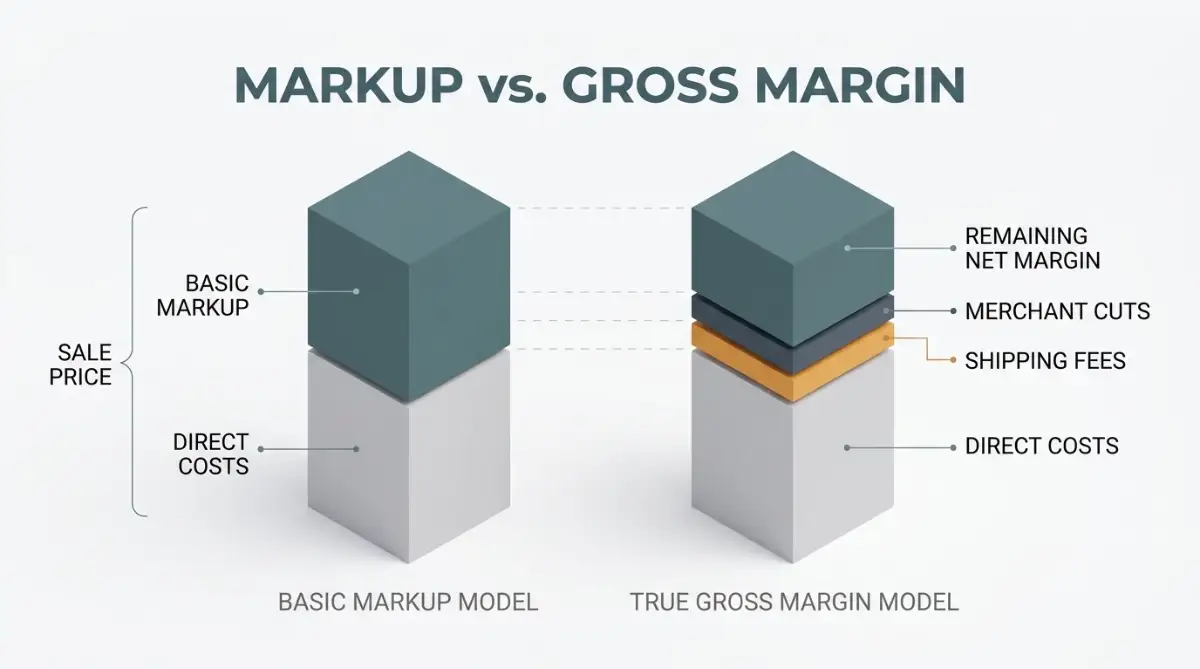
Markup and gross margin sound similar, and treating them as interchangeable numbers is one of the fastest ways to underprice yourself into debt.
Markup is the percentage you add on top of your product's direct cost to arrive at a selling price.
Gross Margin