

Reading Time: 12 Minutes
Difficulty Level: Beginner to Intermediate
Reviewed By: FinanceInfoIn Editorial Team
There is a unique kind of panic that hits you when your card is declined at the checkout line and you realize you only have two dollars left. Just days earlier, I had delivered a massive design project, working around the clock based on a simple spoken agreement over the phone. I trusted their word completely, but I quickly realized that an undocumented promise cannot buy your groceries.
When the time came to settle the bill, they completely ignored my calls and pretended our conversation never happened. The panic that set in that day was overwhelming, and I felt completely powerless because I had nothing on paper.
Millions of honest people face this exact nightmare every single day. You trust someone's word, you put in the hard work, and suddenly you are left fighting for what is rightfully yours while losing sleep over unpaid bills.

The mental toll of trying to prove a spoken promise is exhausting. You constantly second-guess your own memory and wonder how a friendly handshake turned into a stressful dispute.
People often assume the law automatically protects those who tell the truth. Sadly, the reality of spoken agreements is far more complicated and messy.
Quick Summary
Verbal contracts are generally legally valid, but proving their existence is incredibly difficult. You need specific elements like mutual agreement, clear terms, and exchanged value to make them binding. Certain major agreements strictly require a written document to be recognized in court. Keeping text messages, emails, or witness statements is your best defense when a spoken deal goes wrong.
Table of Contents
- The Heavy Cost of Relying on Handshake Deals
- How Spoken Words Turn Into Binding Rules
- The Invisible Elements of a Valid Deal
- When a Handshake Simply Isn't Enough
- Defending Your Spoken Promises in Real Life
- Gathering the Right Evidence to Protect Yourself
Key Takeaways
- Most spoken agreements are technically valid under the law.
- Proving a spoken promise requires solid supporting evidence.
- Text messages, emails, and receipts act as proof of a spoken deal.
- Real estate and long-term deals always require a written document.
- Acting on a promise can sometimes prove the deal actually existed.
The Heavy Cost of Relying on Handshake Deals
When two people look each other in the eye and agree on something, it feels like a solid bond. We are taught from a young age that a person's word is their bond.
However, the legal system does not operate on feelings or moral compasses. The courts operate on hard facts, clear evidence, and tangible proof. When you enter an informal agreement, you are basically trying to capture smoke with your bare hands.
If things go wrong, it becomes a classic case of "he said, she said." The judge was not in the room when you made the deal, so they have no idea who is telling the truth.
Many small business owners and freelancers fall into this trap because they do not want to seem aggressive or untrusting. They think asking for a signature will ruin a friendly relationship.
The exact opposite is true. Clear boundaries and written terms actually protect relationships from turning bitter. A simple email summarizing your chat can save you months of legal headaches.
How Spoken Words Turn Into Binding Rules
A contract does not need fancy legal jargon or a heavy red stamp to be valid. In everyday life, we make informal contracts all the time without realizing it.
When you order food at a restaurant, you make a spoken promise to pay for the meal after you eat it. The restaurant trusts your spoken word and implied intent. If you walk out without paying, you have broken a legally binding unwritten agreement.
To make any deal enforceable, a few specific conditions must be met. First, one person must offer something, and the other person must accept it without any hidden conditions.
I learned this the hard way during my early freelancing days.
Pro Tip: I used to start working immediately after a client said, "Let's do this," over the phone. My biggest mistake was never following up with an email saying, "As discussed, I will do X for Y amount." Now, I always send a quick recap message, and that single habit has saved me thousands of dollars.
Both sides must also exchange something of value, which lawyers call consideration. If you promise to paint your neighbor's fence for free, and then you do not do it, they cannot sue you.

Why? Because they did not offer you anything in return. However, if they promised to pay you fifty dollars for the job, a real legal obligation is formed.
Both parties must clearly understand what they are agreeing to. If the terms are too vague, a judge will simply throw the case out. You cannot enforce a promise that says, "I will pay you a fair amount someday."
The Invisible Elements of a Valid Deal
Understanding the exact requirements of a spoken promise helps you avoid terrible situations. Think of a contract like a recipe for a cake. If you miss one primary ingredient, the whole thing falls apart.
You need an offer, acceptance, consideration, and mutual intent. Both parties must actually intend for the conversation to be legally serious. A casual joke between friends about selling a car for ten bucks does not count.
The intent to create legal relations is often where things get messy. Family members often make promises to each other during holidays or dinners. Courts usually assume family promises are not meant to be official unless clear business terms are discussed.
If you hire your cousin to renovate your kitchen, you must treat it like a real business transaction. Set clear deadlines, agree on specific payment terms, and ideally, write it down.
Watch this video to understand exactly how judges view spoken promises in a real courtroom setting.
When a Handshake Simply Isn't Enough
There is a massive exception in the legal world that you must understand. Some deals are simply too important, too expensive, or too long-lasting to be left to memory.
This rule is famously known as the Statute of Frauds. It is an old legal concept designed to prevent people from lying about high-stakes transactions. If your deal falls into certain categories, a spoken promise means absolutely nothing.
For instance, any agreement involving the sale of real estate must be documented on paper. You cannot buy a house with a handshake, no matter how well you know the seller.
Similarly, if an agreement takes more than one year to complete, it requires a physical signature. If you agree to a two-year employment gig over the phone, the law will not fully protect you.
Expert Tip: If your spoken deal involves a large sum of money, usually over five hundred dollars, stop immediately. Draft a simple one-page document outlining the terms before you take another step forward.
Agreements to pay off someone else's debt also fall into this strict category. If your friend owes a bank money, and you verbally promise the bank you will cover it, that promise is rarely enforceable.
The law protects you from being held responsible for massive financial burdens based purely on a phone call.
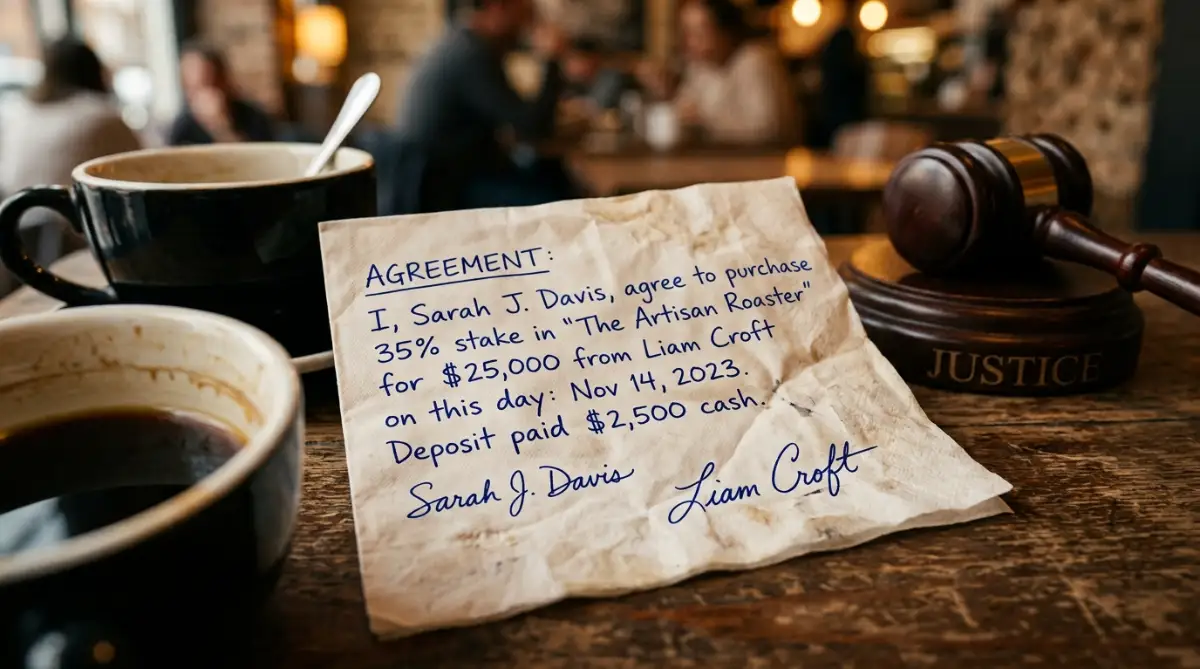
Defending Your Spoken Promises in Real Life
So, what happens if you are already stuck in a broken spoken agreement? All hope is not lost, but you have to become your own private investigator.
Since you do not have a signed contract, you must rely on circumstantial evidence. You have to show the court that the deal was real by pointing to actions and behaviors.
If a client hired you verbally, did they send you login credentials to their website? Did they introduce you to their team via email as the new consultant? These small actions strongly suggest an agreement was made.
Partial performance is one of the strongest arguments you can make. If you agreed to buy a custom bicycle from a friend and already paid half the money, your payment proves the deal exists. The court will look at that money transfer as hard evidence.
Witness testimony can also sway a judge, though it is not always perfect. If a mutual friend was sitting at the coffee table when the deal was struck, their statement holds weight. However, human memory fades quickly, and courts know witnesses can be biased.
Ultimately, your best defense is a trail of digital breadcrumbs. Even if the main agreement was spoken, the surrounding communication usually leaves a massive footprint. Gather your text messages, print out your emails, and organize your bank transfers.
The truth about spoken agreements is that they are entirely real, but they are fragile. Protect your hard work, value your time, and never be afraid to say, "Let me just send you a quick email to confirm what we discussed."
Smart Strategies to Protect Your Everyday Agreements
Knowing the rules is only half the battle when it comes to spoken deals. You must also know exactly how to manage your daily interactions to keep yourself safe. You can completely change how you handle business by simply tweaking your communication style.
The smartest professionals do not avoid handshake deals entirely. Instead, they use a hybrid approach that builds trust while quietly gathering solid evidence. This means you can still be friendly and approachable without exposing yourself to massive financial risks.
One of the best habits you can build is the "casual confirmation" method. After you finish a phone call or an in-person meeting, immediately grab your phone or laptop. Send a very relaxed message summarizing what you just agreed upon.
You do not need to sound like an aggressive attorney to protect yourself. A simple message saying, "Hey, great chatting today! Just confirming I will handle the graphic design by Friday for three hundred dollars," works perfectly. If they reply with a simple "Thumbs up" or "Sounds good," you suddenly have a written record of your spoken promise.
If you are running a digital service or freelance gig, you might want to learn how to legally protect your online business from these common communication gaps. Setting up standard operating procedures saves you from chasing payments later.
Quick Action Checklist
Before you start working on any spoken promise, run through this simple checklist:
- Always send a summary text or email immediately after a phone negotiation.
- Ask the other person to confirm they received and read your summary message.
- Never begin physical work or deliver digital files until you have some form of written acknowledgment.
- Take detailed notes with dates and times right after a major in-person meeting.
- If a deal involves expensive materials, require a partial upfront payment before starting.
Sometimes, people will ignore your follow-up messages on purpose. If they refuse to confirm the details in writing, that is a massive red flag. You should strongly reconsider doing business with anyone who avoids putting simple terms into a text message.
If things escalate and they start stealing your ideas without paying, you might need to send a formal warning. Understanding what is a cease and desist letter and exactly when you need one can help you stop them in their tracks.