
Reading Time: 15 Minutes
Difficulty Level: Intermediate to Advanced
Reviewed By: FinanceInfoIn Editorial Team
The Sudden Realization at the Pump
I was standing at a gas station watching the pump total climb, while an EV rolled past without making a sound. That's when I actually started doing the math instead of just guessing.
I remember squeezing the frozen fuel nozzle, doing mental math in my head, and wondering if I was making a massive financial mistake.
Every single time you open a browser to research your next vehicle, you get hit with a wall of confusing opinions. One person screams that electric vehicles are the only way forward, while your neighbor swears their traditional gas engine is the only reliable choice left on earth.
Then, there are the hybrid owners, quietly smiling in the middle, claiming they have found the ultimate cheat code to driving.
But the reality of living with these choices is often completely different from the shiny dealership brochures. People are losing sleep over this decision.
You buy a gas car, and you panic every time oil prices spike. You buy an electric vehicle (EV), and suddenly you are stressing out over finding a working public charger during a holiday road trip.
You just want a straightforward, honest breakdown of how these machines actually fit into your daily routine, your weekend plans, and your monthly budget.
Quick Summary
Choosing between gas, hybrid, and electric comes down to your daily commute, charging access, and budget. Gas cars offer ultimate convenience for road trips but cost the most to fuel. EVs deliver massive savings on daily driving and zero emissions, but require home charging for true convenience. Hybrids offer the perfect middle ground, blending excellent fuel economy with total freedom from range anxiety.
Key Takeaways
-
Your driveway dictates your choice: Without reliable home charging, a full EV can become a frustrating experience.
-
Hybrids are the ultimate safety net: They bridge the gap between old-school reliability and modern efficiency.
-
Hidden costs matter: EVs save on fuel and maintenance, but insurance and registration fees can sometimes be higher.
-
Cold weather is a factor: Extreme temperatures reduce EV range significantly, making gas or hybrid options more appealing in freezing climates.
Table of Contents
-
The Sudden Realization at the Pump
-
Breaking Down the Powertrain Battle
-
The Real-Life Math: Sarah’s Commute Cost
-
The Most Confusing Alternative: HEV vs PHEV
-
Honest Pros & Cons of Every Option
-
Maintenance and Long-Term Ownership Reality
-
How to Make Your Final Decision
Breaking Down the Powertrain Battle
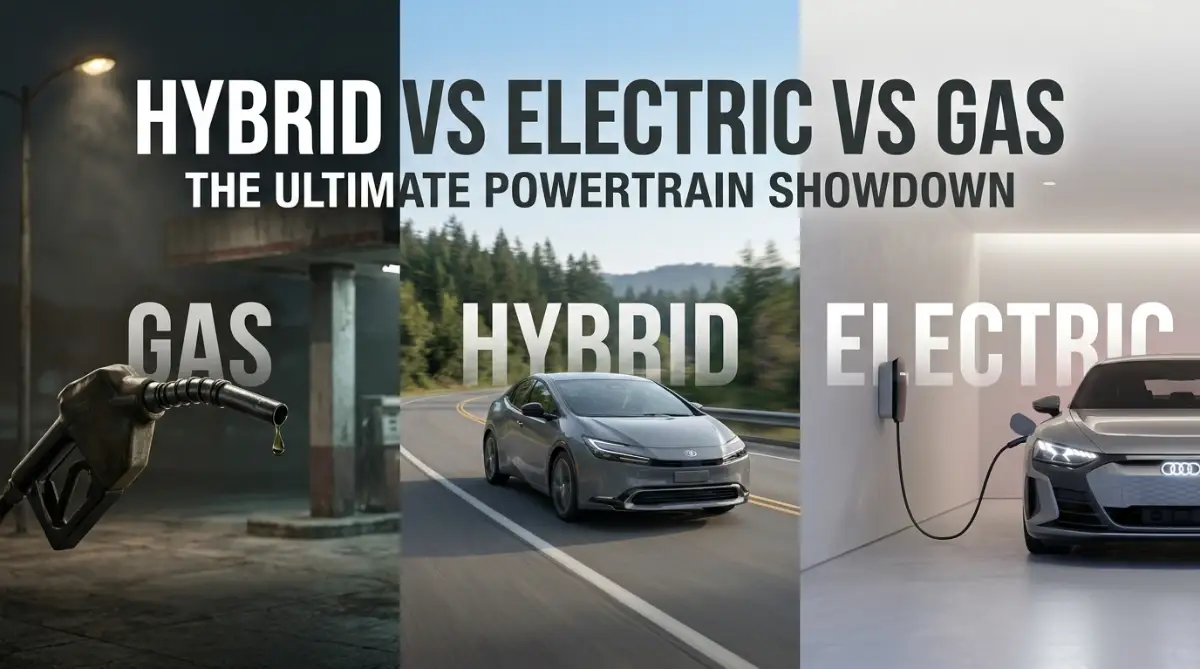
To truly understand what you are buying, we need to strip away the marketing jargon. Let's look at the actual DNA of these three distinct driving experiences.
A traditional gas-powered car relies entirely on an internal combustion engine. You put liquid fuel in the tank, small explosions happen under the hood, and the wheels turn.
It is loud, it has hundreds of moving parts, and it is a technology we have spent over a century perfecting.
An electric vehicle flips that script completely. There is no engine, no gas tank, and no exhaust pipe.
Instead, you have a massive battery pack sitting under the floorboard, feeding power directly to electric motors. It is smooth, completely silent, and incredibly fast off the starting line.
Then we have the hybrid. Think of a hybrid as a team effort between the old world and the new world.
It pairs a smaller traditional gas engine with a battery and an electric motor. The car’s brain constantly switches between the two, figuring out the most efficient way to get you down the road.
The Real-Life Math: Sarah’s Commute Cost
Let’s step away from the abstract theories and look at actual numbers. Numbers do not lie, and they are the best tool you have right now.