

Reading Time: 12 Minutes
Difficulty Level: Beginner to Intermediate
Reviewed By: FinanceInfoIn Editorial Team
Table of Contents
- Quick Summary
- Key Takeaways
- The Silent Killer of Crypto Portfolios
- Decoding the Core of Tokenomics
- How Supply Metrics Control the Market
- The Reality of Token Distribution
- Token Unlocks: The Hidden Avalanche
- Emissions and Inflation Mechanics
- Tying It All Together for Smart Investing
Quick Summary
Investing in cryptocurrency without understanding token mechanics often leads to unexpected losses. This guide breaks down the core concepts of supply, team allocations, vesting schedules, and inflation rates. By mastering these hidden data points, you can accurately evaluate a project's true long-term potential.
Key Takeaways
- High circulating supply combined with low demand naturally pushes token prices down.
- Fair token distribution prevents early investors and developers from manipulating the market.
- Heavy token unlocks can cause sudden, massive price drops overnight.
- Deflationary emission models often increase a token's scarcity and overall worth.
The Silent Killer of Crypto Portfolios
Staring at a smartphone screen while a portfolio bleeds red is a feeling most new investors know too well. You buy a popular coin when it is trending heavily all over social media. The project has great marketing, a solid development team, and massive community hype behind it.
Everything looks perfect on the surface. But suddenly, the price tanks by fifty percent overnight, leaving you completely confused and stressed. The truth hits hard when you realize the developers just dumped millions of new coins into the open market.
This hidden trap ruins the financial peace of mind for countless ordinary people every single day. People invest their hard-earned savings hoping to build a better future, only to see their money vanish into thin air. The real issue is rarely bad luck or bad timing.
It is a complete lack of understanding about how the internal math of a cryptocurrency actually works. When you do not know where the coins come from or who holds them, you are essentially gambling blindfolded.

Decoding the Core of Tokenomics
Tokenomics is simply the combination of two words: token and economics. It represents the basic mathematical rules that govern how a specific cryptocurrency operates. Think of it like the rulebook for a digital economy.
If a country prints too much paper money, the value of that currency drops rapidly. The exact same principle applies to digital assets. When you understand the underlying rules, you can easily spot projects designed to fail.
You start seeing the market through the eyes of an insider rather than a regular retail buyer. The math never lies. Let us break down exactly how these systems dictate the money you make or lose.
How Supply Metrics Control the Market
The most fundamental driver of any asset's price is the basic rule of supply and demand. In the crypto space, supply is not just a single number you glance at once. It is a dynamic, moving target that you must track carefully.
There are three main types of supply you need to monitor. First is the Circulating Supply, which tells you how many coins are currently available to trade right now. Second is the Total Supply, which includes coins that exist but are temporarily locked away.
Third is the Maximum Supply, showing the absolute hard limit on how many coins will ever be created. Understanding the relationship between these numbers is the key to surviving in this space.
Market Cap vs. Fully Diluted Valuation
Many people see a coin priced at one cent and think it is incredibly cheap. They assume it can easily reach one dollar, making them instant millionaires. But price alone means absolutely nothing without looking at the supply.
You have to calculate the Market Capitalization by multiplying the current price by the circulating supply. Then, you look at the Fully Diluted Valuation (FDV), which multiplies the price by the maximum supply.
If a project has a massive gap between its circulating supply and its maximum supply, warning bells should ring. This means millions of new tokens will eventually flood the market, heavily diluting the value of your current holdings.
The Reality of Token Distribution
Who holds the majority of the coins is just as important as how many coins exist. Distribution refers to how the initial supply of a token is divided among different groups. This usually includes the founders, early venture capitalists, the community, and the treasury.
If the development team and early insiders hold a massive percentage of the supply, the project is highly centralized. These insiders bought the coin for fractions of a penny. When the token hits public exchanges, they can easily dump their massive bags on regular retail investors.
Spotting Fair vs. Predatory Allocations
A healthy project usually allocates a large chunk of its supply to community incentives, liquidity pools, and network rewards. They keep insider allocations relatively low to maintain trust and decentralization.
Pro Tip: I once lost a significant chunk of my portfolio investing in a gaming token without checking its initial distribution. Later, I realized the founders and private investors held 60% of the entire supply, and they slowly sold off their bags, crushing the price while I kept waiting for a bounce.
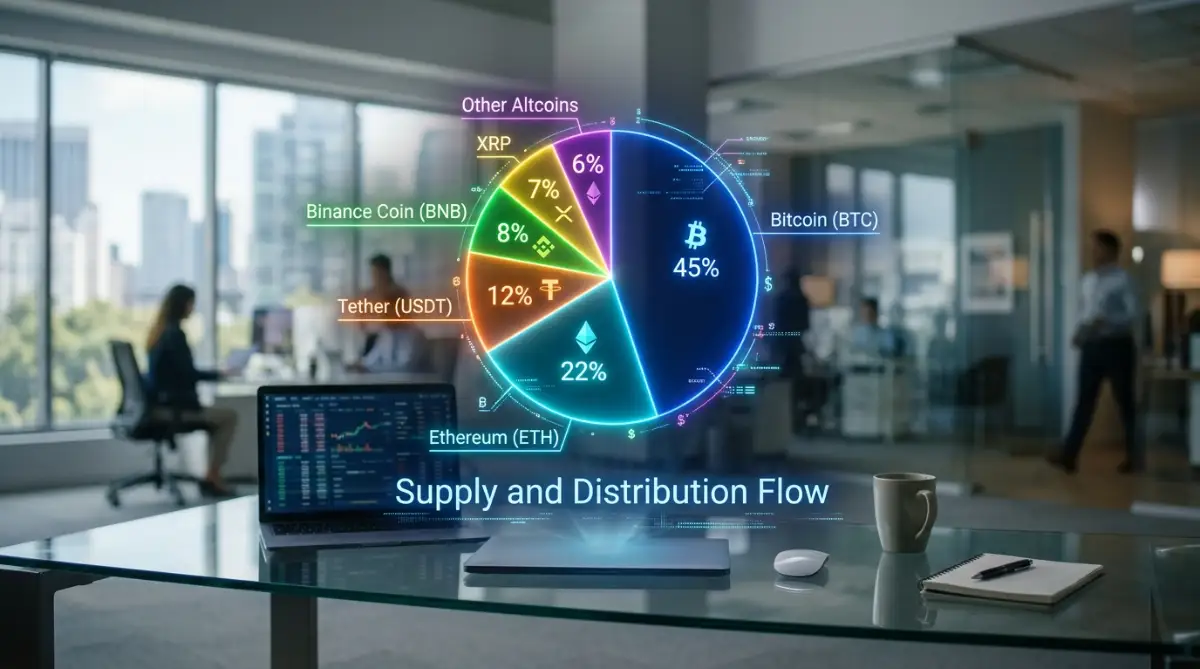
Always look for transparent pie charts on a project's whitepaper detailing exact percentage allocations. If the team hides this information or makes it confusing, take your money elsewhere immediately.
Token Unlocks: The Hidden Avalanche
Even if a project has a massive total supply, those tokens are usually not available all at once. They are held back by something called a Vesting Schedule. This is a smart contract mechanism that locks up tokens for a specific period.
Token Unlocks happen when these locked tokens are finally released into the circulating supply. This is often the most dangerous time to hold a cryptocurrency. When millions of new tokens hit the market simultaneously, the sudden increase in supply heavily outweighs demand.
Reading the Vesting Schedule
There are typically two ways tokens are unlocked: Cliff and Linear. A Cliff unlock means a huge batch of tokens becomes available on one specific day. This almost always leads to a sudden and violent price crash.
A Linear unlock, on the other hand, releases tokens slowly day by day or block by block. This creates a steady, continuous downward pressure on the price, bleeding it slowly over months.
See exactly how smart money tracks hidden token unlocks before the market crashes:
Emissions and Inflation Mechanics
Every blockchain needs a way to secure its network and reward people for participating. This is where Emissions come into play. Emissions dictate the speed and volume at which new tokens are generated and given out as rewards.
If a network prints new tokens too fast, it creates high inflation. Your slice of the pie gets smaller every single day. Some networks try to counter this by introducing deflationary mechanics.
The Power of Token Burns
A Token Burn happens when a project permanently destroys a portion of its circulating supply. They send these tokens to a dead wallet address where they can never be retrieved. This mathematically reduces the overall supply.
Expert Tip: Always calculate a network's net inflation rate by subtracting the burn rate from the emission rate. If more tokens are burned than printed, the asset is truly deflationary and historically performs better long-term.
If demand stays exactly the same but the supply shrinks, the price of the remaining tokens naturally goes up. This is why projects with strong utility and built-in burn mechanisms tend to hold their value significantly better during bear markets.