
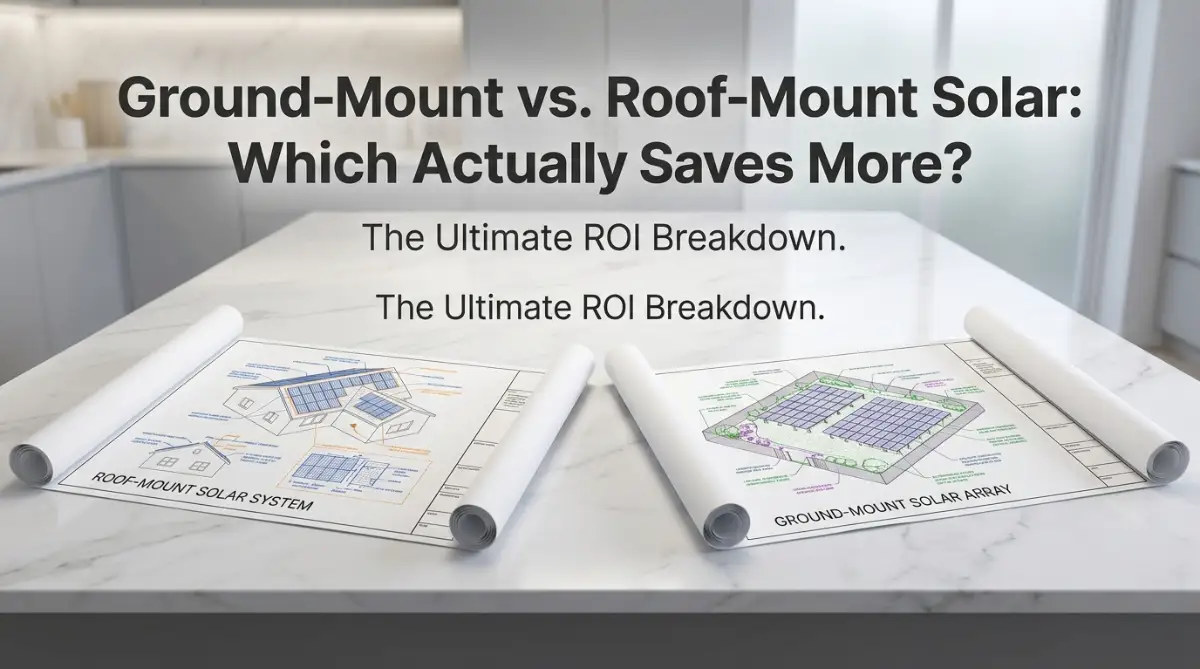
Reading Time: 12 Minutes
Difficulty Level: Beginner to Intermediate
Reviewed By: FinanceInfoIn Editorial Team.
Roof or Ground? The Most Expensive Decision You'll Make Before Going Solar
I was sitting at my dining table on a Tuesday night, staring at two solar quotes that didn't line up at all, and I couldn't make sense of either one.
One installer swore up and down that putting panels on my roof was the only sensible option. The next day, a different guy walked around my backyard, pointed at the empty patch of grass, and told me a ground-mounted system would nearly double my output.
Both pitches sounded reasonable. Both people wanted a big chunk of my savings.
If you're in the same spot, you're probably not looking for a "feel good about the planet" answer — you want the math to actually check out. You want the electric bill to stop climbing every single month.
Get this decision wrong and it's not a small mistake. You can end up losing thousands of dollars in production you never needed to lose, or paying for installation work you didn't need in the first place.
So before anyone shows up with a contract, it's worth looking at the real numbers — not the sales pitch.
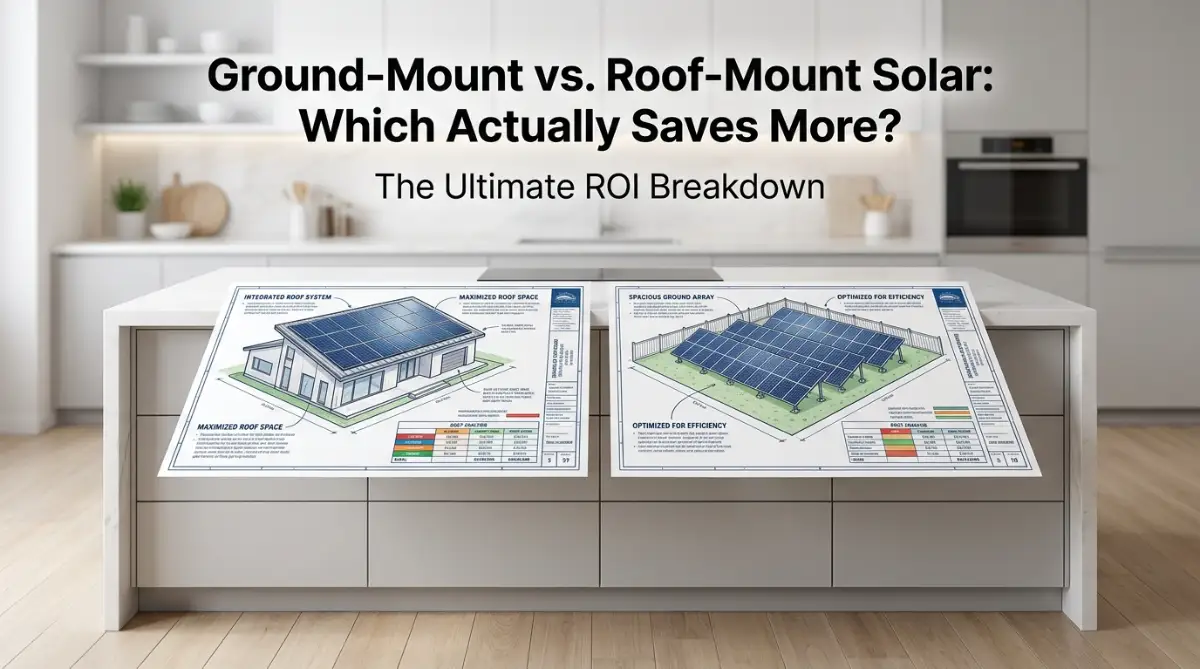
The Short Version
Whether you go roof or ground mostly comes down to three things: how much open space you actually have, what you can afford upfront, and what you want out of the system long term. Roof mounts cost less to install because you're using a structure that's already there, but shading and heat cut into their output. Ground mounts cost more upfront — trenching and custom framing aren't cheap — but they usually generate noticeably more power. If you've got the yard for it, ground-mount tends to win on long-term return.
Quick Takeaways:
-
Roof mounts are cheaper to install but depend heavily on your roof's angle and how much shade it gets.
-
Ground mounts catch more direct sun, which means more power over time.
-
Trenching and custom framing are what push ground-mount installation costs higher.
-
Proper spacing between panels is what actually gets you the most out of a ground array.
-
Check your roof's age before committing to a roof-mounted system — this one trips up a lot of people.
Why Placement Matters More Than People Think
Most homeowners assume a solar panel performs the same no matter where you bolt it. In practice, where you put it decides most of what you get out of it.
Mount panels on your roof and you're stuck with whatever direction the house was built to face. An east-west roof, or one with multiple peaks and valleys, is never going to hit peak efficiency — there's just no fixing that after the fact.
A ground system flips that. You control the angle completely, and you can point the panels dead south to pull in sunlight all day long.
The Heat Problem Nobody Mentions
Here's something that surprises a lot of people: solar panels actually perform worse as they get hotter. It's not a flaw in the equipment — it's just how the physics works. Panels bolted flat against asphalt shingles have nowhere for heat to escape, so they cook all summer with zero airflow underneath.
Ground-mounted panels sit up on a metal frame with open air moving beneath them. That alone is often enough for a ground system to outproduce a roof system of the exact same size, simply because it runs cooler.
Pro Tip: Walk outside around noon and actually look at your roof. If a big tree is throwing shade across it, no amount of premium hardware will fix that. I learned this one the hard way — a neighbor's chimney was casting a shadow I hadn't noticed, and it was quietly cutting daily output by around 15%.
The Baseline Differences, Side by Side
A Real Cost Comparison
Theory is fine, but the numbers tell you what's actually going to happen. Here's a realistic example.
Say a couple — call them Dave and Sarah — live in a fairly typical suburban house and pay around $200 a month on electricity. They want that bill gone entirely.
Their roof faces slightly east and has a steep pitch, so the roof quote comes in at 24 panels to cover about 80% of their usage. Total cost: $18,000.
Then they get a ground-mount quote for their large, sunny backyard. Because the installer can angle everything due south, they only need 20 panels to cover 100% of usage. But the custom metal frame and the trenching to run wire back to the house push that quote to $22,000.
What the Ten-Year Picture Actually Looks Like
The sticker price is only half the story.