

Reading Time: 14 Minutes
Difficulty Level: Beginner to Intermediate
Reviewed By: FinanceInfoIn Editorial Team
Table of Contents
- The Hidden Trap That Drains Your Savings
- Quick Summary
- Key Takeaways
- Spotting the Silent Accumulation Phase
- The Danger of the Hype and Expansion
- Recognizing the Silent Sell-Off (Distribution)
- Aligning Your Strategy with Market Realities
Quick Summary
This guide breaks down the hidden mechanics of cryptocurrency market cycles into simple, everyday language. You will learn the exact differences between the accumulation, expansion, and distribution phases. We provide clear visual tables and real-life analogies to help you spot when large investors are buying or selling. By the end, you will know exactly how to time your market moves without relying on social media hype.
Key Takeaways
- Big investors buy quietly when prices are boring and everyone else is scared.
- Rapid price growth is designed to pull in retail investors who fear missing out.
- The distribution phase looks like a healthy market, but large players are actually cashing out.
- Following trading volume tells you much more than just looking at the price.
The Hidden Trap That Drains Your Savings
I remember sitting in my parked car outside a grocery store, staring at my phone screen in absolute disbelief. My portfolio had just dropped by $4,500 in less than twenty minutes. I had exactly $12 left in my checking account for the week, and the rent money I foolishly gambled on a "sure thing" was vanishing right before my eyes.
I bought that specific coin because everyone on social media swore it was about to explode. Instead, my stomach tied in knots as I realized I had just become exit liquidity for someone much wealthier than me. I felt completely paralyzed, entirely unaware of a hidden market secret that I am going to reveal to you later in this guide.
If you do not learn how these price movements actually work, you are walking into a financial slaughterhouse. Ignoring the structure of a market cycle means you will continuously buy at the highest possible price. In a matter of months, you could easily lose 60% to 80% of your hard-earned savings just because you followed the crowd.
Here is the truth about what average people go through every single day. They work incredibly hard at their day jobs, save up a small amount of cash, and look for a way to get ahead. They see a digital asset shooting up on a chart and feel a massive wave of FOMO (Fear Of Missing Out).
They finally gather the courage to buy, thinking they are securing a better future for their family. Almost immediately after they hit the buy button, the market reverses. The mental toll this takes is absolutely devastating.
You start losing sleep, snapping at your loved ones, and constantly checking your phone at 3 AM. The financial market is entirely unforgiving to those who do not understand market psychology. The good news is that these price movements are not random at all; they are carefully orchestrated events.
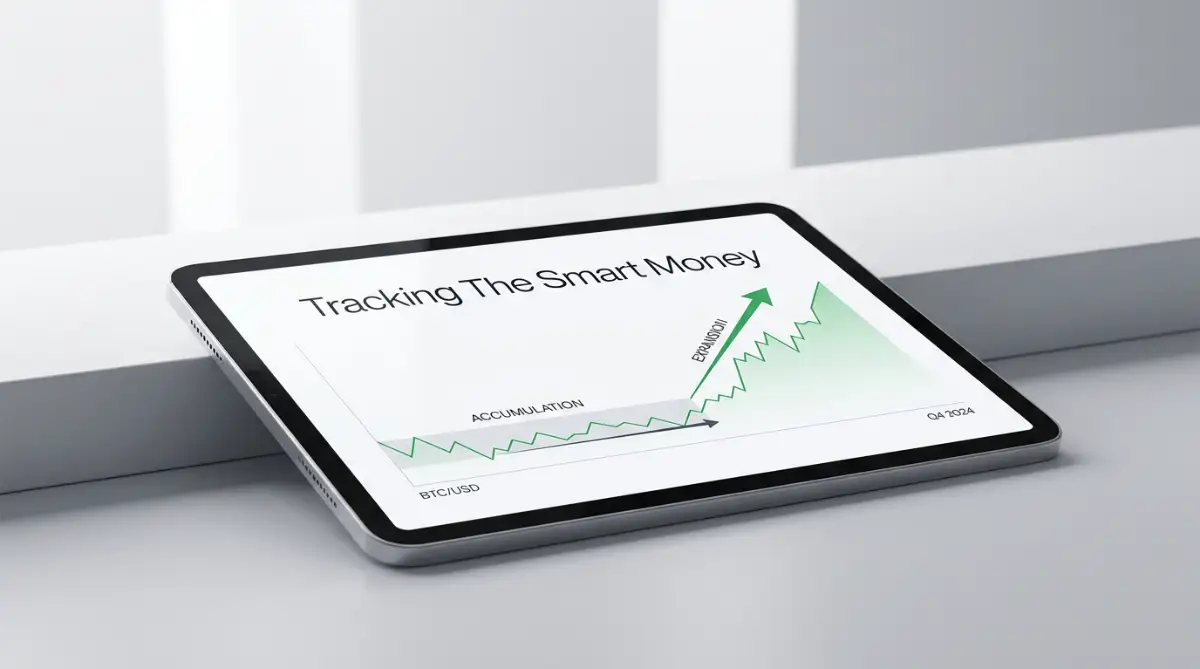
Decoding the Blueprint of Smart Money
The financial markets operate just like the changing seasons of the year. You would never plant seeds in the dead of winter, yet many investors use the wrong strategy during the wrong market season. To stop losing money, you must understand how institutional investors—often called "smart money"—operate in the shadows.
These massive hedge funds and institutional traders do not trade like you and me. They cannot simply buy a million dollars worth of a coin all at once without causing the price to skyrocket. Because of their massive size, they must manipulate the market sentiment to buy quietly.
They do this during a period known as the accumulation phase. This happens right after a brutal market crash when the general public is completely terrified.
The accumulation phase is incredibly boring to watch. The price just chops around sideways in a tight, frustrating range for months. However, this is exactly when the smartest players are building their wealth.
They place small buy orders right at major support levels. Every time a terrified retail investor panic-sells, a smart money algorithm is waiting there to scoop up those discounted coins.
Pro Tip: I used to get incredibly bored during sideways markets and would sell my holdings just to find something more exciting. I quickly realized that selling during the boring phase means I was handing my future profits directly to a billionaire. I now view boring, sideways price action as the absolute best time to slowly build my positions.
The Fireworks and the Trap of Expansion
Once the big players have filled their bags, the supply of available coins completely dries up on the open market. This naturally triggers the next season, known as the expansion phase or the mark-up. Because there are practically no sellers left, even a tiny amount of buying pressure causes the price to shoot upwards rapidly.
Suddenly, the asset breaks past old resistance levels and starts trending everywhere on social media. The news cycle turns incredibly positive, and your friends start asking you how to buy digital assets. This phase is characterized by massive green candles and a huge surge in trading volume.
Think about it for a second. The expansion phase is intentionally designed to be loud and flashy. It is a giant billboard meant to attract new money from people who are watching from the sidelines.
Here is exactly how to spot a real breakout versus a dangerous fakeout.
During the expansion phase, every minor price dip gets bought up instantly. People feel invincible because practically every trade they enter quickly turns a profit. However, this aggressive upward trajectory is mathematically impossible to sustain forever.
To help you understand the risk, look at this value matrix based on when you enter the market.
The Silent Exit and Market Distribution
This brings us to the most dangerous season of all, known as the distribution phase. After months of explosive growth, the smart money decides it is time to secure their profits. But they face a massive problem with liquidity.
If a hedge fund dumps millions of coins all at once, the price will instantly crash, and they will ruin their own profits. To prevent this, they sell their holdings very slowly into the incoming wave of new, excited retail buyers. The price stops going up and starts moving sideways again at the top of the chart.
To an untrained eye, this looks like the market is just taking a quick rest before going even higher. The media is still aggressively claiming that the price will double in the next few weeks. Retail investors keep buying, genuinely thinking they are getting a fantastic deal on a small dip.
Meanwhile, the big players are quietly offloading their assets directly to these unsuspecting buyers. This phase is a masterclass in market manipulation and human psychology.
The Golden Rule: High trading volume combined with a price that refuses to go higher is the ultimate warning sign. It means smart money is heavily selling into the retail buying pressure.
The institutions will often create false breakouts during this time. They push the price slightly above the recent high just to trap late buyers who trade breakouts. Once the smart money has completely emptied their bags, they pull their buying support entirely.
Without that foundational support, the market enters a devastating markdown phase, crashing back down to start the cycle all over again.
Here is a simple checklist you can use right now to read the current market weather.